Tuesday, August 04, 2009

Impound It - The Ride | by Michael

And then there was one.

In 2008, the most widely used group of runs in the playbook was the Ride series. Besting the Toss, Jab, Draw, and Sprint series, the Ride series embodies the spirit of "Pound It" because they are straightforward runs designed to attack the heart of the defense through both zone and man blocking schemes. It's important to note at this time that these runs are not listed in the partial Patriots playbook that was used to classify the other Irish running plays, although the term Ride was seen often as it related to play action passes. Because of Ride's absence from that playbook, a copy of Dan Henning's playbook from the Carolina Panthers was procured to complete this research. Both Henning and Charlie Weis coached together under Bill Parcells with the New York Jets, and there are too many similarities between their offenses to ignore. Nonetheless, not being able to cross reference runs directly with the Weis playbook leaves room for error. Please keep that in mind as you continue reading.

From this series, Charlie Weis could call five runs: a strongside inside zone, a weakside inside zone, a trap run with zone blocking, a strongside isolation play, and a weakside isolation play. Three of those runs dominated the playcall sheet.

Ride 34/35 Zone
The first run in the series is the inside zone play to the strongside of the formation. There are several key distinctions from the outside zone. First, the linemen don't all move laterally as much as they do for an outside zone play. Secondly, the quarterback takes a sharper angle to hand the ball off, whereas with the outside zone his goal is to get as deep and wide as possible. Last, the halfback's take-off angle is understandably wider on an outside zone play. For a visual, compare the two runs in this example.

The Irish tended to use this inside zone play with bigger backs or multiple tight end personnel groupings and sometimes both. In fact, Ride 34/35 Zone was the only run where carries were not dominated by Darius Walker. Of the 39 times it was called in 2005, Walker toted the ball 19 times, while Travis Thomas and Rashon Powers-Neal each received ten carries. Nearly half of the time they ran this play, three tight ends were on the field. As an individual run, not the series, it was the most popular run in 2005. At the same time, it was called only eight times in the last six games; contrast that with 31 times in the first half of the season.

2005 Two Tites
Detroit New York Half Totals
Ride 34 Zone
6 - 4.7
6 - -0.2
9 - 3.1
1 - 1.0
22 - 2.6
Ride 35 Zone
2 - 8.5
4 - 3.0
10 - 4.1
1 - 14.0
17 - 4.9

Heading into 2006, the Irish lost Powers-Neal to the NFL as a free agent and Thomas to the linebacking corps, although he would occasionally line up in the offensive backfield from time to time. While steady blocking Marcus Freeman moved from the third tight end role to the second, the third tight end position was now commandeered by freshmen Konrad Reuland and Will Yeatman. A few times the Irish even used an offensive lineman in that spot. Last, freshman Sam Young stepped into the starting line-up at right tackle while returning linemen like Dan Santucci, Bob Morton, and John Sullivan stopped rotating and settled in at permanent spots. Given Ride 34/35 Zone's decreasing usage as the '05 season progressed, and the smaller, more athletic offensive line paired with a smaller halfback, it didn't take a rocket scientist to predict the play would be used even less.

2006 Half Detroit New York Two Tites
Total
Ride 34 Zone
5 - 2.8
2 - 1.0
6 - 3.0
--
13 - 2.6
Ride 35 Zone
5 - 4.8
--
1 - 3.0
1 - 2.0
7 - 4.1

The increase in Half and decrease in other groupings make obvious sense. The struggles running right are also not surprising given the combo of Morton and Young. The Irish moved away from trying to pound the ball inside, in part because they were less successful, as these '05 and '06 clips, placed in chronological order, illustrate.


And then there was 2008. Stronger, more massive offensive line? Check. Bigger halfbacks? Check. Multiple tight ends? Check. Even after Mike Ragone suffered a season-ending knee injury, Will Yeatman was suspended, and Luke Schmidt's concussions kept him out, the Irish called Ride 34/35 Zone over and over again.

2008 Half Regular Detroit New York
Goal Line
Total
Ride 34 Zone
31 - 4.6
10 - 3.6
9 - 3.4
3 - 3.3
2 - -1.0
55 - 4.0
Ride 35 Zone
13 - 3.6
4 - 1.5
5 - 1.6
2 - 5.0
--
24 - 3.0

Similar to another popular run from 2008, Sprint 38/39, the Irish ran the ball with more authority to the right side and struggled going left. Then again, remove three big plays (16, 21, 16) against lowly Purdue, and then running to the right (3.2 ypc) wasn't much better than running left. Breaking it down between the halfbacks isn't much better, except for Allen's performance against Purdue.

2008 Allen Hughes Aldridge
Ride 34 Zone
20 - 5.6
23 - 3.1
6 - 1.7
Ride 35 Zone
5 - 4.0
14 - 2.7
4 - 3.0

Take out Allen's runs against over-matched Purdue and Navy, and his stats look a lot like those for Hughes and Aldridge. Fourteen carries, 43 yards, 3.1 yards per carry. The inside zone was an effective run in those games, and Mike Haywood/Weis kept calling its number. But why didn't it work in the other games? Take a look for yourself.


Ride 32/33 Wham
The next running play is another inside zone run, but where it differs is that it involves trapping one of the interior defensive linemen with a wham block by the fullback or tight end. What that means is that an interior offensive linemen will release to the second level by not blocking a defensive tackle, who keeps charging into the backfield. The fullback or tight end will stun him momentarily (wham!), which allows the back enough time to hit the hole. Meanwhile, the trapping lineman downfield has hopefully tied up a linebacker. The diagram to the right provides a solid example.

Like the previous play, this run peaked in 2005 but then faded away the following year. In fact, as Ride 34/35 Zone's usage plummeted over the second half of the 2005 season, Ride 32/33 Wham's increased. Of the 32 times it was called in 2005, 22 occurred in the last six games. Where it received the most attention was against Tennessee's vaunted defense, and it worked, gaining 10+ yards on three of its six carries. It was also a run that was used in five different personnel groupings, although a clear majority seemed to occur in New York, Regular, and Detroit.

Play Regular New York
Detroit
Ride 32 Wham
7 - 5.7
6 - 5.0
9 - 4.7
Ride 33 Wham
--
5 - 5.0
2 - 8.0
Total
7 - 5.7
11 - 5.0
11 - 5.3

Of the groupings not shown, twice it was run in Goal Line, and both times it worked. Yet another time, the Irish ran it from a 3-WR bunch formation, and it picked up four yards.

In 2006, Weis called Ride 32/33 Wham far less frequently. Several factors could have played a role in this, whether it was the personnel changes outlined above; playing catch-up against Michigan, Michigan State, and UCLA; the loss of John Carlson down the stretch; or, maybe it was simply due to the play's lack of success.

Play Regular New York
Detroit
Ride 32 Wham
3 - 3.3
1 - 2.0
1 - 1.0
Ride 33 Wham
--
1 - 1.0
4 - 5.8
Total
3 - 3.3
2 - 1.5
5 - 4.8

Apart from what's shown above, it was also called on two other occasions with different personnel groupings, and each carry netted only a yard. As the data clearly demonstrates, it just wasn't the same play as in 2005.

Many of the runs from both seasons can be seen below. As you watch, pay close attention to the different formations from which the Irish ran it.


The first half of clips show Weis's offense when it works well: the same play concept makes it easier for the offense to execute, but its different formations make it harder for the defense to recognize pre-snap. The last third of clips, all from 2006, show an offense struggling to open holes. Not even Walker, who has looked simply dazzling in some of the other runs, could spin this straw into gold.

In 2008, the straw burnt up and the Irish were left with nothing. Six attempts, three yards.


Ride 34/35 Slam
The next run in this series is a strongside isolation play. It's similar to what can be seen to the right, although there's a major difference. Whereas in this diagram the Z receiver blocks the the backside defensive end, the Irish version would motion him toward the tight end to block a safety. If there were no safety in the box, then the Z receiver would remain in his original alignment. The hole would ultimately depend upon the defensive front employed by the opposition.

Because this run necessitated a fullback, it was only run from Regular, Two Tites, and Goal Line personnel groupings.

2008 Regular Two Tites Goal Line
Ride 34 Slam
15 - 3.9
3 - 2.0
2 - 2.0
Ride 35 Slam
9 - 5.0
1 - 3.0
1 - -1.0

Early in the season, Hughes and Aldridge split carries from Regular, but after the Michigan State game, this was Aldridge's run-- until the bowl game. For the season, he carried the ball 21 times, compared to seven for Hughes and just once for Allen. This was also the run that led to many posts on Irish message boards about the predictability of the running game. When the Irish motioned the Z receiver, they nearly always ran to the that side (which makes sense because he was supposed to block the safety). Rarely did Notre Dame call another run that would hit another hole. In other words, with Aldridge in the backfield and the Z receiver motioning toward the formation, odds were strong that this run was coming. And the few times the Irish utilized play action yielded very little, so defenses weren't afraid to take the gamble. Here are some of the run's best and worst moments from 2008.


Despite this play's inconsistent production, this play provides me with hope. Why?

This was a new play in the Weis running game.

The closest run I could find to it was this run against Tennessee in 2005. That play was run once, albeit with the fake end around, and then it remained dormant in the playbook until 2008. If Weis could install a new run for 2008, why couldn't he re-examine the entire running game (with the help of his run game coordinator Frank Verducci) and possibly add/delete running plays?

And upon closer observation, it wasn't the only new addition to the offense, either. Two other running plays emerged that, according to my notes, the Irish utilized for the first time in 2008.

Ride 34/35 Zorro
A companion play to Ride 34/35 Zone is this weakside inside zone run. In some ways, it can be confused with Sprint 36/37 Gut, but the way to differentiate the two runs is to watch the initial movement of the linemen. The sprint play typically pulls a blocker around, whereas in this run the push is more vertical than horizontal. The Irish only used this play three times in 2008, and it picked up 25 yards for an 8.3 per carry average. It was never seen in 2005 or 2006.


Ride 34/35 Base
The companion play to Ride 34/35 Slam is this weakside isolation play. It was called only twice all year. The second play of the 2008 season picked up four yards against San Diego State, and then it resurfaced in the first quarter of the USC contest, where it picked up three yards. Like Ride 34/35 Zorro, it was invisible in 2005 and 2006. In the clip against the Trojans below, notice that the Z receiver motions toward the line of scrimmage (as though the Irish were about to run Ride Slam). It's a nice adjustment, but why wasn't it run more often during the season?


And so it's fitting that the Ride series comes last, not only because it was the most popular group of runs, but also because of how additions to the Irish playcall sheet might offer hope for next year's running game. One implication of these three "new" plays is that it confirms that Weis's playbook is not set in stone. Evidence proves that new plays can-- and have been-- installed. And given the focus on the running game -- highlighted by the hiring of Verducci to fix fundamentals and the study of BCS championship caliber programs -- who can honestly say with conviction that structural changes, in addition to technical improvements, in the Irish running game are impossible? Weis has already done it, right under the fan base's collective nose.

Weeks ago, I would have told anyone-- and I did-- that what we've seen from the Weis running game over the last four years is all we'll ever see. Now I'm just not so sure. And I don't know how I feel about that. Someone please hit me with a bucket of cold water before I start quoting Andy Dufresne.

Monday, August 03, 2009

2009 Opponent Position Preview: Quarterbacks | by Pat

For the past few years, the first week of August has meant sticky, hot summer days, barbeques, and the sudden realization that I need to get cracking on the opponent position previews. This year Kevin has graciously agreed to help me out, but the format should stay the same as we work our way through the best and worst players who will line up against Notre Dame in just over a month's time. As always, we start with the quarterbacks and welcome any and all feedback in the comment section.

NEVADA

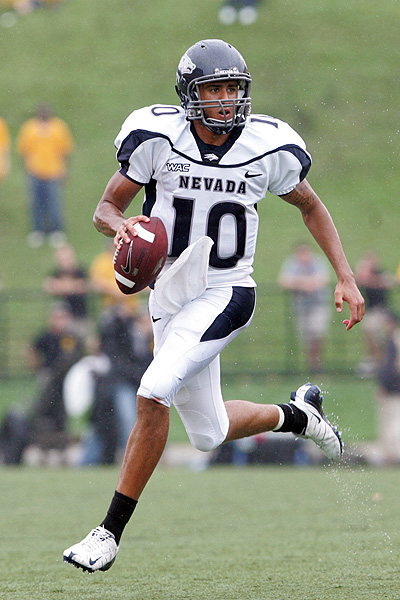
Colin Kaepernick. (#6) RS Junior. Returning Starter.
2008 stats: 208-383, 2849 yards, 22 TDs, 7 INTs.

The tallest quarterback the Irish face this year could also be the best. A 6'6" redshirt junior, Colin Kaepernick is a quality passer with a QB efficiency score in 2008 (132.01) that was practically identical to Jimmy Clausen's (132.49), but his real threat is with his legs in Nevada' Pistol offense. Consider only two QBs in nation had more rushing yards than Kaepernick's 1130 and only seven players total had more rushing touchdowns than his 17. His 7.02 yards per carry average was also good for 12th in the nation. Subtract out his sack total yardage (16 sacks for -120 yards) and his rushing average jumps to 8.6 yards/carry, second in the nation only to Florida's Percy Harvin. Depth: While Kaepernick sat out spring practice nursing an injured ankle, two redshirt sophomores took all the snaps in the bid to earn the backup QB role. Tyler Lantrip and Luke Collis only combined for two pass attempts in the 2008 season, but a split spring of 1st string snaps should speed up the development of both. Lantrip is listed ahead of Collis heading into fall camp, but that could all change in the leadup to the first game of the season.

MICHIGAN

Tate Forcier.
Freshman. New Starter.
2008 stats: N/A

It's a new beginning in Michigan as a freshman will likely lead the Wolverines against ND in early September. Newcomer Tate Forcier enrolled in Ann Arbor early and received a majority of the first team snaps. With a strong showing in their spring game, he's the leading starter candidate in the wake of the transfer of last year's starter Steven Threet. Generously listed at 6'1", 187 pounds on the roster, Forcier is a skinny and elusive runner for Michigan's spread offense with some demonstrated accuracy while on the run. While he will certainly make freshman mistakes, he could surprise some people when improvising outside of the pocket. Depth: The starting job is still technically open, giving former walk-on Nick Sheridan a chance to beat out Forcier. Sheridan did start four games last year, but a broken leg early in spring practice cost him valuable snaps. He has the game experience that Forcier lacks after passing for 613 yards last season on 63 of 137 passing, but lacks the ideal athleticism for the spread. Senior David Cone is a holdover from the dropback passing Lloyd Carr era and not an ideal fit for the offense either. Freshman Denard Robinson will need some work as a passer, but is incredibly fast and will be dangerous running the ball. It wouldn't be surprising to see him get a few snaps even if Forcier wins the starting job. This past spring Robinson finished 3rd in Florida in the 100m dash and his personal best during the track season was good for 2nd best in the nation.

MICHIGAN STATE

Kirk Cousins. RS Sophomore. New Starter.
2008 stats: 32-43, 310 yards, 2 TDs, 1 INT.
or
Keith Nichol. RS Sophomore. New Starter.
2008 stats: Sat out transfer year.

The starting QB job in East Lansing is still up in the air after a two-way battle in the spring. Redshirt sophomores Kirk Cousins (right) and Oklahoma transfer Keith Nichol split time in the spring as each worked to replace the graduated Brian Hoyer. Both earned praise for their strong springs, but neither moved ahead of the other. Cousins has the advantage of actually playing in a collegiate game while Nichol is a bit more of a threat with his feet. In all likelihood, there will still be a bit of a position battle by the time the Spartans play ND. It's always good to have two competent choices, but lack of a clear starter can sometimes cause problems of its own. Depth: The loser of the battle for the starting spot will take the backup job while incoming freshman Andrew Maxwell presumably will take the #3 spot.

PURDUE

Joey Elliot.
RS Senior. New Starter.
2008 stats: 8-15, yards, 0 TDs, 0 INTs.

What was supposed to be a spring competition to replace Curtis Painter ended quickly when likely frontrunner Justin Siller was dismissed from Purdue for academic violations. That left redshirt senior Joey Elliot as the winner by default. A career backup behind Painter, Elliot has played in a handful of games the past three seasons and would have played even more last year had he not injured his shoulder in October and sat out the rest of the year. He certainly has experience, but with a coaching change, he'll be learning some of the new plays along with everyone else. He's a bit quicker on his feet than the past few Purdue QBs, but it will be his passing skills that he'll need to improve to help Purdue win. Depth: He might not take the starting job by the Notre Dame game, but redshirt freshman Caleb TerBush is pushing for the starting job should Elliot falter or get off to a slow start. At 6'5" 222 pounds, TerBush is a big pocket passer with a stronger arm that Elliot. At the very least, he will probably get a few series against Notre Dame as the staff tries to turn him into the future starter of the Boilermakers.

WASHINGTON

Jake Locker. (#12) RS Junior. Returning Starter.
2008 stats: 50-93, 512 yards, 1 TD, 0 INTs.

Perhaps the biggest name QB facing ND in 2009, redshirt junior Jake Locker is back after injury knocked him out for most of the 2008 season. A tough, strong runner and excellent team leader, all that remains for Locker is to improve his accuracy and completion percentage. If he can do that while mastering new coach Steve Sarkisian's playbook, he will be one of the toughest QBs that ND will face all season long. Early returns from spring ball suggest the transition is going smoothly for Locker. At the very least, he will be one of the harder QBs to bring down behind the line of scrimmage given his size, strength, and mobility. Depth: After Locker went down in the fourth game of the season last year, redshirt sophomore Ronnie Fouch started the final eight games of the season. His numbers weren't great (113-250, 1339 yards, 4 TDs, 13 INTs), but he gained valuable game experience, something most backup quarterbacks lack. If Washington needs to rest Locker for a play, series, or game, they won't have to turn to an untested replacement and hope for the best.

SOUTHERN CAL

Aaron Corp. (#16)
RS Sophomore. New Starter.
2008 stats: 2-4, 14 yards, 0 TDs, 0 INTs.

In the three-way battle to replace Mark Sanchez, redshirt sophomore Aaron Corp held off two competitors who were both ranked the #1 QB in their respective recruiting class. The next step for Corp will be to use the embarrassment of riches surrounding him on offense to keep the Trojan offense from skipping a beat. He won the starting job in the spring by not pushing the issue and playing as mistake free as possible. With the Trojans talent, that's a realistic way to keep playing, but at some point he will need to press a bit more and lead the team. How he will perform then is still in question. What helps is that the 6'4" 195 pound Corp is very athletic and will be able to pick up some yards with his feet if he's flushed out of the pocket. Depth: Finishing second to Corp in his first semester on campus, early enrollee Matt Barkley has a decent shot of taking the starting job away from Corp by the time the Trojan visit South Bend. Pete Carroll kept raving about the freshman and it very well may just be a matter of time before Barkley becomes the next multi-year starter for the Trojans. Rounding out the depth chart is redshirt junior Mitch Mustain (#35). He saw more game action than Corp last year, but wasn't able to capitalize on it in the spring. At the very least, he gives the Trojans a very deep and talented bench.

BOSTON COLLEGE

Justin Tuggle / Codi Boek / David Shinskie
2008 stats: N/A

There might not be a team in the nation with more questions marks at quarterback than Boston College. The starting job is wide open and none of the contenders have taken a single snap under center in college. Presumed starter following spring practice Dominique Davis left BC after being suspended from the team for academic reasons. In his wake is youth, inexperience, and a wide open QB race. More importantly, none of the options have taken a single snap under center. Redshirt freshman Justin Tuggle, son of Pro Bowler Jessie Tuggle, was supposed to push Davis this past spring, but had his ups and downs going just 2 of 7 in the final spring scrimmage. Junior college transfer Codi Boek (right) is the only one of the three main challengers who actually played football last season, but rather than at QB, he played fullback and special teams for the Eagles. The 6'3" 220 pound Boek will need to now transition back to QB, a spot he played at Idaho State and American River Junior College. His spring scrimmage showing wasn't much more impressive than Tuggle, going 2 for 10. The latest addition is 25 year old minor leaguer turned college freshman David Shinskie. Giving football a try, Shinskie has the maturity and physical development edge over his teammates, but hasn't played competitive football since his senior year in 2002. Depth: There are a few more options, but the odds are stacked against them. Freshman true freshman Mike Marscovetra will start practice in the fall, not giving him much time to get up to speed. Redshirt junior Billy Flutie is the only one of the bunch who has actually attempted a pass for BC, doing so during trick plays from his WR position last season. Odds are though he will stay at receiver for the Eagles.

WASHINGTON STATE

Marshall Lobbestael.
RS Sophomore. New Starter.
2008 stats: 53-103, 571 yards, 4 TDs, 4 INTs.

Four different quarterbacks started games for WSU last season as injury -- including a fractured spine on opening day starter Gary Rodgers -- and poor play kept any of them from getting a solid hold on the starting spot. Redshirt sophomore Marshall Lobbestael appeared to be the best of bunch, taking over the starting spot for three games until hurting his ACL and MCL and being forced to sit the rest of the season. Rehab kept him out of contact drills in the spring, but if he's back to being 100% healthy, he's a likely candidate to be the starter at least early in the season. Depth: Redshirt senior Kevin Lopina started before injuring his back and losing his job to Lobbestael and then started the rest of the season after Marshall's knee injury. He has a shot to beat out Lobbestael in the fall, but his awful 0 TD, 11 INT showing in 2008 isn't a positive indicator for the Kansas State transfer. Sophomore J.T. Levenseller saw some time at QB last year as a backup, but will probably slide to 3rd on the depth chart if Lobbestael and Lopina can stay healthy all year long.

NAVY

Ricky Dobbs.
Junior. New Starter.
2008 stats: 9-16, 212 yards, 1 TD, 1 INT.

As always, the passing stats for Navy's quarterback aren't terribly important. How they do on the ground is far more important, and in the case of junior Ricky Dobbs, he was excellent. Despite only playing in eight games in a backup QB role, Dobbs finished the season 3rd on the team in rushing (495) and tied for first in rushing TDs (8). Nearly half of those yards came against SMU when he picked up 224 yards and 4 TDs on 42 carries. ND fans might remember him as the QB who engineered the late Navy comeback that just fell short. Half of his season pass attempts came against the Irish as well. With a strong arm and frequent mentions of his leadership skills, Dobbs's main challenge will be to master the decision making needed to execute Navy's flexbone offense. Depth: Sophomore Kriss Proctor was a multi-sport star in high school in California and recruited by a few other colleges for defense. But he chose the Naval Academy and now is the next in line to line up under center when Dobbs needs a break.

PITTSBURGH

Bill Stull.
RS Senior. Returning Starter.
2008 stats: 188-330, 2356 yards, 9 TDs, 10 INTs.

The only game redshirt senior Bill Stull missed last year was the Notre Dame game. He started the other 12 and so far has the lead in the race to be Pitt's starting quarterback for 2009. However, a lackluster 2008 culminating in getting yanked in Pitt's bowl game after going 7 for 24 for 52 yards doesn't give him the firmest footing for keeping the starting job. Despite his faults, he keeps winning the starting job, so he must be doing something right. Depth: Pushing Stull for time will be junior Pat Bostick. It was Bostick who QB'd Pitt last year against ND while seeing time as a backup in five other games. He also started eight games in 2007 as a freshman, so he does have legitimate experience. The former highly-regarded recruit just hasn't been able to get over the hump and beat out Stull. With the ND game later in the season, perhaps he will have pulled ahead by then. Redshirt freshman Tino Sunsuri is a local product and more athletic that Stull or Bostick, but will probably have to wait another year before getting a serious shot at the starting job.

CONNECTICUT

Zach Frazer. (#29). RS Junior. New Starter.
2008 stats: 46-83, 536 yards, 2 TDs, 6 INTs.

UConn's starting quarterback should be a familiar name to all as ND transfer Zach Frazer will be the man under center to start off the Huskies 2009 season. A backup last season, Frazer did wind up starting two games while appearing in five overall. He won the starting job for 2009 during the spring but whether or not he is still starting by the time they play ND depends on him improving his 1/3 TD/INT ratio and how well he picks up UConn's new no-huddle, up-tempo offense. Depth: Pushing Frazer for the starting job is redshirt sophomore Cody Endres. Like Frazer, he started two games last year in a relief role and, like Frazer, he threw more interceptions than touchdowns (39-84, 441 yards, 0 TDs, 3 INTs). The upside is that UConn has two quarterbacks with starting experience. The downside is that throwing a combined 9 interceptions against 2 touchdowns isn't going to instill much confidence this fall, especially when you add in a revamping of the offense.

STANFORD

Andrew Luck
. RS Freshman. New Starter.
2008 stats: redshirted

It's not often a player with no game experience can beat out a two-year returning starter, but that is what happened at Stanford. Redshirt freshman Andrew Luck emerged from spring practice as the Cardinal's likely starting QB for the 2009 season. The 6'4" 235 Luck has a bright future, however he will still have to overcome the usual stumbling blocks that every first-time starter hits. His 5-TD performance in the Stanford spring game set expectations pretty high though and with nearly an entire season to play before facing the Irish, he could quickly develop into a tough QB opponent. Depth: Redshirt senior Tavita Pritchard may not be the starter on opening day, but if Luck fails to build upon his spring showing, Pritchard could return to the starting gig he held for 19 games, including every single game last season. Pritchard's stats (147-254, 1633 yards, 10 TDs, 13 INTs)improved last year from his 2007 numbers, but he lacks the natural talent of Luck and he didn't even have a postive TD/INT ratio at home (3/3), let alone on the road (7/10) last season. Pritchard does give Stanford the luxury of having an experienced QB on the roster, not only to help instruct the young Luck, but also come off the bench and know how to run the offense when needed.


2009 Opponent Quarterback Analysis and Ranking

The one word summary of this year's crop of opposing quarterbacks is "inexperience". Last year, there were 8 returning starters on this list. In 2007, the number was 9. In 2009 however, the total number of returning starters is a paltry 3, with one of them missing nearly the entire season last year due to injury. Sure, there are a handful of new starters at schools like WSU, UConn, and Navy who have a few starts under their belt and Stanford has the experienced Pritchard on the bench, but that still only puts the number up to 7. Michigan, Boston College, Stanford, and possibly even USC and Michigan State will be starting QBs this season who have yet to take a single snap in college.

That sound you hear is Jon Tenuta salivating at the thought of all that inexperience lining up opposite his defense. While ND will have their own inexperience issues on the defensive line and at linebacker, Tenuta will be dialing up blitzes and changing coverages non-stop in an attempt to rattle the quarterback. Where this plays into ND's favor is the talent and experience in ND's secondary. One of the more game-tested secondaries in the country, if the front seven can produce steady or even semi-steady pressure on the opposing QB, the opportunities for interceptions or at least batted down passes should be very high this season. ND's defenses have consistently produced between 9 and 15 interceptions the past 6 seasons. A good goal for this year's secondary would be to try and match or beat the 21 interceptions put up by 2002 defense that featured Shane Walton, Vontez Duff, Gerome Sapp, and Glenn Earl in the defensive backfield.

Of course, in this era of the spread offense, defenses also have to worry about a quarterback's feet. And while there may not be many (any?) proven pocket passing threats this season, there are a handful of dangerous runners lining up under center. At the front of the pack are Jake Locker and Colin Kaepernick. Kaepernick rushed for over 1,000 yards last season and Locker was only 14 yards shy of the same milestone in 2007. The revamped Irish linebacking corp will have their hands full keeping both QBs from turning potential sacks into 20+ yard scrambles. And while they are inexperienced, Michigan's Forcier, Navy's Dobbs, and Boston College's Tuggle and Boek all have the mobility to rack up quality rushing yards against an undisciplined defense. Throw in the more-mobile-than-you-might-expect Corp and Nichol at Southern Cal and Michigan State respectively and the list of running threats at QB is more impressive than the list of strong-armed pocket passers.

Moving to the rankings, as always I will favor experience, production, and overall position depth over potential. If the opponent faces ND later in the season, I might give potential a bit more of a boost, but for the most part these rankings try to stick to what we have already seen, rather than what we hope or fear to see. And sticking with previous years, I will attempt to keep coaching acumen and offensive system out of the rankings as much as possible.

1. Washington - Locker is a talented and tough player. Fouch provides some experience off the bench.
2. Nevada - Kaepernick will become a household name this season, especially if ND isn't ready for him.
3. USC - Three high school All-Americans on the roster, but lacking in experience for now.
4. Pittsburgh - Nothing flashy here, but Stull and Bostick have been around for a few years now.
5. Stanford - Luck has as much potential as any QB on this list with Pritchard adding experience.
6. Michigan State - Two decent prospects will be slowed a bit by their lack of career playing time.
7. Navy - Dobbs is a respected teammate and will be a tough runner to keep in check.
8. UConn - Will Frazer still be the starter for his return trip to ND?
9. Purdue - Elliot could surprise a bit, but more likely TerBush will pass him by later in the year.
10. Washington State - This position was a mess last season. If injury-free it will be much improved.
11. Michigan - A skinny freshman or a former walk-on are the main options for Michigan.
12. Boston College - No experience on the roster and a three-way QB battle that will split snaps in practice.

Friday, July 31, 2009

Impound It - The Sprint | by Michael

Next up for dissection in the BGS lab is the collection of runs known as the Sprint series. These are outside runs that utilize zone blocking, and they are commonly referred to as "stretch" plays because of the way they stretch a defense horizontally. There are three different runs in this series: one back strongside outside zone, one back weakside outside zone, and a two back strongside outside zone. Need a zone blocking primer? Let a former Irish coach be your tutor.

Back in December, Tom Thayer launched an attack on the zone blocking schemes in Charlie Weis's playbook. In many ways, his criticisms were directed toward these Sprint plays, where the linemen move laterally before they start moving downhill. Jay already responded to Thayer's comments, and new offensive line coach Frank Verducci somewhat addressed the question back in the spring when he answered, "Blocking is blocking" and emphasized effort and fundamentals. With this series being the second most popular set of runs (ahead of the Toss, Jab, and Draw), Verducci's coaching will be keenly scrutinized in 2009.

Sprint 38/39
The first outside zone play is a one back strongside run. The Irish predominantly run this play with three different personnel groupings: Half (3 WR, 1 TE, 1 HB), Detroit (2 WR, 2 TE, 1 HB), and New York (1 WR, 3 TE, 1 HB). To the right is an example when it's run with two tight ends. As Thayer brought up in his criticisms, you should notice the first step, which is lateral. The easiest way to determine whether the play is an outside zone run is to watch the line move en masse. Sometimes uncovered linemen will pull, and other times they will block down on a defensive tackle, but the lateral movement of the line is too obvious to miss.

In Weis's first year, the Sprint plays weren't called as often as one would think. It's anyone's guess why that occurred. A second surprise is the huge disparity between running left and right in Half given that left tackle Ryan Harris was considered that offensive line's most athletic and consistent blocker. The chart below details more. (First number is the rushing attempts, second number is yards per carry average.)

2005 Half Detroit New York Totals
Sprint 38
15 - 4.9
4 - 1.8
3 - 5.7
22 - 4.5
Sprint 39
3 - 6.7
8 - 2.6
2 - 0.5
13 - 3.2

The following season saw use of the play increase by 50% in Half, due in large part to the injury to John Carlson and the vanilla offense run by the Irish against weak opponents (Navy, Air Force, Army) leading up to the USC game. The Irish ran 14 of the 27 Half carries in 2006 against the service academies. Additionally, Sprint 39 was called more often, as one would expect with the more mobile Dan Santucci playing left guard and freshman Sam Young at right tackle. Not surprisingly, production going left behind Harris and Santucci was phenomenal.

2006 Half Detroit New York 3 Wides Total
Sprint 38
10 - 5.2
7 - 2.7
1 - 1.0
2 - 4.5
20 - 4.1
Sprint 39
17 - 9.2
4 - 6.5
--
6 - 8. 5
27 - 8. 7

The inclusion of 3 Wides was a mid-season experiment against UCLA and Stanford that likely resulted on account of Asaph Schwapp's injury. Against Stanford and its 3-4 defense, John Carlson lined up in the backfield as a fullback with Walker. The strategy paid off, as it resulted in the longest touchdown run in the Weis era. Finally, it's important to note that despite the fact that although many of the rushing yards came against bad teams like the Cardinal and the service academies, it's unfair to say that the play wasn't successful against quality defenses. Take a look for yourself.


Last year saw Sprint 38/39 be called nearly exclusively from Half as a result of injuries and suspensions to Irish tight ends. All five of the plays not run from Half came against San Diego State. It would seem that Weis and Haywood wanted to run this play from as many formations and groupings as possible, but that opportunity quickly vanished. The biggest question mark has to be why the Irish couldn't run this play left behind Mike Turkovich and Eric Olsen, two of the best linemen on last year's squad. Also defying logic is the fact that Weis and Haywood continued to call Sprint 39, as though they expected a different result.

2008 Half Detroit New York Total
Sprint 38
28 - 4.3
--
2 - 4.5
30 - 4.3
Sprint 39
17 - 1.7
2 - 0.5
1 - 2.0
21 - 1.8

It's beyond belief that a run averaging less than two yards per carry was called as often or more than it was in previous years, when it was three to four times as productive. For all the talk of Weis and his self-scouting, this one boggles the mind. Consider that at the bye week juncture, Sprint 39 had been called 11 times in games. Four of those carries were stuffed for no gain or behind the line of scrimmage. The longest run was just six yards, and only two other times did it pick up more than three yards. Quite simply, the staff needed to delete this play during the bye week, but yet they stubbornly ran it ten more times, picking up 18 yards in the process (15 on three attempts versus Navy). Here are some of those lowlights.


On the bright side, only once was one of these plays called in the Hawaii Bowl, and it wasn't Sprint 39. Perhaps the extra prep time allowed Weis to sit back and finally see its flaws.

Sprint 36/37 Gut
Whereas the previous play is run to the strongside, this outside zone play is run to the weakside of the formation. It has been run with three wide receivers every single time except once, with James Aldridge in 2006 (which makes me wonder if the freshman erred), and it has been run both toward and away from the slot receiver. Most of the time, though, it's run away from the slot receiver. The numbers suggest that it could be the most productive run in the Irish playbook.

Play 2005 2006 2008
Sprint 36 Gut
1 - 4.0
7 - 7.0
9 - 5.9
Sprint 37 Gut
4 - 7.5
19 - 5.5
18 - 5.6
Total
5 - 6.8
26 - 5.8
27 - 5.7

Oddly enough, back in 2005 Sprint 36/37 Gut was called three times against Michigan, one of the better defenses faced all year. Despite its effectiveness, it showed up just twice more that season and never after the Purdue contest. However, it has been a staple of the offense ever since the 2006 season.


Looking in the rear view mirror, one of the few times it didn't work in 2008 was one of the costliest-- 2nd and Goal from the Pitt 3-yard line in overtime. Prior to that play, the Irish had run three straight strongside stretch plays, and then Weis tried to trick Pitt by calling the weakside version. That play and other highlights are below. Notice, too, that most of the unsuccessful plays in these clips occur when the weakside run is also called to the boundary side.


Sprint 38/39 Boss
The last outside zone play used by the Irish is a strongside outside zone with a fullback, whose responsibility is to block whomever is out on the perimeter; in the diagram to the right, the safety. Meanwhile, the halfback does not have to follow him around the edge; he is free to find the daylight in the zone blocking and cut up inside. The play's heyday came in 2005, when it was run 25 times from three different personnel groupings, including Two Tites (2 TEs, WR, HB, FB) and Goal Line (3 TEs, HB, FB). Although it is used in normal situations, it is a staple of the goal line rushing attack.

2005 Regular Two Tites Goal Line
Sprint 38 Boss
2 - 4.0
4 - 2.5
--
Sprint 39 Boss
10 - 4.5
4 - 4.0
5 - 0.8

To put the Goal Line carries in perspective, twice the Irish scored a touchdown and a third time they picked up the first down. Rather than focus on the yards per carry average, it's probably more accurate to say that 60% of the time were the Irish successful.
The play's usage was cut drastically in 2006, likely on account of Asaph Schwapp's knee injury. That year it was used five times in short yardage situations, where it worked only twice, and a sixth carry inside the redzone on first and ten was stuffed for no gain.


In 2008, the Irish began the season by using the play twice a game against San Diego State, Michigan, and Michigan State. After the staff traded in "pound it" for "spread it" against Purdue, Stanford, and North Carolina, the Irish tried it twice more against Washington before shelving it. It returned one last time for the USC game, where it ironically picked up its longest gain of the year against the nation's best defense. That run, in addition to a few others, can be seen below. For the season, it averaged 5.2 yards per carry (with a median of 3.5 yards) on eight carries with Regular personnel and was perfect (two tries, two touchdowns) with Goal Line personnel (both against Michigan).


Despite the desire to understand the problems of this play, I'd be out of my element to analyze the specific fundamentals of outside zone blocking and critique how the halfbacks have been coached to read the blocking and pick a hole. I'd rather defer to those who have played and coached offensive line to read their insights. Nonetheless, the research has left me with some additional thoughts and questions heading into 2009.
  • Before he was working for the Irish, Jon Tenuta once said that one of his goals in designing and practicing defensive gameplans was to take away first the opponent's favorite running plays. Because the Irish couldn't run Sprint 38/39 from a variety of formations (due to their tight end issues), did that make it easier for defenses to prepare during the week to defend it?
  • Last year James Aldridge typically played halfback in Regular instead of Armando Allen or Robert Hughes; was his lack of vision or footspeed (or something else) a reason why we didn't call Sprint 38/39 Boss more often? Did its scarcity also contribute to the perception that playcalling was often predictable based on personnel?
  • Zone blocking requires so much communication, and the Irish are likely entering 2009 with only Young returning at the same spot. Can Verducci get the line to gel quickly enough?
  • Two words: play action. Where was it in 2008? (More on this later...)
It would appear logical to expect improvement given the returning talent and Verducci's background as a "technician." But why does it seem like a matter of faith rather than logic?

Tuesday, July 28, 2009

Across the Sea | by Pat

It was a blast from the past this weekend with Lou Holtz on the Notre Dame sideline, Tony Rice lining up under center, and the interlocking ND on the uniform sleeves. Taking the barnstorming idea to the extreme and resurrecting the idea of an ND All-Star team, the Notre Dame Legends team faced off against Japan National Team in the Toyko Dome in the 2009 Notre Dame Japan Bowl. The Fightin' Alumni Irish won 19-3, giving Lou wins on three different continents.

You can watch the replay of the game on August 10th on CBS College Sports (formerly CSTV) and here is the official recap of the game. Former player Derek Curry even put up two videos on youtube about the game. But thanks to the international readership of BGS, long time contributor Nate provided BGS with his own personal recap of the Notre Dame Japan Bowl experience. An excerpt is included below, but make sure to check out Nate's entire recap here. Nate also provided some excellent youtube videos for those who can't wait two weeks for the broadcast and has a photo gallery with some great shots from the pre and post game parties.

Take it away, Nate...

Saturday morning we took the kids and Mom-in-law out to lunch prior to heading to the Tokyo Dome for the game. We’d seen an NFL preseason game at the Dome a few years ago—Indianapolis vs. Atlanta, with Manning and Vick at QB’s, and I wondered how the crowd would compare. Would Japanese people, even football fans, care about a game against Notre Dame? Would the Japanese National Team be any good? Would they be TOO good, and kill our team of old-timers? The questions weighed on our minds, but the excitement of getting to see ND football overmatched anything else. Amy and I hopped the subway to the Tokyo Dome, and were pleasantly surprised when we got there. The crowd was fairly large for a sport that your average Japanese knows NOTHING about; many Japanese people were in Irish gear: the “Shirt”, Brady Quinn jerseys, and all manner of ND-logo’d apparel. Of course, many were simply football fans getting a taste of what American football was all about, so you saw Farve, McNabb, Brady, and all manner of NFL/other team jerseys as well. As we’d seen at the NFL preseason game, Japanese football fans are a passionate, knowledgeable bunch, precisely because the sport is so unknown in Japan—for them to learn, they have to teach themselves. They really don’t have the chance to be a casual fan, so for every fan who could barely tell the ND team from the Japanese team, there were fans who could diagram a Cover 2 and understood the spread variables the Japanese team ran. Interesting, to say the least. We made our way up to the VIP section, where we were presented with game programs and game jerseys from the ND team. Amy chose #3, a nod to Joe Montana and our hopes for Michael Floyd this year, and I chose #5, hoping I can pull Armando Allen through a 1000 yard season, and because my freshman year Ajani Sanders, an ND Safety who wore #5, lived on my floor in Morrissey. We found our balcony seats on the 50 yard line and settled in. 50 yard line sounds great, until you remember that the Tokyo Dome is a baseball stadium—the 50 yard line is the furthest point from the actual field. It was a decent view, but just far enough away to cause our camera to have some problems (apologies right now for the graininess in some of the pics).

GAMETIME! First, the Japan National Team took the field, in their red jerseys and white helmets. The crowd and their cheerleaders were appropriately enthusiastic, but everyone was really waiting for those Golden Helmets to come streaming out. When the ND team was announced, and the Irish took the field, the smaller American section, filled with player families, expats, and military stationed here, erupted in cheers. Seeing the players stream on the field got me pumped and choked up all at once, I’ll admit. The team captains met at midfield for the coin toss, which Japan won; Japan elected to receive, and the game began. The Japanese took the kick, and got a decent runback to about the 30, I think. And promptly called timeout. Huh? Amy and I looked at her—was Bob Davie coaching the Japanese team? Would this be an indication of their level of play?

The short answer is “no”. After coming out from the timeout, the Japanese put on a fairly impressive display of offense, driving the length of the field, only to be stopped on 4th down deep in Irish territory. The Japanese run a version of the spread, mixing precision passing with shotgun based option. Imagine a team an entire team of scatbacks, and you’ve got what their offense looked like. It was like playing a Navy team that could pass. The Irish D would hold them to minimal gains on 1st and 2nd down, only to give a Japanese WR or RB just enough space to wriggle through to the sticks on 3rd and long. I commented to Amy that it was like watching Urban Meyer’s Utah team—disciplined, precise, and frustrating. WR’s ran exactly 1 yard past the 1st down marker and the QB would hit them to move the chains. Misdirection option plays and shovel passes left their RB’s with open space in front of them. Meanwhile, our offense, a vintage Lou Holtz I-formation option game, had trouble doing much of anything. As the 1st quarter ended with Japan up 3-0, Amy and I looked at each other and thought “uh-oh…”

Of course, to Japan’s credit, there’s was an all-star team of both professional and college players, ranging in age from 20 to 34. For those not familiar with Japanese football, Japan has two leagues: a professional league made up of teams sponsored by corporations, and a college league where most of the major universities compete against each other. Each year the champions of the two leagues compete against each other in the “Rice Bowl”, Japan’s version of the Super Bowl. Could you imagine the Gators winning the NC, and their reward is to play against the Pittsburgh Steelers after the Super Bowl? Crazy, but there doesn’t seem to be too much of a gap between the college and pro levels here in Japan. I’ve seen a Japanese exhibition game featuring players from one prefecture (Japan’s version of a state) playing those from another prefecture, kind of like the Florida-Georgia high school all-star game, and the level of play was…well…they seemed to have fun. It was somewhere around lower high-school level. But the Japanese National team was the best of what they had, and their coaching staff wasn’t a bunch of slouches. They’ve obviously done a lot of work studying the US game, and the spread attack they employed allows their smaller but quick players to get the ball in space and make the most of what they have. I don’t know if any teams in the Japanese leagues play smash-mouth football, but with only 1 300lb’er on the whole team, Japan wasn’t going to grind it out against the Irish.
Notre Dame’s “Legends” team, on the other hand, ranged in age from 23 (Thomas Bemenderfer, the most recent graduate) to 52 year old Kris Haines and 51 year old Joe Restic. The average Irish player was around 30. Quarterback, Tony Rice, just turned 42.

While it was obvious that the actual Notre Dame team of any year would destroy the Japanese team, the collection of volunteer players Coach Holtz assembled was a bunch of players from different eras, different systems, and I’m sure different levels of fitness. Sure, they had tryouts, and I’m sure they all worked really hard to get back to “playing shape”, but many of the team hadn’t hit anyone in a long time. The younger, fittest players were by definition not the best players from their time, as they aren’t on NFL rosters. I don’t say that to disparage them at all—they played their hearts out, but when Ambrose Wooden would start and play most of the game at quarterback, and Brandon Hoyte is the starting full back (yes, you read that correctly, Irish fans), it shows that you’re at the mercy of who is willing and able to volunteer when you put together the roster. Rather than anything negative, I’m extremely impressed with and grateful to the players who volunteered their time and energy to coming over here and playing a game. None of them got paid, nor did the coaches. It’s truly remarkable that this many former players and coaches would give up not only a week in Japan, but all the time spent practicing leading up to it, in order to strap it on one last time for Our Lady. Truly inspiring.

Monday, July 27, 2009

A Rudy Introduction | by Pat

(ed. Here's another unique post from our good buddy John Walters...Enjoy)

A Rudy Introduction
-John Walters

First, the shameless plug. The nice people at "Here Come the Irish", which hits newsstands this week, allowed me to write a couple of features for this year's edition. One of them, a labor of love, was an oral history of Notre Dame in the Seventies compiled from conversations with, among others, Ted Robinson, Rudy Ruettiger and John Swarbrick.

Many great anecdotes emerged, but perhaps my favorite comes from Rudy, with whom I have quite a history. When his movie premiered in New York City back in 1993, I was seated next to him. So the two of us go way back.

Anyway, as I did with everyone I interviewed, I asked Rudy where he was during Notre Dame's epic hoops victory over UCLA in 1974 that snapped the Bruins' record 88-game win streak. Rudy being Rudy, he informs me that he was seated right on the court itself. "In fact," Rudy said, "if you look at the cover of Sports Illustrated the following week you'll see that I'm right between Bill Walton's legs. I once had a speaking engagement with Walton and I said, 'Hey, Bill, you and I made the cover of Sports Illustrated once."

This intrigued me. I worked at SI. I worked on a special edition of SI once devoted to nothing but the history of the SI cover. And I'd never heard that Rudy had ever made the cover. And now, thanks to the internet, Rudy's assertion could be fact-checked in a matter of minutes.

What followed was a series of hilarious and intriguing discoveries. First, that arguably the most famous regular-season college basketball game of all time did not, in fact, make the cover of SI. Why not? Because the editors of SI had already slotted the annual swimsuit issue (featuring perhaps the last only moderately hot model, Ann Simonton) to run that week.

As current Clemson associate A.D. Tim Bourret, who was the Bookstore Basketball commissioner for three years in that era told me, "You never saw 8,000 college-aged guys so angry to receive the swimsuit issue in the mail."

So, what? Was this yet another incident of Rudy's blarney?

Actually, no. Rudy simply got the game and the year wrong. Being the unofficial N.D. historian that he is, Bourret, an old and dear friend, recalled that the previous year's UCLA-Notre Dame basketball game in South Bend had made the cover. Why? Because it was the Bruins' 61st consecutive win, which broke the existing record set by the University of San Francisco.

A few minutes and a few clicks on the internet later, I did indeed find the cover to which Rudy was referring. And here it is.

That's Bill Walton skying for the board (that may be Keith, later Jamaal, Wilkes next to him) and if you look below, there in the striped shirt with a mop of black hair is none other than Daniel "Rudy" Ruettiger.

Twenty years before the outside world had ever heard of him, Rudy made the cover of Sports Illustrated.

There was only one last problem. Rudy enrolled at Notre Dame a full year after this photo was taken. What was he doing so close to the court in one of the biggest games of that season when he wasn't even a student at either school?

I caught up with Rudy just today--he was boarding a flight to Newark--and he clarified it all: " I had a job to sweep the court at halftime of the basketball games," he told me.

But you weren't even a Notre Dame student yet, I replied.

"I know," he said, "I was still at Holy Cross. But it was part of my arrangement to live in the apartment in the A.C.C. Heck, I was even on the Notre Dame student government when I was at Holy Cross before they found out and kicked me off."

What was your role?, I wondered. "I was chairman of the Social Committee," he replied.

I'm too tired to investigate that one, but would it surprise you?