Wednesday, April 22, 2009

You turn your camera on | by Pat

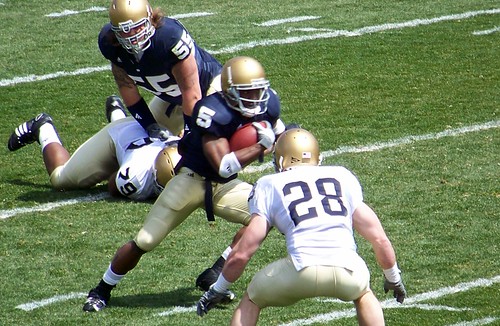
Once again we've got a reader-submitted photo gallery from this past weekend's Blue-Gold Game.

As always, thanks to those who submitted pics including Chris P., Justin F., and James C., who took the photo at the right. If anyone else has pictures of the weekend events to contribute, email them to BGS and we'll add them to the slideshow.

In addition to those pics sent to us, you can find other fan photo galleries courtesy of WLO and IrishFans. On the professional side of things, there are photo galleries on UND.com, Irish Illustrated and the South Bend Tribune.

If videos are your thing, Youtube is already filling up with clips from the game to complement the highlight compilation posted on UND.com. Thanks again to those who sent in pictures and links.

One last thing to add, there is a new blog on the sidebar entitled "The Casual Observer" written by the sports staff of ND's student-run Observer. In addition to coverage of all ND sports, they have an excellent live blog of the Blue-Gold game for those who weren't able to attend. Check it out.

Tuesday, April 21, 2009

Pat Tillman | by J-DUB

Note: The following entry was written in commemoration of the 5th anniversary of the death of Pat Tillman. It has no direct connection to Notre Dame and very little to football and you may want to skip it entirely.

I was raised in Tempe, Arizona, where Pat Tillman's legend first gained a foothold at Arizona State. And while our paths never crossed and I am ten years his senior, Pat Tillman became my hero. How many pro athletes do we really ever think of as heroic once we are past puberty? Thanks --JW.

***

Pat Tillman had bigger plans. And if you wonder how big, I'd like to share with you some quotes I came across recently, the first of which was written shortly before this soldier had his first real taste of combat along the Afghanistan-Pakistan border.

"I have faith in my star--that I am intended to do something in this world," he writes. "If I am mistaken--what does it matter? My life has been a pleasant one and though I should regret to leave it, it would be a regret that perhaps I should never know."

The author of that quote is not Pat Tillman. The soldier who wrote those words (to his mother) was Sir Winston Churchill, arguably the greatest statesman of the 20th century.

It was about a month ago that I at last picked up and decided to tackle a book that is approximately the size and mass of a package of Gold Medal flour. The tome, "Churchill: A Life", by Martin Gilbert, had been taunting me for nearly a year. I'd bought it with the best of intentions--to learn more about the widely quoted Brit-wit--but at 980 pages it was just so daunting. And there were always so many more easily digested distractions. Deadspin, for example.

Thankfully, last month I found myself unemployed and in the midst of a 12-hour train ride. It was now or never. The early chapters, Churchill's childhood, were perfunctory reading at best. But once Winston turned twenty? The next five years of his life were as thrilling as any Indiana Jones film. Seriously. And as I read the words, culled from letters and books that Churchill had written about his combat experiences in what is now Pakistan, the Sudan and South Africa, a recurrring thought abided: this is Pat Tillman.

Winston Churchill was a fairly privileged young man (his father had been a member of the House of Commons) who never had to leave Great Britain. He would have been prosperous and influential anyway, a member of Parliament in what was at that time the most imperial superpower the world had yet seen.

Instead, Churchill begged his widowed mother to prevail upon her influential friends to get him to the front--and England in the 1890s was fighting battles on many fronts. In 1897 Churchill, then 22, wrote his mother while on a 2,000-mile rail trek from Bangalore (in southern India) to what is now the Peshawar region of Pakistan.

"I have considered everything and I feel that the fact of having seen service with British troops while still a young man must give me more weight politically-- must add to my claims to be listened to, and may perhaps improve my prospects of gaining popularity with the country."

The future Prime Minister of Great Britain did not experience battle from the comfort of a tea garden.

"
So close and critical did affairs become," Churchill wrote his grandmother following his first day in action, "I was forced to fire my revolver nine times in self-defense....I think I hit four men. At any rate, they fell."

That was in Peshawar. In the Sudan, fighting the Dervishes, Churchill led two cavalry charges against men armed with spears and rifles. In one chaotic account, Churchill recalled an enemy fighter who "wounded several times, staggered towards me raising his spear. I shot him at less than a yard. He fell on the sand and lay there dead."

The most incredible accounts, however, were to come from South Africa. Churchill journeyed to the front of the Boer War not as a soldier, but having retired from the military, as a war correspondent. Didn't matter. He was taken prisoner and likely would have been shot dead first had he not lost his gun while helping to save a platoon of men. He spent his 25th birthday in a prison camp (Tillman, meanwhile, spent his 25th birthday reeling from a loss to the Philadelphia Eagles and preparing for the next Sunday's loss to the New York Giants).

Churchill truly burnished his legend, though, when he escaped from camp solo and journeyed solo 300 miles through enemy territory--in Africa, mind you--to safety. Less than a month later he was back at the front and once again in the midst of life-and-death adventure. According to Gilbert:

"McNeil (the British commanding officer) ordered his men back. At that very moment the Boers opened fire with their rifles. Churchill, who had dismounted, put his foot in the stirrup. The horse, terrified at the firing, plunged wildly. He broke away and galloped madly off.

Churchill was alone, dismounted, within close range of the Boers, and a mile at least from cover of any kind...He turned and ran for his life on foot from the Boer marksmen. As he ran he thought to himself, 'Here at last I take it'."

Churchill, incredibly, was spared. A fellow Brit heroically risked his own life and galloped back into the fray to rescue him. As I read these accounts, my stock image of the middle-aged and pudgy world leader, bundled in an overcoat and huddling with the likes of FDR and Stalin in the last days of World War II, vanished. Suddenly Churchill was just another young soldier risking his life and, like Tillman, taking chances that his good fortune did not require him to take.

"I have had some dangerous hours," wrote Churchill. "I had to play for high stakes and have been lucky to win. (But) I am so conceited I do not believe the Gods would create so potent a being as myself for so prosaic an ending."

As I read on about a pale, slightly-built soldier in the 19th century, my thoughts turned to a chiseled-jawed, muscular warrior of the 21st century. Both Churchill and Tillman found themselves fighting Afghan rebels-- "Civilization is face to face with militant Mohammedanism," Churchill wrote some 107 years before Tillman's untimely death, penning them within a hundred miles or so of where Tillman would perish. But what really struck me was this recollection of Churchill's from his final day in the mountains of Peshawar: "I was nearer killed-- by a subaltern who forgot his pistol was loaded--than at any other time. It would have been an irony of fate."

***

"You know, Pat was working on his masters in history at the time of his death," Kadi Tierney told me. Last week I phoned Tierney, the pleasant and accommodating media contact for the Pat Tillman Foundation, and asked her about this connection I'd made between Tillman and Churchill. I knew, as you do, that Tillman was a student of history and the classics. But I wondered if he'd had more than a casual relationship with the biography of Sir Winston Churchill. I wondered if the events of Churchill's life had been a prime inspiration for Tillman to detour from the wealth and fame of the NFL to become a U.S. Army Ranger.

It was only two days before Pat's Run, the annual 4.2 mile (after the number, now retired, that Tillman wore as a Sun Devil) celebration of Tillman's life that this year would draw 21,000 runners. Tierney was obviously busy. Still, she promised to speak to Pat's brother, Kevin, as well as to his widow, Marie.

Yesterday, Tuesday, Tierney got back to me. "You were on the right track," she said. "Pat was an avid reader of biographies of Churchill. He was someone whose life, in the course of getting his masters degree, Pat studied extensively. Pat was a great admirer of his."

When Tierney asked Marie Tillman about the connection between the two men, she replied, "Pat would have been incredibly flattered by the comparison."

Who knows how differently World War II might have played out had Churchill met his demise in the rugged Peshawar region, or in the sand dunes of northern Africa, or while running for his life in the Transvaal. It is worth noting that both Churchill and Tillman had one brother who served in the military at the same time. And while Churchill strode through enemy fire recklessly, like Robert Duvall in Apocalypse Now, he never suffered so much as a scratch from a bullet in two continents. His younger brother Jack was wounded in the leg, while taking appropriate cover, in his very first battle.

It might seem blasphemous to compare the life that Pat Tillman would have gone on to live with the historic achievements of Churchill. Then again, Tillman probably accomplished more before the age of 25 than Churchill did. Tillman did not necessarily need to become a soldier to achieve great things, for himself and for others, in the subsequent chapters of his life. On the other hand, he may have been following a role model of his own:

"Nothing, not even the certain knowledge of approaching destruction, would make me turn back now, even if I could with honour," Churchill, then 23, wrote on the eve of a battle in the African desert. "But I shall come back afterwards the stronger and the wiser for my gamble. And then we will think of other and wider spheres of action."

Pat Tillman died five years ago today. He died in part because he subscribed to a maxim made famous by Churchill in his later years: "Courage is rightly esteemed the first of qualities... because it is the quality which guarantees all others."

I hope, no matter what your politics, that you pay tribute to Tillman today. Take a moment to remember him. Or better yet, commit yourself to being courageous--you don't need to be a soldier to do that. After all, who knows when your time will come? I'll leave you with one last quote from Sir Winston, written after he left Peshawar:

"One has only to look at Nature and see how very little store she sets by life. Its sanctity is entirely a human idea. You may think of a butterfly---12 million feathers on his wing, 16,000 lenses in his eye--as beautiful. A bird thinks of it as a mouthful. Let us laugh at fate. It might please her."

Saturday, April 18, 2009

Game On | by Jay

Some thoughts on the way. In the meantime, here's the Gary Post-Tribune's John Mutka.

Why 31,000-plus people would watch Notre Dame scrimmage under a goofy scoring system amazes me...
Update: on a livelier note, check out this wide-ranging interview from Saturday with Lou. About fifteen minutes in, he starts talking about prospects for this year's Irish squad, what it takes to win a national championship, his relationship with Urban Meyer, his thoughts on scheduling, and all kinds of other stuff.

Classic Lou | by Jay

From the UND.com liveblog earlier this morning...

9:00 AM. There was a star-studded cast Saturday morning on the Notre Dame football practice fields, as some 70 former Irish players in t-shirts and shorts went through tryouts and workouts for the July 25 Notre Dame Japan Bowl. Among the familiar names? Tony Rice, Bobbie Howard, Brandon Hoyte, Mike Goolsby, Jeff Burris, Ray Zellars, Tim Ruddy, Jeremy Akers, Shane Walton, Bobby Brown. The oldest candidate? Kris Haines, a senior on the '78 team. Notre Dame film/television/theatre professor Ted Mandell was all over the field, filming a documentary on the Japan Bowl experience. There were a variety of media in attendance, some following Lou Holtz (and his staff) as he went from position group to position group. All the players ran 40-yard dashes to determine speed and conditioning. The players wore shirts with the Japan Bowl logo on the front and the adidas logo on the back. After the practice session, Holtz kidded that most of the announcements coming were about food. He suggested that about 52 players would be selected today and that there would be some alternates "in case I shoot somebody!" Holtz's last comments to the squad were: "This will be one of the great experiences you will have. That's my commitment to you." At his press conference, Holtz said, "We'll ask all these guys to play five plays as hard as they can, then we'll give `em mouth-to-mouth resuscitation until we can get `em back in there."
For much more on the the Notre Dame Japan Bowl, here's the homepage with all the details. The game will feature a group of Notre Dame all-stars (who tried out today) against the Japanese Senior national team on July 25th.

Update: here are some photos from the tryouts care of Irish Illustrated.

Friday, April 17, 2009

Bloggin' Blue and Gold | by Jay

I'm busy putting together a collage of items and impressions from spring practice. If you have any sound bites, snippets, or video clips from the last three weeks that made you sit up and take notice, feel free to email them or post 'em in the comments. I'll try to hit the highlights and put together a little digest.

In the meantime, the spring game is upon us, and I wanted to let you know that if you aren't going to the game but still want to follow along, Michael Rothstein at the FWJG will be live blogging the game over at Irish Insights.

In addition, the crew over at UND.com have set up a Scrimmage Central which will feature weekend blog updates and streaming audio from the game itself.

The game will feature the offense versus the defense (as opposed to splitting the team into two full squads), and thus will be using a unique "scoring system" to accumulate both offensive and defensive points.

Offense
Defense
1-
2-
3-
6-
1-
2-
1st Down
Explosive Play (10-yard rush/20-yard pass)
Field Goal
Touchdown
Extra Point
2-point Conversion
2-
2-
3-
3-
6-
10-
1-
2-
3-
Defensive Stop
Sack
3 and Out
Missed Field Goal
Turnover
Turnover for Touchdown
Missed Extra Point
Missed 2-point Conversion
Blocked Field Goal
Using this system, the Hawaii Bowl would have been like 196-42.


Call for Pictures. As we've done for blue-gold games past, feel free to email us your blue-gold photos from the weekend and we'll string them together into a slide show. Snap away.

ND Appoints a "Director of Gameday Operations" | by Kevin

In another potentially positive development for the Notre Dame gameday experience, the University has appointed Michael Seamon the Director of Gameday Operations. According to the University, Seamon's role will include include "coordinating the football game-day safety, security and hospitality operations that are shared among various University units, including athletics, the Notre Dame Security Police Department, and the Office of Student Affairs."

In other words, ND will have one accountable point person presumably responsible for oversight of Notre Dame security, ushers, and maybe even the relationship with South Bend police and Indiana Excise "police," and that person's name will not be Bill Kirk.

Seamon said, "In my conversations with Fr. Jenkins in the past ... both he and I and everyone here is keenly aware and extremely proud of the fact that Notre Dame is very special place. It leaves an impression on people when they visit here."

The most important word in the article is highlighted within: Seamon said his objective will be "to work with the various departments on campus to create a more coordinated effort on how we serve the Notre Dame community on gameday weekends."

This is the first public follow-up to the March 17th report, which included 21 recommendations. That actual report may never be made public, so we do not know which of the recommendations will or will not be implemented. However, if properly executed, this might be a good first step in relieving the mounting football weekend tension among the University, its students, and guests.

Monday, April 13, 2009

There's no easy way out. | by Pete

As spring football helps college football fans slowly recover feelings in their extremities following a long, cold, blitz-free winter, Charlie Weis took some time to revisit those tortured days following the horrific Southern Cal loss with Teddy Greenstein at the Chicago Tribune, the time when his tenure at Notre Dame was hanging by a thread that looked mighty frayed. That chat yielded some fairly interesting nuggets.

While Swarbrick & Co. were weighing whether Weis should stay at Notre Dame, apparently so was Weis.

Leave Notre Dame. Return to the comfort zone of an NFL coordinator's job. End the abuse, the kind that led son Charlie Jr. to skip school for three days after the Irish's home loss to Syracuse.

"We talked about all that as a family, and we felt that we didn't want to leave that way," Weis said during a recent 35-minute interview with the Tribune. "That would have been the easy way out. That's not why we came here."
Do I think that Weis and his family legitimately contemplated quitting and heading back to the NFL? Yes.

Do I think that Notre Dame probably thought longer and harder about firing Weis than Weis and family did about resigning? Also yes.

He also touched on the fact that some alumni organizations and former players felt a bit ruffled at the beginning of the Weis tenure. But on those matters, he says they weren't intentional snubs.
Shortly after Weis was hired, top Notre Dame administrators, including then-athletic director Kevin White, encouraged him to focus on the team rather than his dozens of speaking requests.

Victories would make the alums happy, not handshakes. So Weis made a point to attend the annual Rockne dinner in Chicago, and nothing else. "I didn't find out a problem existed until Year Three," he said...

Weis said he had an "open avenue" for former players, but he instituted a complicated policy that was poorly communicated to monogram winners.

Thursday practices were open, but former players had to give an administrator 24 hours notice and wear a credential. If a former player or VIP wanted to attend practice on a different day, he had to be accompanied by White; the university president, Rev. John Jenkins; or deputy athletic director Stan Wilcox...

"I do enough other things wrong on my own. But those major ones I was innocent of, even though I was perceived guilty."
While I feel like Weis is doing a bit too much to cover his own rear end, I want to give him the benefit of the doubt because he's shown a willingness to be relatively upfront with his own shortcomings in the past. And our new AD appears to agree, and wants Weis (rightly so) to focus far more on the field than on ensuring he has proper glad-handing technique.
Notre Dame athletic director Jack Swarbrick said that in his eight months on the job, he hasn't seen any issues — or any problems with Weis' comportment.

"What I've observed is uniformly positive," he said. "He's a guy who does a million small favors, or courtesies, for people. He was one of the first people to call [women's basketball coach Muffet McGraw] after that tough loss [in the NCAA tournament]. And he reached out to call Father Jenkins after the controversy with President Obama."

After asking Weis to return this season, Swarbrick told him his first priority is to win football games.

"Don't focus on trying to modify people's perceptions of you," Swarbrick told him.
All in all, a fairly interesting interview that shines a light from Weis's perspective on some issues he's faced in the past, as well as where he plans to go moving forward.

Friday, April 10, 2009

Devo Postscript | by Jay

Just a quick followup for Michael's post below, and specifically the importance of tight ends to the Weis offense. Eric Hansen in the SBT had a good piece today on the comeback of Mike Ragone.

Eventually the 6-foot-5, 251-pound New Jerseyite reveals the anterior cruciate ligament tear that wiped out his entire 2008 season and opened the gate for Kyle Rudolph to leapfrog him on the depth chart also caused him to wonder if football would go away for good this time.

And then the wall came down and the frustration spilled out.

"I cried," he said. "So many emotions went through my mind, so I cried. I never cry. It just really hurt. It hurt more than anything I've ever experienced. Football is everything to me."

His passion has halted a slide down the depth chart, with freshman All-American Rudolph the clear No. 1 option through 12 spring practices, another sophomore-to-be — Joseph Fauria — pushing hard for No. 2 and walk-on Bobby Burger making a splash.

"With Ragone, he's just rallied recently," ND head coach Charlie Weis said. "I think when he first came back, he was a little bit afraid — not afraid of playing football. But having one knee (injury) and then shortly after that having another (knee) injury, I think when you first put the (pads) on and you start hitting each other, he was a little bit anxious early on. But the last couple of days have probably been the best couple of practices he's had the entire camp."
One of the bases for Hansen's piece is the Weis presser of April 3rd, where Charlie talked a little bit about the return of his Jersey paisan. I went back to watch it, and one passage struck a note of synchronicity.
Q: The competition and numbers at tight end, how much does that help the offense overall?

Coach Weis: Sometimes, like last year, you get a little pidgeon-holed at the tight end position. So now you go from one that can play to three or four that can play. It gives you a lot more flexibility...in both formations and playcalling. Now, you're not just locked in to putting three or four wide receivers out there on every play. It opens up a whole personnel grouping and a number of things you can do [from it]. You were dealing with Rudy [Kyle Rudolph] being a freshman and Joseph [Fauria] not being ready to play yet -- as the year went on, Joseph was more ready to play -- but now with Michael [Ragone] back, and Joseph, and us not being afraid to play [Bobby Burger], it's really helped us.
So here's to the continued rejuvenation of Mike Ragone, and the further development of Rudolph, Fauria, and Burger. We're going to need them this year.

Wednesday, April 08, 2009

Wire We Different? | by J-DUB

Late autumn, 1994. I am 28 years old and have the greatest job in the world as far as I am concerned: writing the "Inside College Football" section at Sports Illustrated. The final column is to be an awards-style roundup of the season and the previous four months' peregrinations have yielded quite a harvest. There is, for instance, this classic quote courtesy of then Texas A&M coach R.C. Slocum regarding the difficulties involved in running a clean program: "John, back in the Garden of Eden they had two people and just one rule...and they couldn't even handle that."

There were just two problems. First, there was only one page of space for the column and second, my sense of glibness was a hit-or-miss affair with SI's top editors. It was like being Adam Lambert without quite that much talent, but with just as much nail polish (I know).

And, well, I no longer write for Sports Illustrated, and I imagine you're good at math, so...

But I will never forget what my editor, a wonderful mensch of a guy who was then in his early thirties, told me that day after my column was panned. He called me into his office and thanked me for the effort. Then he said, "You have to remember that you're not writing for the entire country here. You're writing for that small group of men down the hall. Those are the people you have to please."

The top editors. Those were the people. A coterie--an oligarchy, actually--of mostly Ivy League-educated, mostly white males. The "Princeton Junction Boys" (in honor of the New Jersey Transit stop so many of them used), as it were.

My editor was right, of course. But that was the twilight of an era, the last days of disco of sports print journalism. The "Print is dead" age was nearly upon us.

Today, thanks to the internet, space is never an issue when covering college football (though brevity remains a wildly underrated trait--if only I could apply it) and the scope of your audience is as limitless as literacy itself. The coverage of college football is, for the most part, better for it. A sport so overflowing with passion and populism fosters an insatiable appetite among readers, one that only the web can begin to sate. It's like dining at a Texas Roadhouse and actually being able to save room for dessert.

Moreover, something closer to a democracy bordering on meritocracy begins to take shape. Twenty years ago, the most difficult step toward becoming a successful journalist was landing the job at a brand-name outlet (Why else would J-School exist?). Who cared how talented a writer or reporter you were if you had no access to spread your message?

Today? Launch your own site and, if it connects with readers, word-of-mouth will do the rest. Phil Knight launched the world's most successful athletic apparel brand out of the back of his car. Steve Jobs began the world's most influential digital-age company out of his garage. And Bill Simmons became the most popular sports journalist of this decade only after being unable to land a job at the Boston Globe and instead starting his own site called "The Boston Sports Guy". If it weren't for the web, Bill Simmons might still be the funniest (and most opinionated, which is saying something) bartender in Boston today.

Too, there is something to be said for young people having a voice in the coverage of college sports (as if the idea itself were heresy). I recall fact-checking a story in 1991 written by Sally Jenkins. She described a wide receiver at the University of Washington as being heavily into "grunge" music. The editor changed it to "groove" music. He was UP HERE and I was down there on the masthead, but I politely stood my ground. He was dismissive, even suggesting we kill the reference. I stood my ground, having been schooled by people I worshiped such as the Ricks, Reilly and Telander, to fight for a writer's lines. The editor reiterated that no such thing as grunge existed.

(Looking back, it was all very "Moors" "Moops" of us: "Groove!" "Grunge!" "Groove!" "Grunge!")

What could I do? This was pre-internet, so I couldn't simply tell him to Google "mudhoney and flannel". Only after I ran down to the magazine stand in the bowels of Rockefeller Center and procured an issue of Rolling Stone did he relent. It isn't that a man in his mid-forties should have been familiar with the grunge scene before the release of "Nevermind". It is simply that the prevailing mindset of the day--that people under age 25 should be obscene and not heard, or something like that--was so withering.

The enthusiasm, the cheekiness of college-aged fans is certainly better represented on "EveryDayShouldBeSaturday" than it is by Beano Cook. And there's room for both. In the past, however, only the latter voice was heard.

And too often the mainstream media failed/fails to provide an anti-establishment voice to college sports, whose denizens are at an age where questioning the establishment is a given. Case in point: During the second half of Saturday's Michigan State-U Conn Final Four contest, CBS play-by-play man Jim Nantz broached the topic of the alleged NCAA violations by the Huskies as exposed by the recent Yahoo! Sports investigation. While not discrediting the report, Nantz seemed to go out of his way to note that Jim Calhoun has a "spotless" record in Storrs. Considering that one of UConn's players on the floor at that moment, A.J. Price, had once been suspended for stealing a fellow student's laptop (and another, Stanley Robinson, hasn't received a grade for a class since the 2007 fall semester), Nantz might have at least acknowledged that the Yahoo! Sports story raised some valid questions as to propriety and UConn basketball. But hey, this was just a story that appeared on the internet. It wasn't as if Katie Couric had broken it.

There are two reasons--besides humor--that Jon Stewart has a more devoted following among people under the age of 35 than Couric or anyone else delivering the news. Trust and candor. Stewart makes the jokes on-camera ("Mess o' potamia") that the more established anchors can only make off-camera. And they do. Stewart's on-air candor, meanwhile, gains our trust. And so it is with college football sites such as EDSBS ("Every Day Should Be Saturday"), which gives us the Fulmer Cup (a yearlong standings of miscreantism in the sport), or "Deadspin", which boasts the "Hugh Johnson Project", a fall Saturday staple where readers comment on the vast array of games in real time, transforming the site into the pigskin equivalent of "Mystery Science Theater 3000".

To be fair, Sports Illustrated has never backed down from pursuing investigative pieces in college football (or any avenue of sports). And just as it is much easier to sit on your couch and say, "I could've made that catch" (which begs the question, Then why didn't you get a free ride to an FBS school?) when watching a game, it's a lot easier to opine from the safety of your own home or cubicle than it is to stand face-to-face with a player or coach and ask the difficult questions. We live in a "Guitar Hero" culture; a Wii republic, where too many equate bowling a 200 on a video screen with being a good bowler.

Deadspin founder Will Leitch infamously told Bob Costas last spring, "It's hard goddamn work writing a blog." You know what else is? Writing a captivating story in 1,000 words or less (hence, I have failed on both counts here) by interviewing various and often contradictory parties, foraging for facts and drawing conclusions. Is it just a coincidence that while Bill Simmons' mailbags are freaking hilarious, his columns that appear in ESPN: The Magazine are just average?

The reason so many of us veterans appear to be screaming at the wind so often is because the blogosphere places too little emphasis on accountability, on accuracy, on real talent. You want to read an outstanding college football piece? Read this 1997 story in SI by my friend Steve Rushin about Scott Frost and Nebraska. And Steve was not even on the college football beat (nor did the constraints of SI allow him to make any wiener jokes...though God knows he often tried to slip one past).

I'm rambling (once again, God bless the internet for allowing me the space to roam, to wonder aloud about such things as, "If I don't look anything like someone else, does that mean I bear a canny resemblance to them?" with no threat of being edited). Here, then, are a dozen top sites and why I visit them (and I've avoided naming any individual school site, though there are many excellent ones, of course, including this one and my personal favorite, in terms of names, the WVU site "We Must Ignite This Couch"):

1) College Football Data Warehouse

Every score, every coach's record, even a link giving you the outcomes of the misnomered "Kickoff Classics". This should be the first site anyone covering or interested in college football should bookmark.

2) CollegeFootballNews.com

I don't know anyone who has the time to read all of the insightful analysis and stories posted on this site, and I often disagree with their columnists, but I do know that I never miss Pete Fiutak's weekly "Cavalcade of Whimsy" column each Tuesday during the season. And I enjoy their sense of fun, such as rating a games on a spectrum of great TV ("Extras") to horrendous TV ("Flavor of Love")

3) TheWizofOdds.com

Founder Jay Christensen spent some two decades at the Los Angeles Times, but his legacy should be this outstanding site, which plucks the most newsworthy stories from around the country while also providing its own original items. Daily dosage highly recommended. And, perhaps because he is old enough to remember the bicentennial, Jay's items are refreshingly free of profanity and the "Anyone who is successful must be a phony" attitude.

4) SI.com

Having worked there for nearly 15 years, I'm intrigued by the manner in which the site (and its writers) has usurped the magazine in the public consciousness. Austin Murphy has been covering college football for the main mag for more than two decades, and there is no more universally-liked writer in the sport (he also happens to be immune to the aging process...damn him!). But Stewart Mandel has ambitiously claimed the web as his turf and has endeavored to become as knowledgeable as anyone on college football's byzantine ways, from the BCS to the fact that the Big Ten is comprised of eleven teams. Stewart's the smart kid in class, and he prides himself on that. It shows in the work.

5) NCAASports.com

Want to know who led the nation in rushing offense last season (Navy) or who finished last in passing offense (Army)? Visit this site, find the "statistics" link for football, and dig all you want.

6) Dr. Saturday

Matt Hinton and a small staff of contributors serve as a digital version of the Times Square ticker, keeping you up to date on the newsworthy and the bizarre, which often find themselves overlapping. Today, for instance, the site had an item concerning the position switch of Demetrius Jones' to linebacker at Cincinnati (how much more can this kid take?).

7) Everydayshouldbesaturday.com

This unabashedly Florida-centric site is crude and funny, with inspired bits such as the aforementioned "Fulmer Cup" and "Mustache Wednesday" earning it a devoted fan base akin to that of the "Daily Show".

8) Deadspin.com, "The Hugh Johnson Project"

Remember how you and your friends would watch a game in your dorm room and mock the announcers or the players with the weird names (Elvis Peacock?!?). Well, imagine if all the other idiots in all the dorm rooms all over the country were doing the same thing? And if someone could somehow filter all the remarks so that only the funny ones made it through? We welcome you to Hugh, also known as the worst thing ever to happen to Pam Ward.

9) The Quad Blog

The New York Times gets out in front of the digital age with a blog of its own that is updated about half a dozen times daily. Writers such as Pete Thamel and Thayer Evans are that rare breed in this age who both go out and report their own stories (much to the chagrin of Mack Brown) while also writing a fairly popular blog.

10) Fanblogs.com

Like The Wiz of Odds and Dr. Saturday, this site acts as a terrific filter for absorbing all the news that's out there and providing it to you in a less daunting fashion.

11) Smartfootball.blogspot.com

If you know that the A-11 is neither the latest, greatest innovation in steak sauce nor the conference of the Rhode Island Rams, this site may be for you. If you care to learn the intricacies of how the A-11 is run, this site will keep you enthralled for hours.

12) CollegeFootballResource.com

Have to admit that I'm partial to this site because, like me, it does not want to see a playoff in college football. Before you condemn us, look who else is part of our coalition: Chuck Klosterman, Mike Greenberg and Megan Fox (okay, I'm just guessing on that last name).


*****

This is a many-layered topic, of course. For instance, where are the boundaries drawn? If West Virginia head coach Bill Stewart can Twitter us about having thrown his kickers out of a team meeting (ooh, tough guy), then why can't a blogger "friend" that kicker on Facebook and ask him what really happened without requesting an interview through the sports information director?

Or, how do sports information directors define who warrants a press box credential? After all, as with parenting, journalism is not a vocation that requires a license. Does a beat writer from a newspaper with a circulation of 20,000 readers deserve a credential over a blogger with five times that many (not that the blogger would request one on most occasions, but what if he or she did?). And should the NCAA have the right to prohibit live blogging during a game? You might as well order Google to stop mapping the planet.

This much I do know. Fifteen years later, the "Inside College Football" section of SI is well-written, meticulously edited, fact-checked and copy-edited. But the earliest you'll ever read it is five days after Saturday's games. In terms of 21st century college football coverage, it may as well be written on papyrus.

Tuesday, April 07, 2009

Video Digest | by Jay

There's a lot of great video coverage of spring practice this year; more than I ever remember. In addition to the usual outlets of Irish Eyes, Irish Illustrated, and Blue and Gold, UND.com has been posting the full versions of interviews.

One new bookmark I wanted to pass along is the video index link for Irish Illustrated, hosted on Yahoo. This is a great, all-in-one reference you can use to get caught up on the highlights of the day, with three-to-four-minute excerpts of all the interviews and practice sessions. I'm enjoying it. I hope you do too.

Sunday, April 05, 2009

the Twittering Irish | by Mike

By now, you've probably heard about Pete Carroll's Twitter feed. If you haven't, here are some representative Carroll "tweets":

9:07am 4/3 - Just split from staff meeting... It's already day 4, spring ball is rolling along! Really, really fired up about this thing right now!!
2:40pm 3/29 - Really jacked Coach Floyd is staying!! He's the best hoops coach in the history of SC and it's awesome he's remaining a Trojan!!!!
2:08pm 3/23 - Loved the energy and excitement out on the field today... 1 down, 14 to go... one step at a time... always competing!
8:26am 3/31 - Will Ferrell Twitter? Will he?? (get it?? it's a play on words...) Keep competing, let's turn him into a tweed!
7:08am 2/23 - The new baby is awesome and he said he'll be ready to compete in the spring!!! Picture coming tomorrow!!
Third-year Minnesota head coach Play4brew also jumped on the Twitter bandwagon, slavishly imitating Pete Carroll's writing style:
6:25am 4/4 - High Fives Everywhere!! Go Gophers!
6:45pm 3/31 - Another great practice in today! We were in full pads and the guys really competed!
7:08am 3/30 - Players Play- TOUGH Players Win!!!!!!
2:34 pm 3/24 - WINNING ON AND OFF THE FIELD EACH AND EVERY DAY IS WHAT CREATES A CHAMPION!
10:01am 3/26 - Vince Vaughn is a big Gopher football fan!!
Other coaches are jumping on the twitterwagon: UM_CoachRod, coachsark, and even coachronzook.

As we can see from these examples, this nascent form of coach communication has already developed its own informal rules and conventions. Among these rules and conventions are the following:
  1. The only acceptable forms of punctuation are exclamation points and (multiple) question marks
  2. Do not allow a “compete” gap – if you’re not trying to work some form of the word “compete” into every tweet, you’re just not giving 110%
  3. Be relentlessly positive and upbeat
  4. Only tweet about subjects that have you really, really pumped and/or jacked
  5. Mention actors
Last Tuesday, Charlie Weis joined the list of coaches with Twitter feeds. Now that we've identified the conventions of coach twittering, let's see how Charlie is doing:
6:59am 4/4 - Scrimmaged for 47 plays. Some good, some bad. Heading in to watch the tape.
This tweet violates a number of the rules. First, it contains not one, but three, periods. The only time Pete Carroll or Play4brew would ever be caught using a period is in an ellpsis. Second, the "some bad" comment hardly qualifies as positive. Finally, Charlie does not sound very pumped. Let's take a look at another:
3:26pm 4/1 - Lots of hitting in practice. Very competitive.
I'm pretty jacked about the use of "competitive," but where are the exclamation points? Come on, coach.
6:21am 4/1 - Spring practice #8 this afternoon, working on short yardage & red zone. Go IRISH!
We finally come across the sole exclamation point on Charlie's twitter feed, and the tweet ends with some Play4brew-worthy ALLCAPS. Nice to see the potential is there, but coach needs to work on his twitter suddenness.

To help Charlie compete with the pumped and jackedness of Pete Carroll and Play4brew, we gathered in the BGS Lounge and brainstormed some stock tweets Charlie can pull off the shelf when he's feeling short of inspiration:
  • What time is it? It’s Competition 10:00 a.m.! My favorite hour of the morning! Really JACKED!!!
  • Players play! Tough players WIN! Irish players WIN AT THE GAME OF LIFE
  • Did you catch Oscar-nominee Jon Bon JOVI on Jimmy Fallon?? Great actor and Irish fan!
  • Watching a great flick right now – Glengarry Glen Ross! Loving Alec Baldwin’s speech! But if I gave it, ABC would stand for Always Be COMPETING!!
  • Coach Hart is WIRED FOR SOUND. He has great IRISH ENERGY!!
  • Really, really psyched about Jeff Jackson and his team!! Going all the way next year!!! And with Coach BREY!
  • Pete and Compete were in a boat! Pete fell out! Who’s left???
  • Sam Young is one BIG MUCHACHO!!
  • Really, really fired up about this championship micturation I just had!!
  • Have you guys been reading Kevin’s posts?? Really pumped to see the new bloggers compete!!!
  • Got a text from BRADY QUINN! He is really competing over there in Cleveland!!
  • Just did a CHEST BUMP with the LEPRECHAUN!! GO IRISH
If you have any Carroll-esque tweets Charlie can use, feel free to post them in the comments.

Friday, April 03, 2009

On the Warpath | by Jay

In addition to the daily drumbeat of reports coming out of Spring practice, here's a trio of national stories covering the Irish that came out this week.

Matt Hayes of The Sporting News talks about the spirited practices this spring in South Bend.

"In the three years I've been here," said Notre Dame quarterback Jimmy Clausen, "I've never seen it like this."

This is far from your typical spring drills across the college football landscape. Spring is a time for young guys to make a move and veterans to sharpen skills and not get hurt.

Yet there was Notre Dame, six practices into spring drills -- and only the third in pads -- banging and brawling for their ever-loving football lives. Play by play, position by position.

"We saw what we could be that last time we stepped on the field," said guard Eric Olsen. "That kind of shook up everyone; made them realize we have to play with that intensity every time out."
Andy Staples at SI goes over prospects for the Irish defense.
Weis stopped the drill, but he didn't discipline the senior. Instead, he got in the freshman's ear hole. "You're never going to make it around here if you let that happen," Weis said later. "Not that I'm looking to instigate, but at the same time, it was a perfect coaching point for him. I was saying, 'You're going to have my blessing in that situation. ... Don't count on [junior linebacker] Brian Smith to come to the rescue. Stand up and defend yourself.'"
And finally, ESPN's Ivan Maisel works up a insightful profile of Charlie, the result of an all-access, behind-the-scenes week spent shadowing the big man through meetings and practices. It's a long read, and well worth it.
The Gug's staff rooms are smaller than those in most football buildings these days. Behind Weis, there are two cabinets filled with computer and video equipment. The whir of the computer fans deadens any other ambient noise. The wooden window blinds, a rich brown to match the cabinets, are fully drawn. The glow of gray light seeps in at the edges.

Weis looked to his immediate left, where the new line coach, Frank Verducci, sat. On Tuesday, Verducci had sent a four-page e-mail to Weis and each of the linemen, breaking down their play.

"I really like the e-mail you sent," Weis said. "It called them out, good and bad."

After last season, Weis asked for the offensive and defensive averages of the 10 teams that played in the BCS games, plus Cotton Bowl participants Ole Miss and Texas Tech. "If the goal is to be a BCS team," Weis reasoned, "then that's what we should be doing."
Plenty of good tidbits buried in each of those articles.

Thursday, April 02, 2009

Devolution of an Offense | by Michael

Eons ago -- well, way back at the end of the 2006 season -- when Charlie Weis had an impressive 19-6 record and two BCS berths already under his belt, we examined how his offense had evolved in that short two-year span, and how it might continue to progress given the new talent recruited on offense.

Fast-forward to the present: the offense seems to have lost its way, and has yet to recover its imaginative spirit from those first two years. In fact, it's gradually devolved into a primitive, generic version of that efficient, high-powered unit that shredded defenses in 2005 and 2006.

Four years and change have passed since Weis was first introduced as the head coach. Supposedly nothing has changed -- philosophically speaking. But the declining performance on the field tells a different story.

(This post might require some background reading. If you're hiding in the back of the class because you need a refresher on Charlie's 'multiple' offensive philosophy, check out our remedial course from May 2005, or peruse this excellent 400-level course offered by the must-read Smartfootball.)

An Offense Badly Out of Balance


A quick glance at the distribution of packages utilized tells the story of the offense's devolution. Packages are listed from heaviest (more tight ends) to lightest (more wide receivers).


The 3-WR set Half has been swallowing up the offense's diversity since the end of the 2005 season. Irish fans have noticed, and you've probably seen complaints (or voiced them yourself) that the creativity and imagination of the offense seems to be missing.

There is certainly some truth in that. When an offense uses one personnel grouping 62% of the time,
it's simply less imaginative because so much of it is the same. There really are only a finite number of ways to deploy three wide receivers, a tight end, and a halfback. Furthermore, the offense appears stale because a limited number of plays are run from a core group of formations within that grouping, rather than running a multitude of plays from a few formations.

Let's contrast this situation with 2005. Back then, Half was only used 37% of the time. The Irish threw the ball from Half more often (71% compared to 66% last year), but Weis employed it more as a hurry-up device, both when the Irish were behind or simply to throw the defense a curveball, and in obvious passing situations. It was a situational personnel grouping instead of a staple.

3 receivers, a tight end, and a halfback.
Look familiar?

Last year, however, Half was the base offense. Of course, the reason why it became the base offense was the fact that we had only one viable tight end for much of the year: Mike Ragone went down with a knee injury during fall camp; Will Yeatman was suspended for an alcohol-related offense; Luke Schmidt was sitting out because of multiple concussions; Konrad Reuland had transferred to Stanford; and Paddy Mullen had long ago moved to defensive line to shore up recruiting misses. True freshman Kyle Rudolph was the only tight end in the rotation for much of the year, with fellow freshman Joseph Fauria finally getting in the mix towards the end of the season.

The tight end position is what gives the Weis offense its flexibility
and diversity; with only one, Rudolph, the offense was severely limited. This sameness eventually put the Irish in poor situations on the field in 2008, especially against top-five defenses like USC and Boston College, where the Irish failed to even reach the red zone. Opponents could spend the majority of their time game-planning for Half and Regular formations, and the lack of tight ends prevented Weis from being more creative with the offense.

Back in 2005, the Irish possessed three stellar tight ends in Anthony Fasano, John Carlson, and Marcus Freeman. Not surprisingly, the production out of the multiple tight end packages was solid:
  • Detroit - 5.7 yards per play
  • New York - 4.2 yards per play
  • Two Tites - 5.2 yards per play
Two of those three are levels that haven't been matched since; only the Golden Tate 48-yard touchdown and the 29-yard heave to Rudolph in the Hawaii Bowl pushed the average for Two Tites in 2008 to an incredible 8.6 yards per play. However, it's worth noting that the Irish only called 12 plays all year from Two Tites, compared to 88 in 2005.

Earlier this week assistant coach Bernie Parmalee noted that the lack of tight ends was a serious problem in last year's offense:
"[Last year] we couldn't do what we needed to do, we couldn't use certain packages with multiple tight ends because we only had one. The more guys we have at that position, the better we are. We have three guys right behind Rudolph that really can play some ball and allow us to do more things."
With Rudolph, Ragone, Fauria, transfer Bobby Burger, and incoming freshmen Tyler Eifert and Jake Golic, the tight end depth is beginning to look more promising again. Their development, and in particular, Ragone's health, will play a major role in helping the offense diversify its attack, and will force defenses to spend extra time game-planning for the full variety of looks that Charlie's offense can put forth.

Same Old Song and Dance


Once tight ends became scarce, the diversity of personnel groupings within a game all but vanished, as can be seen in the distribution below.


After Yeatman disappeared, the Irish used Half over half the time in every game until USC.

Tied very tightly to the lack of overall diversity in the offense is the homogeneity of personnel within a single offensive series. Although this tedium was rife through the entirety of many games in 2008, we can see it especially in an examination of several opening drives.

If we look at the first drive of games in 2008, after Yeatman's suspension following the Michigan State loss, the Irish used only one personnel grouping against Purdue, UNC, Wash, Navy, and BC: Half. In the Stanford and Pitt games, the Irish subbed a short yardage grouping on a 4th & 1 and 3rd & 1, respectively. Against Syracuse and USC, the Irish used just two personnel groupings on their two opening drives (both went three-and-out).

However, in the Hawaii Bowl, the Irish used four different personnel groupings on their opening drive. That, of course, is Charlie Weis football.

Again, let's look to 2005 for the platonic ideal. Back then, the Irish mixed and matched liberally: Charlie used five personnel groupings on the opening drive against Tennessee; four each against Pitt, Washington, USC, and Navy; three against Michigan State and Purdue; and, only two against Stanford (although Jeff Samardzija's 80-yard touchdown prevented any further plays on that drive). Weis topped all those efforts in the bowl game against Ohio State, as the first 11 plays featured six different personnel groupings. (Recall that the first drive of the Michigan game and the entire BYU game plan revolved around hurry-up offenses that didn't change personnel.)

The Irish badly need to restore such diversity in each offensive series. Defenses must be pressured to adjust constantly throughout a series to the offense's personnel groupings. Defenses should be shuffling personnel on and off the field, and they need to be forced to consider and think, rather than just react (Who's on the field? What are their tendencies? What did I see in film study?). Last year, Weis and the offense allowed defenses to find their groove, and never forced them out of their comfort zone. That can't happen in 2009.

Ir-Regular Production

The decline of overall offensive production can also be clearly linked to a decrease in production from the Regular personnel grouping, which was the second most popular grouping (21.6%) in 2008. Regular places two receivers, a tight end, halfback, and fullback onto the field. Despite its prevalent use, the Irish failed to meet two basic offensive benchmarks: they were short of four yards per carry and failed to achieve seven yards per pass attempt.

Production from "Regular" (2/1/1/1)
"REGULAR"
Rushing
Passing
Sacks
Breakdown
Year Plays % Used R Yds Ypr PC PA Yds % Ypa No Yds Pass Run Per Play
2005 180 20% 82 372 4.5 61 89 941 69% 10.6 9 23 54% 46% 7.4
2006 106 12% 51 187 3.7 23 42 214 55% 5.1 13 -40 52% 48% 3.4
2008 189 22% 121 453 3.7 26 57 290 46% 5.1 11 -61 36% 64% 3.6

Looking back, it's hard to believe that the Irish averaged over ten yards per pass attempt in 2005, but it's no typo. Fourteen times that year the offense completed a pass out of Regular for 20+ yards, and five of those went for 40+ yards. Secondaries were not nearly as kind to the offense in 2008: the Irish completed only four passes all year that went for more than 15 yards, with three of those coming against Hawaii. Likewise, the poor average in 2006 resulted from the same lack of long passes: only one pass play of 20+ yards all year from Regular. It's worth noting, though, that Regular was used less frequently in 2006 once Asaph Schwapp suffered a season-ending knee injury.

A second issue with Regular was its predictability. Even Weis admitted it to an extent:
"Usually when we go into that personnel group [Regular], James and Asaph are in the game, the teams we're going against knows that there's a good chance, higher chance it's going to be run than pass. Of course, you can never just sell out because it could be a play action shot that you're throwing at the same time." (Oct 28, 2008)
For the season, the run-pass ratio out of Regular was a heavily-tilted 64-36, whereas in prior years the Irish showed a slight preference in passing the ball in 2005 (54-46) and 2006 (51-49). Teams loaded up against the run when they saw Schwapp and Aldridge, and the Irish rarely took any play-action shots until the bowl game against Hawaii. In fact, Clausen entered the bowl game having completed just six of 24 play action passes for a modest 53 yards. The 69-yarder to Tate is a great example of the possibilities of passing out of Regular; the Warriors cheated a safety into the box, Clausen faked the hand-off, and the cornerback, with no deep help, was toast. We need more of that in 2009.

The third issue with Regular was the horrifically inept toss play, which constituted 15% of the Regular rushing attack. The toss play sadly averaged 1.6 yards per carry on 18 chances, and on ten of those carries, the play was stopped for no gain or lost yardage. The best two tosses? Aldridge picked up 17 yards against Purdue, and Jonas Gray had a ten-yard run in garbage time against Washington. The other 16 attempts managed a total of one yard.

Without an effective toss play, and for that matter, without a decent outside zone run (5 attempts) from this grouping, the Irish were very limited in how they could attack a defense on the ground. Schwapp's sluggish pro day results provided further evidence of why the Irish had trouble creating gaps on the perimeter of the defense -- their lead blocker couldn't get out there. Whether the potential dual-back Aldridge, Steve Paskorz, or even Burger (his role has yet to be clarified) can do better remains to be seen.

Perhaps the break after the Southern Cal game provided Weis time to work out the kinks in Regular, with play-action passing and big play capability were evident against Hawaii. (The lone toss play run lost seven yards, so there is still work to be done). With that in mind, given the loss of Schwapp, and the move of Aldridge to fullback, which will leave Hughes or Allen as the starter in Regular, there is reason to be hopeful about Regular production heading into 2009. As Charlie noted this spring:
“The good thing is, now James is repping in there and that will eventually allow you to put in formations where you can take somebody like Armando (Allen) and line Armando out of the backfield; now all of a sudden you are running or passing against base defense because you have a base offensive personnel group out there without putting a lesser skilled player in a position to be able to do that. I think there are some serious options that would open up if this continues to move in the direction that it is going.”
Aldridge should have the foot speed to get to the perimeter, which Schwapp didn't; the question is, can he block? Aldridge is also a much more reliable runner between the tackles, and likely more of a threat to catch a pass. Furthermore, as Weis hinted at, Aldridge at fullback would also allow Weis to use Armando Allen as a receiver out of the backfield. With Hughes or Allen as the tailback, and Aldridge at fullback, the Irish should be a more diversified running team from Regular, and defenses will always have to remain vigilant for a screen pass (or even the double screen pass). Weis called a screen pass for Aldridge less than 1% of the time he was in the game as a Regular halfback; for Hughes, it was 5%; and, for Allen, it was 20% of the time.

In sum, Weis cannot afford to allow Regular to be as one-dimensional as it was last year; he should return to making defenses account for every offensive player in the huddle, and force them to defend every inch of the field.

The Decline of Detroit

As mentioned above, the lack of tight ends clearly limited the offense's creativity and production. Nowhere is this more evident than with Detroit, which utilizes two receivers, two tight ends, and a running back. In Detroit, that extra tight end allows an offense more flexibility than having a fullback or a third wide receiver: he can be lined up in the backfield, flexed out wide, on the line of scrimmage, or on the outside shoulder of the other tight end. Additionally, the match-up of a linebacker on a tight end can often favor the tight end, especially if one has recruited tight ends as well as the Irish have in recent years.

Weis mentor Bill Parcells describes the advantages of Detroit best:
"The nickel player nowadays is...playing about half the time, so he's considered a specialist. He's working on being a nickelback. My contention is the match-up that you get with an additional tight end against a normal safety or normal linebacker is really more advantageous than what you get by deploying your third wide receiver in the game and having defenses put their specialty player in."
As we saw with Regular, production from Detroit has gone down since 2005, although for different reasons. While the issue with Regular has been its predictability, lack of big play capability, and inability to force defenses to account for every player, Detroit has suffered from a shortage of healthy tight ends on the roster.

Production from "Detroit" (2/2/1/0)
"DETROIT" Rushing
Passing
Sacks
Breakdown
Year
Plays
% Used
R
Yards
Ypr
PC
PA
Yds
%
Ypa
No
Yds
Pass
Run
Per Play
2005 179 20% 76 353 4.6 53 92 696 58% 7.6 11 28 58% 42% 6.0
2006 142 17% 57 213 3.7 45 78 478 58% 6.1 7 -31 60% 40% 4.6
2008 54 6% 32 74 2.3 16 22 116 73% 5.3 0 0 41% 59% 3.5

(It's worth mentioning the Detroit's passing numbers took a dip once John Carlson went down with injury in 2006, and when he returned less than 100%. Without Carlson, Brady Quinn completed 3-13 passes out of Detroit for 34 yards. As far as the rushing numbers, the longest run from scrimmage in 2006 was 15 yards; by contrast, Darius Walker had five runs longer than that in 2005, including 37- and 38-yard scampers.)

When we talk about "lack of creativity" in the offense, much of this can be traced back to the disappearance of Detroit over the last two years (as well as other multiple-TE packages). Lack of misdirection plays has been noticeable; but, most, if not all, of the offense's bootlegs (a staple misdirection play) are run with at least two tight ends, something we simply didn't have. Another misdirection is the counter run; these averaged 8.7 yards per carry in 2005 and 5.5 yards per carry in 2006, while all but disappearing in 2008. Another missing piece has been the wham-trap play, which Weis had predominantly used with an extra tight end; again, nearly non-existent in 2008.

The importance of Detroit to Weis is clearly evident in how he tried to bring it back late in the season against USC, albeit with Trevor Robinson as the second tight end, and then against Hawaii with Joseph Fauria. In those games, Weis called a play-action bootleg for the first time since the San Diego State game, a wham-trap play, and play-action off the wham. These were relatively small wrinkles in the offense, but important ones nonetheless.

The decline of Detroit explains the last two-thirds of the season, but it raises a question about the first three games, when Yeatman was still a factor: if the 2-TE packages are the missing link, why wasn't the offense more impressive against SDSU, UM, and MSU?


Let's start with the good news. The passing game from Detroit in the first three games was actually working fine. In the season opener against San Diego State, Clausen was 7-8 passing out of Detroit for 66 yards, including a nifty bootleg play action off the stretch play (an option that disappeared from the playcall sheet after Yeatman's suspension). In the next two games against Michigan and Michigan State, Clausen completed 4-8 passes for 25 yards. While that stat line seems a little meager, the circumstances of the incompletions suggest the passing game wasn't quite that futile and, in fact, just missed out on a few big plays:
  • Inc 1: Rudolph can't protect Clausen's backside, and the hurried quarterback can't improvise and connect with Kamara;
  • Inc 2: A defender tips a play action pass at the line of scrimmage, which results in an interception in the endzone;
  • Inc 3: Play action works against the aggressive Spartan defense, but Clausen slightly overthrows an open Mike Floyd in the post; and,
  • Inc 4: Clausen throws a nice ball down the seam to Rudolph, but the defender makes a terrific play to force an incompletion.
The bad news: there is no glossing over the fact that the run game was awful out of Detroit, no matter what the Irish tried. Robert Hughes was the primary back in this personnel grouping, and Weis tried to pound it with him in the first three games. Twelve times the Irish trotted Detroit personnel onto the field for a first & ten, and the Irish ran all twelve times, picking up just 36 yards. Worse yet, half of those yards came on one misdirection play. That's 11 carries, 18 yards, for those of you scoring at home.

Which brings us to the last point...

That Offensive Offensive Line

Schematics are important, but they're worthless without fundamentals. In every personnel grouping except for Half, rushing numbers have dropped since 2005. And that makes sense-- Dan Stevenson and Mark Levoir, both now in the NFL, were replaced by Bob Morton (not in the NFL) and Sam Young (a true freshman); in 2007, we replaced nearly everyone else with brand-new starters. The importance of OL starting experience was covered by Pat back in August 2008, and it's definitely worth another look. Assuming that Paul Duncan reclaims the left tackle spot, the Irish would have 97 returning starts at offensive line heading into the 2009 season.

For all of the items discussed above, the impact of the offensive line cannot be underestimated. Unfortunately, line play is also the hardest to measure: we simply do not have the exact knowledge of assignments against different defensive alignments, nor do we know the line calls. Whereas formations, receiver routes, running plays, and personnel groupings are easier to discern, OL play is a lot more difficult to assess. But Frank Verducci's arrival in South Bend is confirmation that Weis saw the need for change.

Although we were initially lukewarm about Verducci's hire, early returns seem positive. From the practice videos on Irish Eyes, Irish Illustrated, and UND.com, Verducci seems like more of a detail-oriented teacher than Latina. He gives constant and constructive feedback to his players rather than just barking at them, he stresses the importance of mental reps. Most importantly, as Sam Young explains:
"He's a technician. For me, that's a good thing, because I think I've been lacking in my technique, and it's something I've needed to work on. It's a different perspective. He brings a lot of things to the table that I haven't heard before, that the guys haven't heard before."
While the prospect of a three-year starter not having his technique down is alarming, in a way it's also potentially reassuring. For one, it finally sheds light on what might have vexed the line the last two years. And if there are techniques that the Irish line were not taught, and Verducci is providing that instruction, perhaps the gap between potential and performance can finally be narrowed.

And that's also the outlook for the entire offense. Although there are nine returning starters on offense, questions abound:
  • Who will emerge as the second TE? Who can emerge as a third TE?
  • Can the offense regain its big play capability-- both on the ground and in the air-- from 2005?
  • Can Aldridge help Regular become a more productive and less predictable personnel grouping?
  • Can Verducci coach up the offensive line to play more like it did in 2005, and hopefully transcend even that?
Keep an eye on these things during spring football, but realize that answers are temporary for now. It's September that counts.
Wednesday, April 01, 2009

Times Are Tough All Over | by Jay

I found this while digging around at the Chronicle of Higher Education's news feed. No comment.

SOUTH BEND, IN -- Shrinking endowments, funding reductions and fewer anticipated enrollees are forcing many colleges and universities to curb development plans and reassess operating budgets. From well-heeled Ivy League schools such as Harvard and Dartmouth to large public institutions such as the California State University system, many schools are facing difficult financial decisions stemming from the nation's economic standstill.

But nowhere is the downturn being felt more acutely than in the world of university sports. With schools trimming their operating costs, sports program budgets are often the first at the chopping block.

However, some schools are looking at innovative--and sometimes controversial--ways at keeping their sports programs afloat, even in a time of reduced revenue and economic troubles.

At the University of Notre Dame in South Bend, Indiana--a school renowned for its football and other athletic programs--administrators are looking at fresh ideas to keep sports solvent.

"We have been, for the last few decades, financially very stable in the operation of our sports programs" Notre Dame university spokesman Dennis Storin said. "But the landscape is changing, and we will need to adjust to the realities of the current economic climate."

Notre Dame is betting on a series of cost-cutting measures and new revenue generators--mostly centered around the storied Fighting Irish football program--that athletic department officials say will keep their budgets intact and keep their teams on the field. A department memo delineated some of these proposals:

• Expand the season ticket base by creating more comprehensive packages aimed at corporate clients. "It would mean fewer tickets for our alumni lottery, but if we can sell prime tickets to corporations and businesses, in blocks of 20 or 50, and at a premium above the typical face value, we'd be stupid not to look at it," said Missy Convoy, assistant in the athletic department. "This might entail relocating other season ticket holders and students to less desirable end zone seating, but the revenue you could generate from a corporate base, as opposed to just fans, is hard to ignore."

• Reduce operating costs of football game days. Notre Dame typically spends upwards of $10.5 million to host a Saturday football match. The cost of electricity and lighting alone is "significant" according to a university spokesman, "especially later in the game, when the skies darken and we need to turn on the more than 50,000 field spotlights." On the table is a proposal to move all game starting times to 11:00 AM on game day, so that they will finish in the daylight. An earlier start time would also be necessary to mitigate the increased number of "television timeouts" the department is planning in conjunction with host network NBC, another key source of revenue for the program.

• Travel is a large line item for any sports program's budget, but especially so for Notre Dame, which plays a national schedule of games. Officials are looking into Amtrak and other options to go to New York, Palo Alto, and Los Angeles, hearkening back to the "barnstorming" days of Rockne's Ramblers, when the Irish squads would traverse the country by rail. "With the train, we would probably have to leave on a Wednesday, so we would lose a couple of days of practice each week," said Coach Charlie Weis. "But really, one day of practice should be enough going into the Coliseum." For nearer destinations, such as Ann Arbor, Notre Dame would consider canceling its charter bus service and instituting a series of carpools among players with cars. "Stewart can ride with the Golics in the 'brown betty', and Young and a couple other guys can go with McNeil in his '89 Caprice." No word on who would ride in the middle of the backseat (also known as riding "bitch").

• Another operating cost reduction would be to install an ethanol processing plant at the base of the stadium to power essential facilities, such as the press box, the scoreboard, and the electric flushing in the lavatories. Officials believe that this plant could be fueled in part by the patrons themselves. "Our security patrols confiscate a large amount of illicit alcohol both at the gates to the stadium and in the parking lots before the games, and right now it is just going down the drain," said Kirk Williams, director of security. "We should be using that demon rum for better, greener, and holier purposes."

• The school's marching band, the Band of the Fighting Irish, could be merged with the walk-on program, and band members/tackling dummies could be deployed for a dual purpose. "I don't see why we couldn't have the piccolo section also simulate, say, the Michigan defense for practice that week," said Weis. "They're about the same size." Likewise, walk-on players would fill in the ranks of the Irish band. Current Irish walk-on Tunney O'Hanlon is not pleased by this development. "Does this mean I gotta play a bloody horn? Fer fook's sake...I'm here to hit people, not whistle Too-ra-loo-ra."

• Notre Dame prides itself on its congenial atmosphere at home games, with fans sitting and politely clapping on even the most exuberant of touchdown plays. Still, says head usher Cap'n Gaggy, "some fans have been known to curse or take the Lord's name in vain from time to time. I'm not kidding." Gaggy will be instituting a "swear jar" system at each entrance ramp and thinks that the change gathered will add up to something significant. "Especially if we lose to Boston College again. We might need a bigger jar!"

• Open slots on the Fighting Irish schedule could be sold to potential opponents on popular auction website EBay. Slots would not be limited to actual football teams, however. "For those last couple of games in the year, we could see a company like Xerox or Springfield Nuclear 'buying' the game and turning the day into a marketing bonanza for their company. A football demonstration would be just one event in a lineup of seminars, booths, powerpoint presentations, and trust-building exercises, all sponsored by the host company," said Convoy. "We could be a valuable partner to help you leverage your marketing synergies. It's really what Notre Dame Football™ is all about."

University President Jim Jenks understands that some of these developments will not be popular in all corners of the Notre Dame family. "Look, I understand some people would be rankled by putting reusable Shamwows in the restrooms instead of paper towels, or installing video poker machines on the concourse of the stadium. But these are tough times, and we have to be creative." Jenks would not confirm or deny a controversial proposal to strip the Golden Dome and sell it to Cash4Gold. "Let's just say that I hope it doesn't come to that."

Times are indeed tough all over -- even at Notre Dame.