Wednesday, January 26, 2005

the Graduate(s) | by Jay

It didn't seem to generate a lot of discussion at the time, but a couple of weeks ago the NCAA released some new standards for academic performance for athletes at Division 1 schools. Under the new guidelines, college sports teams must stay on track to graduate at least 50 percent of their student-athletes to avoid the risk of losing scholarships for a year, under a plan approved by the NCAA Division I Board of Directors.

The brickbat here seems to be something called a contemporaneous penalty, which means that when one of your players flunks out, leaves, or otherwise fails to graduate, your school may not re-award his/her scholarship a new student-athlete. This restriction lasts for one year. (For a lengthier explanation of the penalty system, take a look here.)

A second component to the new rules involves losing scholarships if your across-the-program grades aren't good enough. A new scoring system will go into place, a 1,000-point scale that measures your overall academic achievement. The Chronicle of Higher Education explained it in an article last Friday:

The 1,000-scale score equates to a percentage: 925 means that a team received 92.5 percent of all possible points.

Each scholarship athlete on a team earns two points per term by returning to college and passing enough classes to remain eligible for sports, according to another complex formula. Athletes who return to college but do not pass enough courses to be eligible earn one point, and those who flunk out altogether earn none.

Take a football team with 80 scholarship athletes at a college with two semesters. Assume, however implausibly, that all the athletes pass their courses for the fall semester. But 10 players decide in February to leave college immediately. Five more do not pass enough courses in the spring to remain eligible, but return to college anyway.

The team can score a maximum of 320 points (two points per athlete per semester). The players who leave cost the team 20 points; those who fail their courses cost five points. So the team has 295 points, or 92.2 percent of 320. Thus, its final score is 922.

Because the score falls below the threshold of 925, the team faces the loss of 10 scholarships for the next year.

But the NCAA decided to cap the number of scholarships teams can lose at 10 percent of the maximum they may award. Football teams are permitted 85 grants, so this team would lose the maximum of 9.

The NCAA estimates that 30 percent of Division I football teams would have lost scholarships, based on 2003-4 data, under the new plan. A quarter of baseball teams and 20 percent of basketball teams also would have been punished.

Now, the NCAA is nothing if not a rule-making body, but as far as I can tell, this is the first time the NCAA has tied actual graduation rates to athletic incentives and penalties. It's quite a bold step, since for the first time it encumbers the school with the responsibility of not just qualifying kids and keeping them in class, but actually sending them off into the world with a diploma when their athletic usefulness has expired.

So, a couple of thoughts on all this.

First of all...50% graduation rate? Well, I'm blown away -- talk about setting the bar high.
Fifty percent. Wow. Except maybe in gambling, or dating (or maybe voter turnout), in what other area of life is 50% anywhere near a successful outcome? Yet, for Division 1 sports, fifty percent is considered an acceptable rate of success.

In fact, it's not just acceptable...for some programs, it's a major improvement. Check out the sub-50% graduation rates of these major college football programs (based on 2003 stats, from an exhaustive analysis by Stanford's TheBootleg.com):


Miami49%
Florida St.49%
Michigan46%
Florida44%
Colorado43%
Ohio State41%
Tennessee41%
LSU40%
Georgia Tech39%
Texas38%
Oklahoma33%

(By the way, these numbers can fluctuate wildly from year to year. Texas, because of a dismal performance by the most recent class, saw its four-class grad rate drop from 50% to 38% in a single season.)

So fifty percent, a really rather modest goal, would nonetheless be a triumph for the likes of Oklahoma. It's really almost unbelievable that only a third of the guys on your football team are going to graduate, but there it is. These football factories needed a healthy dose of healing shame, and the new rules are a good step in the right direction.

And yet, you know they're going to find a way around it, somehow. The risks of not graduating your players has just dramatically increased, and your livelihood and identity as a "football school" hangs in the balance, so you've got to make it work. The obvious recourse, it seems to me, is going to be to simply push the kids through, increasing the number of "gut" classes and greasing the wheels of academia to keep the machine humming along. I'm sure it's the cynic in me thinking this way, but looking at the history of recruiting -- an area where violations have been piling up for years, despite any NCAA sanctions -- you have to realize that where there's a will, there's a way.

So will these new rules really have any teeth? And will the end result be simply a devaluing of the diploma itself, turning it into a meaningless piece of puffery worth no more than the paper it's printed on? NCAA czar Myles Brand actually weighed in on this very argument, saying it's an insult to the faculty who create the classes and the academic environment. "We have to ferret out the fraud", says Brand. Yet, short of installing a truly independent, objective NCAA compliance officer at each school, I'm not sure how you can accomplish this.

A few years back there was a five-part series in the Chicago Tribune on the uneasy relationship between higher education and athletics, and while the NCAA landscape has evolved somewhat since
then, the article still gives a glimpse of how big-time programs manage to operate under the umbrella of academia:

One Midwest football coach said as much: "There are no level playing fields in this academic stuff. Michigan is a big-time institution, and they find a way to hide their athletes. It doesn't take a genius to know what's going on. I can show you the transcripts of the kind of kids they're getting into Michigan. They're going through the back door."

"Did I put (marginal students) into sports management? Yeah, I put them there," said Frieder, now the coach at Arizona State. "They're not going to make it at Michigan in the school of business. All my kids on my good teams went through sports management. If you want those kind of kids, you have to have an avenue for them."

But at the same time, yes, it is a place where Michigan houses several of its student-athletes, some of them who are academically marginal. There are suggestions from sports management's own faculty that some Michigan athletes are directed into the program as a way of surviving in a tough academic climate. In its course curriculum, sports management has "remedial" math and study skills classes that faculty members say are in place for marginal student-athletes.
It's a bit of folly to think that by simple decree, the NCAA can somehow invoke the Platonic ideal of "student-athlete" and suddenly transform these football factories into institutions that truly serve the interests of the students, but it's good that they're trying, and it's got to be done.

And there also needs to be a stark realization that in the grand scheme of things, college isn't for everyone. On some level, the NCAA code of rules is like Frankenstein's monster, cobbled together from spare parts and held together by the thinnest of sinews, an unnatural creature always one step away from falling to pieces. Each year, it seems, new regulations are proposed and passed, all in the name of "student-athletes", and this flimsy web of rules constantly strains to hold back what is, at its heart, a robust, irrepressible, revenue-generating machine. There ought to be a way to divert kids from this machinery who otherwise couldn't give two flips about school, and provide a better alternative than trying to fit them into that preconceived mold. (It's been touted before, but maybe a professional minor league for football and hoops would be a viable option.) The schools would move a little closer to their ideal vision of the athlete-as-student, and the NCAA could unclench their cheeks a little bit more.

So how does Notre Dame fit into this picture? Well, we don't really have to worry about the 50% rule -- ND's grad rates for football have always been among the best in the land. And along with a handful other schools -- Duke and Stanford, to name a couple -- we seem to have cracked the code on the student athlete, providing sound academic grad rates along with competitive teams. We do this in a couple of key ways: a higher academic threshold for incoming recruits, and a serious dedication to academic support once at the school.

Unlike Duke, Stanford, and the rest, however, ND is the only school actively engaged in trying to win a national championship in football, and as such, we offer an important and unique perspective for the college landscape.
We're the sole institution of higher learning that also wants (I'll stress wants) to be a real football powerhouse, on par with the Miamis and the Oklahomas of the world, while maintaining a high level of academic excellence. Due mostly to the sheer number of players involved, a football program requires much more diligence and allocation of resources to its academic well-being -- much moreso than many of the typical football schools seem to devote.

Is the whole idea of a student athlete in this most bottom-line of sports a quaint notion of a bygone era? Is it ridiculous to think that ND can compete with Oklahoma and LSU on the field and still graduate 80-plus-percent of its players? And not just in puffy Michigan-style Kinesiology programs, but in fairly rigorous curriculums, and send them off with a diploma that has some heft and value? Is it even possible?

Well, we are certainly trying. In fact, it's part of our mission. As Father Ted once put it...


“Several years ago Sports Illustrated kindly invited me to express some convictions regarding intercollegiate athletics. In a recent (1958) article entitled “Surrender at Notre Dame,” you say that I have found it impossible to live with these convictions at Notre Dame and have reversed myself, or allowed myself to be reversed, albeit reluctantly. If I read the article correctly, and separated the fact from the fiction, your conclusion is derived from the single fact of our having changed football coaches. Here are a few more facts and convictions that may suggest an alternate, although perhaps less colorful, interpretation of that single fact.

“My primary conviction has been, and is, that whatever else a university may be, it must first of all be a place dedicated to excellence. Most of my waking hours are directed to the achievement of that excellence here in the academic order. As long as we, like most American universities, are engaged in intercollegiate athletics, we will strive for excellence of performance in this area too, but never at the expense of the primary order of academic excellence.”

"He (the ND head coach) understands what we stand for and he has our confidence. Despite any syndicated surmises to the contrary, he is not expected to be Rockne, but only himself; he is not to be measured by any nostalgic calculus of wins, losses and national championships but only by the excellence of his coaching and the spirit of his teams."

“A university could make broad and significant changes in academic personnel to achieve greater excellence, and attract only a ripple of attention. But let the same university make a well-considered change in athletics for the same reason, and it sparks the ill-considered charge that it is no longer a first rate academic institution and must henceforth be considered a football factory. It seems to me a little more thought is in order regarding what makes and institution academically first rate…. What the University does athletically, assuming it to be in the proper framework, neither adds to nor subtracts anything from relevant and all-important academic facts.”

“There is no academic virtue in playing mediocre football and no academic vice in winning a game that by all odds one should lose...There has been a surrender at Notre Dame, but it is a surrender to excellence on all fronts, and in this we hope to rise above ourselves with the help of God.“

Tuesday, January 25, 2005

Trojansphere | by Jay

Apparently Heisman winner Matt Leinart had been keeping a fairly detailed and regular blog for the past year. Anyway, from an ND standpoint, it's pretty funny, in a trainwreck sort of way. Matt on movies:

I also liked 'Rudy' when I was growing up. It made me want to go to Notre Dame for a while but, of course, I grew out of it.
One of Matt's fan letters:
Matt! "Cat's are useless." Say what?!? Matt you are my favorite quarterback ever at SC and I love you dearly, but cats are not useless. You don't have to like em personally, but jeez louise! My cat is very useful. She is my little buddy and keeps me company (although she isn't a huge fan of football, too much excitement for her.) She is very amusing and does funny stuff like zooming around the house with wild look in her eye and getting pissy with the outdoor cats who get too close to the window. She is also very smart and knows many verbal cues. And a huge perk: she smells a lot better than a dog. Anyhoo, I love you just a little less today after reading of your great dislike of cats. I'm even thinking of taking down the picture of you I have above my desk. Ok, I'm messin' with ya a little bit.
But I can't rip on Matt's blog too much. Even though it's clear that someone's ghostwriting it for him, it's a pretty good "inside look". I hope he keeps it up, and I'm looking forward to what he'll write about the ND game this year. Last time around...

Notre Dame
I've always had tremendous respect for Notre Dame. I think that is the centerpiece of the rivalry--the mutual respect between two great programs. Notre Dame didn't really recruit me out of high school. I think they were featured more of a running-style quarterback at the time. By their tradition alone, they attract great players. They get top players and they have great coaches. I think Coach Willingham is an excellent coach. But, it's not just the players, the coaches, the tradition--when you think of Notre Dame, you think of all that comes with it.

The Game

I was approaching the game like any other. I was trying not to listen to the talk surrounding the game. I was trying to go in with the same attitude and I did. It just so happened we made a lot of plays and guys got open and that helps. You throw a five-yard pass to Reggie and he goes for 70. That helps. It was fun to be out there. It's easy for me to keep the discussion of awards away and just play my game.

Working On The Run
We just took what they gave us. They were trying to take away the run, so we passed. We were still able to get some key yards on the ground. Obviously, we wanted a little more, but we were able to exploit them through the air. We always want to run the ball and establish the run, but we'll keep doing the same things.

Notre Dame hardly blitzed. They had a good run defense. They played stout and physical and played back and didn't want to give up anything deep. We were able to play action them and our line blocked great for that.

Sunday, January 23, 2005

Protégé | by Jay

Tip of the hat to Hobbs over on NDN for pointing out two fine articles on Charlie from Sunday's NY Post.

"Charlie Hustle"

He was a fat, obnoxious loudmouth that didn't fit in," said Jim Washburn, a South Carolina assistant at the time and the current Tennessee Titans defensive line coach. "Everybody thought he was a [jerk] and then he became one of the most respected and loved guys down there."

"Jersey Guy Wearing Two Hats - And Both Fit Fine"

"Belichick had a significant role in getting me this [Notre Dame] job," Weis said. "They talked to Parcells a couple times, too. I'm full of gratitude toward Belichick, who helped me get the job and has made this transition period relatively easy, and also Parcells, because they called him and asked him if I was right and he recommended me for the job.

"Belichick and Parcells are the two reasons I was in position to get this job. I would not be in pro football if it wasn't for Parcells and I've grown even more since I've been here with Belichick."

Good stuff.

Friday, January 21, 2005

MEN-DO-ZAA! | by Pat

Charlie Weis continued to make his mark on the Notre Dame football program as Ruben Mendoza was hired as the new strength and conditioning coach for the Notre Dame varsity athletic teams. Mendoza comes to Notre Dame from the University of Mississippi, where he worked alongside current ND assistant coaches David Cutcliffe and John Latina, and will take over for the departed Micky Marotti.

Keeping with the "football tough" attitude that Weis is instilling in the program, Mendoza describes his approach to strength training in similar terms.

"We have a simple philosophy here at Ole Miss that combines a 'no-nonsense' approach with an 'old school' attitude," said Mendoza, who joined the Rebel athletic department in January 2001. "We have a balanced, well-rounded program. We incorporate a variety of training methods from dynamic-conjugate training to Olympic-style movements. Everything we do here is geared toward developing speed, power and strength.

"We want to instill in our student-athletes work ethic, discipline, intensity, attitude and pride. We want the student-athletes to come into the weight room in the frame of mind that they want to work hard to get better every day. Our student-athletes understand what it takes to strive for and win championships."

The 6'6", 320 lb Mendoza is no stranger to hard work himself as he graduated from Wayne State as the football team captain and a Kodak and NAIA All-American offensive lineman. After college he spent time in the NFL for the Green Bay Packers, Miami Dolphins, and Phoenix (now Arizona) Cardinals before returning to college to coordinate strength and conditioning. That sort of size and experience will come in handy should Mendoza decide to "pull an Orgeron" in the weight room.

A widely respected strength coach, Mendoza appears to always be on the lookout for ways to improve his teaching and training. While at Ole Miss he traveled to Nebraska to study their legendary weight training regimen and according to one article, "implemented a new system in Oxford where the players actually perform strength and conditioning drills in deep sand. The sand, according to reports and physical studies conducted by physicians at various research institutes, helps joints strengthen and also stabilizes the bone."

One of the perks that helped to draw Mendoza to South Bend has to be the upcoming opening of the new
Guglielmino Athletics Complex. The new football facility will be one of the best in the nation and will house the football offices, which will move from the JACC this summer. Mendoza and his staff will get to run the new 25,000 sq. ft. weight room which will include three track lanes for speed work and 40 yards of the new Prestige Turf that was recently installed on the field in the Loftus Center. No word yet on whether Mendoza will get his sand pits.

Mendoza was widely credited for increasing the strength and physicality of the Ole Miss football teams in the few years he worked with the program. Add in the fact that he has NFL O-line experience and has already worked with offensive line coach Latina at both Clemson and Ole Miss, and I think it's safe to say that the strength of our offensive and defensive lines won't be an issue. And while it doesn't seem that Mendoza is a strictly "bulk is better" type strength coach, the addition of the Gug speed training areas and returning speed coach Shawn Gaunt should help to provide the lightning to Mendoza's thunder approach.

Oh, and one more time...

MEN-DO-ZAA!!!!

This Thing of Ours | by Jay

A short, but jam-packed article about Father Jenkins today in USA Today, wherein he reiterates some of his previous comments, as well as adds a strong vote of confidence for Kevin White.

SOUTH BEND, Ind. — Notre Dame's incoming president, the Rev. John Jenkins, affirmed his support of athletics director Kevin White and defended the process that led to the controversial firing of former football coach Tyrone Willingham after three seasons.

White has been criticized by fans for the performance of the football program and the way the search for Willingham's successor turned out. The school courted Utah coach Urban Meyer, a former Notre Dame assistant, who went to Florida.

White also defended Willingham in the announcement of the firing Nov. 30.

"Kevin White has given great leadership in the past five years," Jenkins said in his campus office this week, his first formal interview on athletics. "He has been put in difficult situations. I think he performed well. I have every confidence in him."

Jenkins said he initiated phone calls to two university trustees that began the process that led to Willingham's firing. "I suppose insofar as anybody is responsible for that decision, I am," he said, "and I'll take responsibility for it."

Jenkins did not specify a level of expectation for the football program under new coach Charlie Weis. "I am not going to give an expectation in terms of won-loss (record)," Jenkins said. "I think we can and should perform at a high level on the field. I think we should, in all ways, seek to be outstanding. ... We do have a special tradition in football, and so it is a special concern that we show in all those areas — integrity, graduation rate and performance on the field — excellence."

Jenkins said Willingham's acknowledged indirect contact with the University of Washington before the season ended was not a factor. And Jenkins said the need for confidentiality was the reason he consulted a small number of administrators and two members of the board of trustees.

"Everybody feels that they should be included," Jenkins said. "It's difficult to know who to include in such a way that the circle doesn't become so wide that the appropriate level of confidentiality is lost."

Jenkins said donors who have helped fund Notre Dame's athletics budget, $39 million for the 2004-05 academic year, according to school spokesman John Heisler, did not sway the decision.

"I can say categorically that financial considerations weren't even mentioned in our discussion, at least any discussion I had with anybody," Jenkins said.

The incoming president acknowledged that while the integrity of the program had been maintained under Willingham and graduation rates were among national leaders, performance on the field had become a concern.

"Win-loss record," he said. "Obviously, your recruiting plays a role. I think programs have a momentum. If they lose that momentum, it becomes harder to recover it. ... It's the total picture of: 'What is the direction of the program? And what confidence do we have in that program?' And I guess one can infer what confidence players considering here have in that program."

Willingham declined through a spokesperson to comment.

Jenkins said he had discussed the strong response of current university president, the Rev. Edward Malloy, who registered his embarrassment. "I think we're working together well," Jenkins said.

Malloy said through a spokesman he had nothing more to add.

Let's check the scorecard. White is staying; I fired Ty, not anyone else; wins are important, as important as integrity and academics; no more decisions by committee; Monk has nothing more to say. Kind of reminds you of when Tony finally took control of the family from Uncle Jun.

Thursday, January 20, 2005

Nike camps: 40-yard dashes and shuttles | by Michael

There's no question that recruitniks love 40-yard dashes and 20-yard shuttles as a measure of a kid's worth. And to a certain extent, Rival.com's Nike camps have become the college version of the NFL combine. Everyone oohs and ahs over the recruit who shows up measuring 6'2 and 250 lbs, runs a 4.5 forty, a 4.2 shuttle and benches 185 lbs twenty-five times.

Somewhere along the way, 40-yard dashes at Nike camps acquired a kind of legitimacy. There is little question that they're generally more accurate than self-reported 40-yard dash times, and because kids at one camp are all measured under the same conditions, it's great for comparing kids at the same camp. But what happens when you try to compare kids who posted their times at separate Nike camps? Is that a good idea?

Below is some data gathered from the Rivals database for 20-yard shuttles and 40-yard dashes. All that I did was count up the number of kids who separately recorded shuttle times of 4.0 or better or 40-yard dashes of 4.4 or faster.

Shuttles
At Charlottesville, 20 kids.
At State College, 10 kids.
At Baton Rouge, 9 kids.
At Miami, 6 kids.
At Eugene, 5 kids.
At College Station, 3 kids.
At Palo Alto, 3 kids.
At San Diego, 3 kids.
At Columbus, 1 kid.
At East Rutherford, 1 kid.
At Iowa City, 1 kid.
At Atlanta, 1 kid.

40-Yard Dashes
At State College, 11 kids.
At Miami, 10 kids.
At Columbus, 5 kids.
At Charlottesville, 5 kids.
At Atlanta, 5 kids.
At East Rutherford, 3 kids.
At Baton Rouge, 2 kids.
At College Station, 2 kids.
At Palo Alto, 2 kids.
At San Diego, 2 kids.
At Iowa City, 1 kid.
At Eugene, 0 kids.

My first reaction: did someone in Charlottesville make sure the 20-yard shuttle cones were set up 20-yards apart? Maybe they were only 18 yards apart? How else can you explain the incredible disparity between the results achieved there versus other camps? Was the talent at the Charlottesville Nike camp that much better than what showed up at the other ones?

Second reaction: Is it any coincidence that the participants at State College received such high marks in both categories, compared to the other camps?

Were the athletes at State College really that much better than those at the Florida and Baton Rouge camps? Given the trends in college football and the NFL - that the majority of those players come from the states of Texas, California, Florida, Louisiana, Georgia and Ohio (with New Jersey and Pennsylvania clearly trailing those five, though I'm not sure of the exact order) these results don't seem to reflect that trend. It would seem as though the best athletes are not coming from Texas (College Station), Georgia (Atlanta) and California (San Diego/Palo Alto).

All in all, it's hard to reach any water-tight conclusions...but what it does suggest is that it's nearly impossible to adequately compare kids who ran 40-yard dashes or shuttles at different Nike camps, and that the apparent "legitimacy" that Nike camp numbers seem to command needs to be taken with a grain of salt. In other words, it's no problem to compare kids' timed events at the same camp, but that's about it as far as the usefulness of these numbers.

Wednesday, January 19, 2005

Bright Lights, Small City | by Mike

No one will ever confuse South Bend with NYC or LA. But when it comes to college football, the lights shine as brightly in South Bend as anywhere else. This is exactly what Lawrence Wilson is discovering as he mulls over his college decision.

Wilson, an athletic TE/DE, originally committed to Notre Dame under the Willingham regime, but withdrew his commitment upon Willingham's departure. Wilson's decommitment touched off a recruiting frenzy, as Ohio State, Florida, and Michigan leapt at the opportunity to secure his pledge.

However, it is the recruiting efforts of Charlie Weis and his staff that have thrust Wilson's name into the national spotlight. Because he was being recruited by Weis, Wilson has already been mentioned on Monday Night Football. Not many high school prospects can make that claim.

Recently, Wilson received a recruiting visit from seven (!) Notre Dame assistant coaches. While many college coaches employ innovative tactics in their attempts to secure commitments, it's no coincidence that such efforts become national stories when Notre Dame is involved. To wit, the latest from ESPN.com:

SOUTH BEND, Ind. -- Notre Dame wants to make sure that a high school defensive end from Ohio knows he's wanted in South Bend.

Seven coaches showed up at Lawrence Wilson's home in Akron, Ohio, on Sunday. That's the maximum number of coaches allowed on the road recruiting at one time.
Do you think this would have been a story on ESPN for any other school? Apparently this isn't an unknown recruiting tactic, yet for some reason, when it happens with ND, it merits a headline.

Yep, the lights are a little hotter in South Bend. Hope Wilson has his shades.

When News Breaks... | by Teds

Another Beloved ND Relic Collapses Before Everyone's Eyes

The remainder of the Gateway complex collapsed onto the roof of CJ's PubSouth Bend, IN - They say that sometimes you eat the bar, and sometimes the bar eats you. And sometimes, the bar just gets eaten by a six-story apartment building instead.

The old Gateway apartment complex has been under demolition for about a week, but Wednesday afternoon the remainder of the six-story building collapsed on CJ’s Pub on North Michigan Street.

Crews from Warner and Sons of Osceola had been tearing down the complex, now owned by Memorial Health System, when the unexpected collapse occurred.

A cook, a waitress and a bartender were inside the pub when the Gateway building collapsed. They escaped unhurt, although barkeep Kell Varnsen was understandably shaken up by the incident.

"It's enough to make one wax nostalgic for the days when the University and local authorities conspired to thwart student-loved hangouts by simply taking their licenses away and shutting them down," Varnsen sighed.

"Dropping entire buildings on them just seems, well, a little too 'on the nose' for my tastes."

Rick Medick, the owner of CJ’s Pub, says, “I was just walking into the building, so I missed the whole collapse by about 10 seconds. It sounded like a bomb going off. Truth be told, I haven't heard a racket like that since ND's old Director of Football Operations got stiffed on Secretary's Day."

The wrecking crew is working to stabilize the rubble and pull debris off of CJ’s Pub. Utility crews have also been working on the situation.

Crew foreman Art Vandelay brushed off the magnitude of the job ahead.

"We just finished up a long-term project over at the Notre Dame football offices. Digging out from under six stories worth of heavy brick and construction debris is gonna be a breeze compared to that."

Unfortunately, Medick says there is serious structural damage to the pub.

Memorial Health System owns the building and property. The hospital issued a statement saying they are thankful no one was injured in the collapse. “We will be working closely with our contractor and their insurance company to investigate the cause and identify next steps to restore the damaged pub and proceed with the removal of debris. Don't worry -- Ricky Joe should be back singing the Rodeo Song before you know it."

"In the meantime, Legends is just a hop, skip and a jump away from CJ's, and we hear from reputable sources that it's 'where legends are made'. Not to mention chicken wings, and $2.00 margaritas on 'Fiesta Thursdays'. Seriously, though, check it out."

The hospital has plans to turn the property into a parking lot. Rumor has it that the lot is poised to become the University's new Green Field for home football games. "Sure, it's a little far from campus, " said Bill Kirk, Notre Dame's VP for Residence Life, "but tailgating deserves its own special place on gameday. Preferably in another county, but this is a good first step."

Tuesday, January 18, 2005

Coach Cut | by Jay

Nice write-up on Coach Cutcliffe from the South Bend Trib yesterday. Brady's obviously his starting QB going into spring practice, but Cutcliffe has some choice words that should stoke the competitive fires a bit:

"(Quinn) is in a new system with new coaches," Cutcliffe said. "He's got to reprove himself ... the competition is there. What we can do with the young players at quarterback, how far we can bring them, I don't know.

"But I want them to compete to be starters and if they don't then they are not the right kind of people to be quarterbacks in our system.

"Brady is the starter. There is no secret behind that because he has the experience and he has the time," he continued. "But he is also in a position where he is having to reprove himself so he's starting all over again. I think if he uses that to his advantage, he will gain great ground."

Check out the whole article here.

Monday, January 17, 2005

81 | by Jay

It’s those kick returns. The football equivalent of a one-punch knockout, except that it is more deliciously anticipated, or at least awaited, yet always a surprise when it happens.

The ball floats skyward while down below nearly two dozen bodies perform a confused choreography. Sometimes the bodies fan out – either to pursue No. 81 or, depending on their alliances, to throw a miserable two-second block – two seconds? – on his behalf. Sometimes they converge at midfield, a dangerous clot of tacklers zeroing in on this poor man with the ball. Once in a while it’s an awful collision, the kick catcher looking up from the ball just in time to collect 230 hurtling pounds in his face mask. Usually in this game, the play ends with a whimper, the victim slowed by the gauntlet and eventually buried harmlessly in a pile.

But sometimes, more often with Tim Brown than anybody in the country, this muddle down below becomes suddenly transformed. This particle emerges from the mid-field jumble with an astonishing suddenness. The acceleration is breathtaking. “Like a draft when he goes by you,” Michigan State coach George Perles remarked.

No two of these are ever alike. Last week, against Air Force, Brown simply smashed up the middle to open field, or mostly open field. The punter remained lamely holding the fort. Punters are the worst.

“It can be kind of pitiful,” Brown agrees. “But I don’t think they open their eyes anyway.”

Or perhaps, as against Michigan State, it’s entirely freelance. One of those was supposed to be a fair catch and there was no return blocking scheme set up. But he caught the ball – not even Brown knows why – and curled toward a sideline. That acceleration again. He whooshed past everybody, his 4.3-second time in the 40 stirring up a breeze by his own bench.

“Sometimes I break tackles, sometimes I run by people,” he says, trying to be helpful. Explanations, though, are exasperating. “I find it hard to explain. I really don’t know what’s going on, except I’m trying not to get hit.”

It is one of football’s greatest sights, Tim Brown not getting hit. Picture it.

-- Richard Hoffer, LA Times


What picture sticks in your mind when you think of Tim Brown, Irish football hero, Heisman Trophy winner, and surefire lock for the NFL Hall of Fame?

He was of average build for a receiver, about six feet, one-ninety, and he wore oversized shoulder pads fit for a lineman. He caught passes, mostly over the middle, and somehow, with a juke and a cut he’d make you miss, and turn a ten-yard toss-and-catch into a seventy yard romp into the endzone. He got open – a lot. And he caught everything.

He was fast, but he wasn’t a sprinter. He had shifty moves; his hips seemed to go one way while his body went the other. His remarkable peripheral vision enabled him to see the entirety of the field, his eyes anticipating danger, and he’d adjust and change course in a split second.

He was a triple threat, taking handoffs, catching passes, and fielding kicks and punts. He pioneered the importance of “all-purpose yards”, and single-handedly made the stat famous.

And even when he didn’t touch the ball, he changed the dynamic of the game, drawing double (and triple) teams to open up other options, inducing short punts and squib kicks, throwing blocks downfield to help out his teammates.

Off the field, he was contemplative and analytical, with a strong faith and a real dedication to the guys in the locker room. Incredible work ethic. Great sense of humor.

The superlatives that resonate: hardworking, humble, smart, versatile. One of the all-time greats, and for many Irish fans, their absolute favorite player, ever. He had a combination of intense competitiveness and sincere modesty that’s so rare these days, and it’s no exagerration to say that Tim was good at everything he did, on and off the field. As Lou Holtz once said, “He’s special. He’s the type of guy, you’re around him just a few minutes and you can tell: he isn’t average. He’s isn’t an average athlete, and he isn’t an average person.”

And now, amazingly, it looks like we’re getting the legend back. The rumor’s been floating for about a week or so, but on Saturday Tim confirmed that he was in talks to return to Notre Dame in some capacity, probably as a co-recruiting coordinator or a player liaison. He may moonlight as a NFL receiver for another season or two, but come next year, he’ll be working for his alma mater once again.

And so, in light of this excellent news, we thought we’d take the opportunity to pay a little tribute to one of our favorites, No. 81.

--------

“You know how moms are.” -- Tim Brown.

When Tim was a kid growing up in Dallas, Texas, he knew he was talented. “I just realized there were certain things I could do that other kids just couldn’t seem to do. I don’t know why that is,” he remarked later. "Maybe it’s because I’m special.”

He grew up in a very religious family, and his mother, Josephine Brown, had a career path worked out for young Tim: go to college, become a Pentecostal minister.

(Even at the Heisman ceremony, right there in the Downtown Athletic Club, as the award was being presented, Mrs. Brown pushed the idea. “I love my son. I’m proud of him. But one day, he will give up football and become a minister. I really believe that,” she said to the reporters. For the record, Brown doesn’t reject the idea, but he seems to relegate it to later in life. “When the time comes, I will make that decision. But right now, I’ve got to do what’s in front of me.”)

Josephine objected to competitive sports, so she forbade her 5’4” son from playing freshman football in high school. Tim joined the band instead, but after a year he dropped the bass drum in favor of a helmet and shoulder pads, getting his father Eugene to sign the permission slip, unbeknownst to his mother.

“He kind of slipped football on me. Until the band leader called wanting to know why he was skipping practice, I was still thinking he was in the band,” Josephine said.

“The old band story,” said Tim. It worked.

Woodrow Wilson High had only 25 players on their varsity squad, and they were terrible, winning a grand total of four games in Tim’s career. Still, Brown was a standout. “I played wide receiver and running back, returned kickoffs and punts and also played quarterback and free safety. And I played them pretty well. I think that was a big eye-catcher for the recruiters.” He scored 25 touchdowns in his variety of roles, but the team never enjoyed success.

“Possibly it’s because when a bunch of guys think more about getting drunk than playing football, that’s what happens. They just had other aspirations, things they concentrated on, and football wasn’t one of them,” he remarked.

Funnily enough, Brown was also the sports editor of the school paper (and was elected VP of his senior class), and he often found he had to write feature stories about himself. Too modest to print a byline, he wrote them anonymously. “I always ended up writing about myself, but I tried to act like someone else wrote it when I wrote about games I played in. I wouldn’t put my byline on the story. But everyone knew who the sports editor was.”

He had a pretty good senior year on the football field, but in a theme that would repeat itself throughout his career, he was lightly regarded, and was not named to the Texas All-State HS team. Recruiting interest started to trickle in, with Iowa, Oklahoma, Nebraska among others doing some preliminary inquiry. But the decision came down to SMU and Notre Dame. Josephine Brown lobbied hard for SMU so that Tim would be close to home. In fact, Tim was close to signing with SMU when the recruiting scandals broke out, and SMU was placed on probation.

“I really thought I was going to end up at SMU. I’m definitely glad I didn’t end up going there. In the end, I figured if football didn’t work out and I had to have something to fall back on, a Notre Dame education was best," Tim said.

ND was overjoyed. Assistant coach Jay Robertson, who had recruited him, was effusive in his praise: “He was phenomenal – like smoke through a keyhole. He had the sixth sense of anticipating where trouble was. And he had the quickness and athletic ability to get away from it."

(By the way, is "like smoke through a keyhole" one of the most evocative descriptions you'll ever hear about a football player? I'm still not sure what it means, but it seems so damn cool.)

---------

“He’s a thrill to throw to. I can toss a five-yard pass and I never know what’s going to happen.” -- Terry Andrysiak
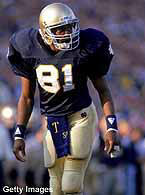
The image “http://images.nfl.com/photos/img7956658.jpg” cannot be displayed, because it contains errors.Brown arrived on Campus in the fall of '84 and promptly ingratiated himself to his teammates. "They called me Country Boy...they thought Texas was a hick state."

Tim saw the field as a freshman, playing third-string wide receiver and returning a few kicks. He got off to an ignoble start -- in his first game, he fumbled a kickoff and Purdue recovered.

The Boilermakers got 3 cheap points off the turnover, and ended up winning 23-21. Brown wasn't fazed. “I knew what I could do. It was just a matter of bouncing back.” Brown finished 1984 tied with Milt Jackson as the #2 receiver on the team.

The next year he started to make a few waves. Against Michigan State, he would return the first of many kickoffs in his career, a 93-yard beauty. It was the first Irish kickoff return for a TD in three years. Later in the game, he caught a 49-yard pass that set up another Irish touchdown.

Still, the Irish were laboring under the inept leadership of Gerry Faust, and were getting booed at home routinely. The offense was mostly a predictable and boring reliance on Allen Pinkett, a great talent, but over-utilized (immortalized in the slogan known to many Irish fans of that era: "Pinkett, Pinkett, Pass, Punt").

For Brown, the two years under Faust were “really tough. It’s nothing against him. He’s a great man and he did all he could. I just felt he was really in over his head.” Faust was fired and replaced by Lou Holtz after the season ended, and for Brown, this would prove to be quite fortuitous.

---------

“Who’s 81? He’s good." -- Beth Holtz.
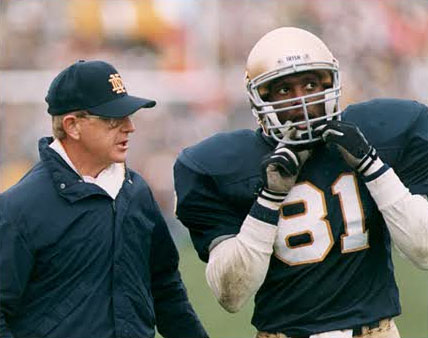
The image “http://www.irishlegends.com/irish/products/loutim.jpg” cannot be displayed, because it contains errors.When Lou Holtz arrived, everything changed for Brown. And for Holtz, discovering No. 81 on the roster was like finding a diamond in a coal mine. Holtz quickly decided that Brown was being underused, and found there were plenty of ways to get him involved in the offense. In addition to keeping him on the return teams, he bumped him up to first-string receiver, and even put him in at tailback in some wishbone formations.

“After three days of spring practice, I made the comment that Tim Brown may be the best football player I’ve ever seen," Holtz said. "He just grasped things. He has an awareness on the field of what he needs to do. He knows the down and distance and when to try to outrun someone and when to cut it back. It’s nothing you can teach or coach.”

This would be the dawning of the classic hybrid role that Holtz would install time and again, first with Tim Brown, and later with the Rocket.

It was the annual game against USC that really launched Brown's reputation as a premiere college football player. On that Thanksgiving weekend at the Coliseum, Tim had a 57-yard kickoff return, a 49-yard catch, and a 56-yard punt return. Brown had 13 touches and 252 all-purpose yards.

He finished out 1986 with 45 catches, 846 receiving yards, and 254 yards rushing on 59 carries, and 698 kickoff return yards, for a total of 1,937 all-purpose yards. He scored 9 touchdowns: 5 receiving, 2 rushing, and 2 on kickoff returns.

Brown had mixed feelings about running the ball out of the backfield. “I like running the ball because you have a chance to see where everybody’s going. But at this level, I don’t think I could take the punishment. "

Holtz agreed. “He’ll run physically, but if he does it on a continuous basis, he will not be the same player he is.”

-----------
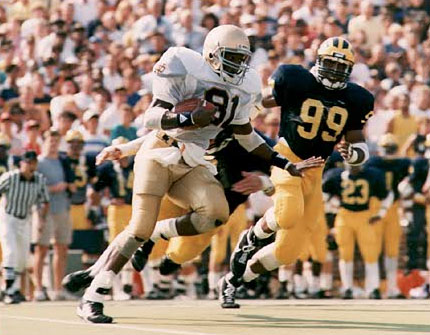
The image “http://www.irishlegends.com/irish/products/images/brown.JPG” cannot be displayed, because it contains errors.“What a move Timmy put on him. I don’t know where a dance is being held tonight, but that’s the only place you might see another move like that.” -- Lou Holtz.

1987 was the pinnacle of Brown's collegiate career, and the game against Michigan State was his finest moment. He returned not one, but two punts against the Spartans.

The first return was 71 yards, a beautiful tackle-breaking jaunt helped along by two key blocks. At one point Spartan cover man Todd Krumm taunted Brown as he ran up the field. "He was saying, Come on, come on," Brown related later. "So I came to him." One swivel-hip fake later, and Krumm was left in the dust.

The second return was shorter (66 yards) but much more impressive. ND put on a 10-man rush, and Brown had no blockers. In fact, “I was supposed to call for a fair catch” Brown said later.

“But we knew Greg Montgomery [MSU punter] had a 53-yard average. We figured he’d overkick the coverage, and that’s exactly what he did.”

Brown said he was going to run the return out of bounds for a short gain until he sensed the Spartans were overflying their mark. In a flash, he burst past all seven. He beat three others then raced toward Montgomery, the last defender.

“One and then another ran past me,” Brown said. “Then another one left his lane, and pretty soon it was just me and the punter.”

“I had to beat the punter. If I got tackled by the punter, I knew I’d hear it from my teammates.”

With a fake and a dodge, he put a beautiful move on Montgomery that buckled his knees and sunk him to the dirt.

Brown also caught 4 passes for 72 yards in the game. All told, he touched the ball 14 times for 275 all-purpose yards, and cemented his reputation as a legitimate Heisman candidate.

Brown was typically modest. “I think this game might have helped me out a little, but I think our defense deserves it more. They gave us field position.”

A few games later, Brown got to showcase how well he played without the ball. Against USC, he was held to only 109 all-purpose yards. Trojan coach Larry Smith had ordered squib kicks and high, short punts. Said Smith, “I’ll give them 10 yards on a kick with no return. I’m no dummy.”

Instead of carrying the offense, Brown threw several key blocks that paved the way for Irish scores.

He also had a long catch called back when an overzealouos referee called the play dead a little too early.

“The official told me it was an inadvertent whistle," Holtz said. "I couldn’t blame him. It’s natural from somebody who hasn’t seen much of Timmy Brown to think, on a play like that, ‘There ain’t no way that sucker can get out of this one.’”

-------------

“It’s nice to pick up a magazine and see my name mentioned with the Heisman, but star-gazing can hurt you. My feeling is if it happens, it happens.” -- Tim Brown
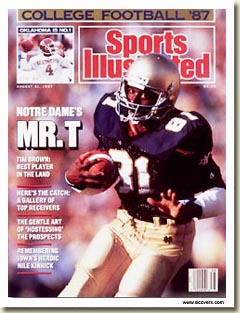
The image “http://i.timeinc.net/subs2/images/si/sistore/products/1987/0831_mid.jpg” cannot be displayed, because it contains errors.As 1987 wound down, No. 81 found himself the subject of deserving, but intense Heisman hype. Yet, none of it came from Notre Dame, or Brown himself.

The low-key response was vintage Brown. “No, I’m not worried about it. I’m only concerned that we keep on winning and that I go out and play good. They were talking about me winning the Heisman, but I think those guys (the defense) deserve it.”

Holtz, perhaps in a bit of creative oratory, seemed to downplay it while bringing it up. “We don’t plan on doing anything special for Tim Brown and the Heisman award.”

Still, the hype was there, and as often happens when you get too much of a good thing, national sentiment turned against him late in the season. Brown heard a lot of reasons why he wasn’t worthy. There was focus on a couple of dropped passes, some terrible losses against Miami and Penn State. As the year went on, teams started to short kick him, kick it away or squib it, and his all-purpose yardage totals started to diminish.

“Air Force kicks two out of bounds and three more so high I had to call for fair catches. The one I returned, I kind of thought he was trying to kick it out of bounds, too," observed Brown. He had 25 return opportunities in ’86; only about half that in 87.

Furthermore, there was a sentiment that the whole idea of "all-purpose yards" was somehow illegitimate.

As one letter to the editor put it, “How long will the nation’s sportswriters let themselves be duped by the inflated 'total yards' statistic pumped out by the ND publicity department on the behalf of Tim Brown? Total Yards includes kickoff return yards which, for each kickoff, contains about 20 yards of running through empty space before meeting any tacklers. I am a 38-year-old executive and even I could lumber for 15 yards per kickoff return."

Pitt fullback Ironhead Hayward, a Heisman candidate himself, jumped into the fray. “I thought the Heisman was supposed to be somebody who dominated his position, not somebody who runs all over the field playing hide and seek.”

Mike Downey of the LA Times wrote, “If TB played for any other school, there is no way he would have a shot at the Heisman. His statistics just didn’t measure up." And yet, in the end, Downey argued that there was nobody more valuable to his team than Brown. “So there is nothing wrong with awarding the Heisman to someone who was extremely valuable to his team, as Tim Brown has been, rather than someone who just piled up better statistics.”

Brown essentially concurred. “I’m not going to apologize for going to ND. I went there because I felt I could better myself as a person, and I found out it helped me in football also.”

--------------

"He’s incredibly valuable -- even when he doesn’t get the ball.” -- ND Heisman winner Leon Hart

In the history of the Heisman, runners and passers dominate. Even in the heyday of the two-way athlete, almost every winner was primarily a running back or a quarterback. And so it was something of an anomaly that Brown would win. He was only the 3rd receiver to take the award, the others being Johnny Rogers in 1972 and ND's own Leon Hart in 1949. Brown finished way ahead of the second place honoree, Don McPherson of Syracuse (the perennial trivia answer Gordie Lockbaum of Holy Cross finished third).

Although they were both receivers, Hart and Brown couldn’t have been more different. Hart was 6’5 and weighed 252 pounds, which was gargantuan for his era. He was a “giant end” who played both offense and defense.

Yet Hart admired Brown. “The important thing with Tim Brown is, he affects the game so subtly that anybody with a trained eye can see what’s occurring when the other team doesn’t kick to him and they loft the ball on a punt so that the teammates can get down under it. They only kick a 25-yard punt instead of a 40-yard punt, and Tim gained 15 yards just by standing there. So he signals for a fair catch and actually gains yards.”

“But the important thing is what Holtz does with him," Hart explained. "His talent is such that they double- and triple-cover him, they put him out wide to the right and then run the option opposite Brown, and the defense doesn’t have enough men left over the cover what ends up as the QB and the pitch man."

Brown responded to the award in his typical modesty, and shared the award with his team. “I thank God, and my coaches and teammates. I said from the start, this was a team award. It would not have been possible if they did not block for me or pass the ball to me. God bless you all, and thank you very much.”

Although the Heisman award is still populated by mostly QBs and RBs, Brown did pave the way for the consideration of other positions for the award, and both Desmond Howard and Charles Woodson owe a lot to his legacy.

(Random Heisman fact: an ND player has finished among the top 10 in Heisman ballotting 35 times in the 68-year history of the award.)

--------------

"I got my towel back. That was that.” -- Tim Brown

Perhaps the low point of Brown's career -- and it wasn't even that low, despite the negative publicity that surrounded the incident -- happened during the Cotton Bowl against Texas A&M in 1987.

In the 4th quarter, Brown was tackled on a kickoff return. After the whistle sounded, he chased an A&M player and tackled him from behind because he had stolen his towel.

It was a blue towel with gold trim and a “T 81” embroidered on it. A gift from teammate Cedric Figaro.

The towel thief was Warren Barhorst, a non-scholarship player who is the infamous “Twelfth Man” on A&M’s kickoff coverage team – a longtime tradition in A&M lore, where a student walk-on plays on the kickoff coverage team.

The score was already 28-10 when Brown was tackled and Barhorst landed on top of him.

Brown got up and ran about 20 yards towards the Aggie bench to catch up with Barhorst. Brown jumped on his back and fell with him to the ground. Benches cleared and surrounded the scuffle.

“Evidently, they had something planned on the sidelines. One guy held me down, and another guy took my towel. I didn’t mean to tackle him. It looked like I tackled him, I know. But I got my towel back. That was that.”

Brown did his part in the game. Returned the opening kickoff 37 yards, caught 10 passes, including a TD, and finished with 238 all-purpose yards. But ND got crushed, 35-10.

Incidentally, Barhorst had been in on only 5 kickoffs all season, and when he landed on top of Brown, it was his first (and last) college tackle. “What a way to end my football career,” Barhorst exclaimed jubilantly.

Brown is a first-ballot NFL hall-of-famer. Wonder what Warren Barhorst is up to these days.

--------------

“I’ve never seen anybody in this football game like Timmy Brown. His mere presence…his leadership...his blocking...the things he does without the ball.” -- Lou Holtz

Brown left ND as the all-time receiving leader with 2,493 yards. He accounted for 5,025 all-purpose yards, scored 22 touchdowns, and averaged 116.8 yards per game over his entire career.

Yet in a continuation of what seems a lifetime of underappreciation, many pro scouts were poo-pooing his accomplishments. Some were trumpeting Michael Irvin, Anthony Miller, or Sterling Sharpe as better pro prospects. Said Tampa Bay coach Ray Perkins of Sharpe, "He's more of a football player [than Brown]."

Brown ended up going 6th overall, to the Los Angeles Raiders. Aundray Bruce, Neil Smith, Bennie Blades, Paul Gruber, and Rickey Dixon were all picked ahead of him. Sterling Sharpe went one spot later, and Michael Irvin went 11th.

------------
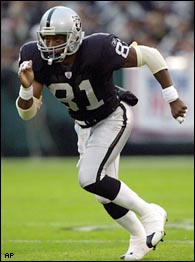
The image “http://sportsmed.starwave.com/i/magazine/new/tim_brown_b.jpg” cannot be displayed, because it contains errors.Brown and the Raiders couldn't agree on a contract right away, but Brown, in an act that seems completely foreign to NFL fans these days, still reported to camp anyway. He signed a temporary 1-year deal at half the going rate just to get in camp and get started (later he agreed to a 4-year, $2.8 million deal.)

In his first regular-season game with the Raiders, he returned a kickoff 97 yards for a TD. By the end of the year, he had broken Gayle Sayers’s league record for total yardage by a rookie with 2317 yards. He racked up 725 receiving yards, 50 rushing, 1,098 on KO returns and 444 on punt returns.

He was named to the Pro Bowl as a rookie kick returner, and also won the Rookie of the Year.

Jim Murray, the great sportswriter of the LA Times, looked back on the low expectations for Brown following his selection by the Raiders:

“So, the Raiders sighed and took what they could get. In this case, it was Timothy Donell Brown, of the Dallas, Texas, Browns, a nice enough young man, soft-spoke, dependable. He’d gone to Notre Dame, which was good, but he was a kind of what-is-it quantity on the football field, which wasn’t.

Then, too, he had won the Heisman Trophy. Now for those of you who think this would be a big plus, you haven’t been paying close attention. Heisman winners have historically been something less than sensational in the pros…besides, there was a notion that for a Notre Damer to win it, all he had to do was be able to frost a glass and not fumble too much.

It’s hard to believe the Raiders didn’t have high hopes for this terrific Tim. But kickoff specialists are a dime a dozen in the NFL. Even Brown’s Heisman didn’t stand out: there were three of them already on the team.

It’s hard to think of a Heisman-Notre Dame luminary, the most celebrated college player of his season as a surprise in his pro debut. But Tim Brown has made a lot of NFL owners look frowningly at their general managers.

Who would have thought you’d get a star like this out of a Heisman? Here’s a guy who started at the top and went up, who rose above the adversity of reputation. Before him, all-purpose used to signify a guy who did a lot of things – with mediocrity. Tim Brown does so many things so well, the Raiders should just be glad he never took up baseball."

In the first game of 1989, he blew out his knee and missed the rest of the season.

------------

“I hate that I have to ask to play football, but if it comes down to that, I’m going to do whatever it takes to get me on the field.” -- Tim Brown

Recovering from the injury took a lot longer than Brown anticipated, even after it was completely healed. He found that when he returned the team, he wasn't nearly as involved in the offense, and he soon was begging for playing time.

To be sure, he wasn't a "me-first" player by any stretch, not Keyshawn saying "give me the damn ball." Rather, he felt like he could contribute, and he didn't think he was doing enough.

“Every time you lose, you can’t help but ask yourself, ‘Is there anything more I could have done?’ Then, it starts to become an ego thing.”

Later, he explained how he went to talk things over with Al Davis. He described what the eccentric Raider owner said to him, mimicking his drawl: “Ya doing aw great job, Timmer, just keep it up. We love ya.”

But Al loved breakaway speed, long bombs and track stars. Willie Gault – fast as lightning, running the streak pattern -- was his prototype, not a dependable but boring over-the-middle possession guy like Brown. Brown was frustrated and contemplated leaving.

He thought a clause in his contract would make him a free agent after the season, but the commissioner ruled in the Raiders favor, and he was stuck with the team for another two years.

But rather than slinking into training camp and pouting his way through the season, Brown took the opposite approach. “I prepared myself harder than I ever have in the off-season. And I worked harder than I ever did in training camp. I wasn’t going to get the money, but I still play this game because I love it.”

He gradually worked his way back into the offensive scheme, and established a great chemistry with new Raiders QB Jeff Hostetler.

Jim Murray again, looking back on this period:

“The Raiders didn’t quite know what to do with Tim. He was a wide receiver but he also returned punts and kickoffs. Stumped, they put him on special teams.

Al Davis’s quarterbacks were known as mad bombers, blitzkriegers. His teams didn’t need the ball much. Let the other guys push it up through the mud. Davis’s teams struck like cavalry.

They had some trouble seeing Tim Brown in this scheme. Tim is not going to anchor the Olympic relay team. They liked his moves – on kickoffs and punts. They were less sold on fly patterns. One year, in 1991, he started only one game.

But gradually, one thing began to dawn on this Raider brain trust: When he was in there – usually on third and long – Brown would be as wide open as Dodge City on a Saturday night.

Brown perfected his craft. He studied defenders the way a pitcher studies hitters, but mostly he studied coverages. He found the soft spots, the open spaces in his opponents’ zones. He exploited them.

And now, Tim Brown is striking a blow for Heisman winners everywhere."
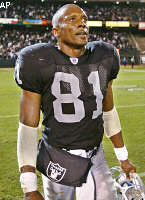
The image “http://images.nfl.com/photos/img6932375.jpg” cannot be displayed, because it contains errors.In ’94 he had his best season to date. He caught 89 balls for 1,309 receiving yards and made the Pro Bowl for the first time as a receiver, not just a special teams player.

And from there, he was simply one of the best players in the league for over a decade, and one of the best players in the history of the game.

Brown went on to capture almost all of the Raider franchise records: most pro bowls, most touchdowns, most receiving yards, most receptions, most yards from scrimmage, most punt returns, most 1,000 yard seasons (9).
  • Led the Raiders 11 times in receiving yards.
  • Was the only raider to score on a run, a reception, a punt return and a kickoff return.
  • Went to 9 pro bowls.
His overall NFL standing is among the top two or three at his position. He's had the most consecutive 50+ catch seasons in NFL history (11).

He's 2nd all time receiving yards in the NFL, after Jerry Rice.

He's 3rd in receptions all-time – and he could move up to second with 7 more catches.

And he's tied for 3rd in receiving touchdowns (100).

-----------
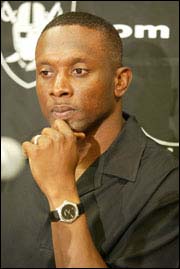
Last year, Brown was let go by the Raiders, and he elected to sign a one-year contract with the Tampa Bay Buccaneers rather than retire. At the press conference to announce he would no longer be a Raider, Brown was his usual honest, gracious self.

“This is a very emotional day for me. I gave my heart and soul to the organization. I battled as much as I possibly could on the field, and tried to restore the image off the field. Obviously coming in here, me being a Notre Dame guy, everybody said that I didn’t fit in here as the typical Raider. I have thoroughly enjoyed my career here. Mr. D and I have not always seen eye to eye, but we have always had respect for each other.”

For his part, Al Davis praised Brown. “One of the truly great players who has ever played the game, and obviously one of the truly great players that has ever played for the Raiders.”

-----------

“One thing I have never done is take the game for granted. I have always known that any given play could be your last.” -- Tim Brown

On Saturday, the Tampa Bay Tribune reported that Tim Brown will be joining Charlie Weis's staff in some capacity this year, although exactly what his role will be is dependent on if he chooses to play another year in the NFL at the same time.

"I will have some title there,'' Brown said of Notre Dame. ''And whatever the title is, it won't interfere with me playing ball - whether I play ball or do TV or whatever.''

Brown met Thursday with Notre Dame athletic director Kevin White to discuss aiding the Irish in their attempted return to prominence.

Brown's role likely will be decided during a future meeting with new coach Charlie Weis.

''Charlie's not in the loop right now,'' Brown said, referring to Weis' role as offensive coordinator of the New England Patriots. ''Once he's out of the playoffs, after the Super Bowl, we'll be able to come up with an official title and see if I can help with recruiting or be a player liaison or something so players there can have an outlet.''

Brown said it might be another month or two before he decides whether to retire as a player.

''I don't know if I'll make a decision before March or not,'' he said.

Brown said he intends to devote a lot of time to the Irish program if he decides to retire as a player.

'If I'm not playing I can have a lot more of an impact,'' he said. ''If I do decide to play ball, then it's up to what Charlie wants me to do. After the playoffs we'll have a chance to iron some things out.''


Whatever the exact timeline happens to be, it seems certain that Tim will be returning to ND, and fairly soon. Even if he plays another year in the NFL, it looks like he's pretty close to retiring, and when he does, we can expect his role and responsibility for the Irish to be substantial.

For a while in the mid-90s, I worked in El Segundo, California, where the Raiders had their practice facility, and I used to see Tim out at lunch a couple of times a year. Always had a smile for me when I mentioned the ND connection; always was gracious in talking to anyone who recognized him and said hello.

Like most fans, I remember Tim Brown for his great catches and his electrifying kick returns. I remember the games and the touchdowns, the Heisman award and the towel incident. I remember liking the Raiders just a little bit more when they drafted Tim, and I remember feeling some gratification that Brown was one of the few Heisman winners to actually live up to his billing.

But I'm glad I had the opportunity to take a look back over his career, and dig up some stories that maybe I'd missed or I'd forgotten. The complete picture of Tim Brown, the person, is one of not just God-given talent, but incredible honesty, integrity, and perseverance.

I can't imagine a better homecoming and sense of personal satisfaction for Tim in this next stage of his professional life, nor can I imagine a greater benefit for the University than having No. 81 back on campus. Congratulations, Tim: another brilliant run is about to begin.

Sunday, January 16, 2005

Pointless | by Dylan

As we head into the long dark of the post-bowl, pre-Big 12 vs. Division III portion of the college football year, I think it’s high time we diverted from the oblong and talked a little roundball. Hence, BGS’s first basketball post.

The image “http://www.nba.com/media/suns/thomas_notredame_200.jpg” cannot be displayed, because it contains errors.I have to say that, despite the gaudy 11-3 record, I am not terribly high on the Irish right now. At the end of last year, I was terrifically optimistic about the returning team, particularly with the addition of Latimore. I had visions of a top 10 squad and a return to the Sweet 16. But when I look at the schedule and the dearth of RPI-bouncing wins, I see a ten-loss Irish squad (potentially 9-7 in the BE) once again bubbling down the stretch to an eventual date with East Tennessee State or somesuch in the NIT.

Defensively, there are few places to find fault, so I won’t. But this team is an offensive enigma. When you take the parts individually, you see a team that should cruise into the mid-70s in every game, but they’ve scored more than 73 points only five times, and two of those games were the exhibitions against St. Joe and Quincy. Their output in their three (!) road games has been 60 (Michigan), 55 (Indiana), and 66 (SHU). So what gives?

My incredibly technical analysis of the situation is this: they are too guardable. Even Chris Thomas, who was an absolute ankle-breaker two years ago, seems to be unable to shake a defender. I’m trying to figure out how this could still be the case, since it was also true last year, and I can only think of two possible reasons. One, that Brey is unable to implement an offense that makes the most of the players’ abilities, or two, that the players are collectively unable to execute Brey’s offense. I tend to think it’s the latter. For the sake of brevity, I’ll settle on one primary culprit, and that’s the high pick-and-roll.

This is the second consecutive year of watching us butcher this most fundamental of offensive plays. It would be easy to blame the lack of effectiveness on Torin Francis, whose footwork seems to have been taught by a tag team of Tim Kempton and a Class Two Power Loader and whose hands make the Seattle Seahawks’ look like the Indianapolis Colts’. It would also be fair to question why Brey insists on using Francis when it’s clear that, were Francis ever to get the ball on the “roll” portion of the play, he does not have the “face-up” moves or the explosion to the bucket needed to finish the play. However, I think the problem really lies at the point. Thomas, who is generally running the point more effectively, doesn’t set up the semi-mobile Francis properly, and doesn’t force his own man into the screen. This generally results in one of two bad outcomes, either Thomas’ defender slides over the screen and Francis’ man does not have to fully commit to the switch, or Francis’ man simply abandons him and joins in a double team out of which Thomas refuses to pass. In either case the high pick works to the advantage of the defense, which is the definition of a poor offensive play.

This leads to phase two of the problem with the Thomas-Francis pick-and-roll combo. As Thomas tries to dribble out of a double team thirty feet from the basket, the offense just...slows.....down. What happens next is a hasty reset, some listless perimeter passing, and then a three. Luckily for the Irish, those threes have been falling pretty consistently (with the exception of the 9-30 effort against Syracuse). ND plays best when they shoot 15 to 20 threes a game. Chuck more than that, and they throw themselves at the mercy of the defense and the iron. That’s what happened against Syracuse. Threes became a substitute for offense. Thirty of fifty-two field goal attempts were threes. Against St. John’s, the number was thirty-four of sixty-five. That is simply not going to work on the road in the Big East, where they play seven of their remaining twelve conference games.

Mike Brey is the coach. He’s quite good. But I know he’s waiting to hear what I have to say, so here’s my three point plan:

“Alfordize” Colin Falls – Break out some tape of the 1986-87 Hoosiers. Run Falls through the lane, around baseline screens, curls, whatever. He’s a spectacular shooter, but his current M.O. of floating outside the three point line does not put enough stress on the defense. ND needs to make Falls a team-wide defensive priority for the other guys. Force their bigs to account for him on switches. Set up mismatches. Get them confused.

Let Francis Become His Inner Dale Davis – This is not meant as an insult. Dale Davis was a great NBA player. But he was never the first offensive option on any of his teams. He and Francis share the same plodding, two-footed jumping technique, the same stony hands, the same trouble initiating the break, and the same warrior’s heart. Francis (and Brey) needs to focus his game on his rebounding and shot-blocking abilities. He plays like he’s 6’8” at one end and 7’0” at the other. Let Latimore roam the offensive low post. Torin should be weak-side support.

Expand The Rotation and Solidify The Roles– I know, I know. Hit me with the Jere Macura jokes. But we need to have a Torrian Jones-type back on the floor. We need to have some semblance of an athletic “3” to get things moving, both in transition and in the half court sets. Quinn/Thomas, Quinn/Falls, and Falls/Cornette are near-redundant combinations. Carter and Cornett need to see more time. Cornette, though a nice shooter, needs to play more like a “3.5” than a “2.5.”

Are these tweaks even possible? You have to assume that Brey has tried, but the materials and the chemistry just aren’t there. I fear the best the Irish have to hope for this year is a return to the Wrong Final Four.

Saturday, January 15, 2005

Hord joins the Irish | by Pat

Notre Dame picked up its 12th* verbal commitment when Kansas City Rockhurst wide receiver DJ Hord picked a Notre Dame hat out of a duffel bag on NBC during the halftime of the US Army High-School All-American game. And while I wanted to write something positive about the talented Hord and the recruiting class that Charlie Weis is building, I have to talk about the sheer comedy value of the Game that Lemming BuiltTM. That is, after I shower to get rid of the creepy feeling I got from watching the broadcast.

Yeah, I admit to watching it. I thought it would be fun to put faces to the names and exaggerated 40 times seen on all of the recruiting websites. But instead I feel like one of the tools featured on the Rivals.com commercial. (For the record, Rivals, I don't need to know where a recruit is going before his momma does).

It seems that when NBC planned this game, they decided to flush any shame they had left after green-lighting The Biggest Loser. The overblown drama and utter seriousness of what really is just a glorified high school football game was at the same time both hilarious and embarrassing. I'll leave the irony and social implications of praising the "heart" and "dedication" of 18-year-old football players in front of a crowd of 18-year-old Army soldiers awaiting deployment to Iraq to someone else, and just point out some of my favorite highlights from the broadcast.

DeSean Jackson's hot dog 4.5-yard dive into the endzone from the 5-yard line (he broke free and was about to score when he decided to somersault into the endzone, came up a foot short, hit the ground and fumbled the ball) was undoubtedly the funniest/best moment from an otherwise sloppy, mistake-filled game won by the West 35-3. But you would never guess how ugly the game was by listening to the praise raining down from the announcers booth. I lost track of how many different players "stood out from the rest" and once the Boss Hog himself, Tom Lemming, began offering up his professionally amateur opinion, the word hyperbole surrendered. I'm pretty sure that half of the NFL Pro Bowl team was used in comparisons to kids still waiting to get lucky on their senior prom. (Okay, so I typed hoping, realized they are already playing football on national TV, and changed it to waiting.)

The only thing that could have topped the high-school-senior-to-Strahan comparisons arrived in the form of Jamie Newberg and his up-to-the-second Recruiting Top 10. Considering he was told all of the choices of the kids before the game (do you think they just happen to have the correct college fight song cued up over the PA?) his "predictions" early in the show weren't exactly a result of his keen insight. Seriously though, did we really need to know that Iowa jumped from outside the top 10 before the game, to 7 or 8 sometime in the 2nd quarter, before settling in at 4 at the end of the game? Why don't we just update the college basketball Top 25 on a bucket-by-bucket basis? Sadly, it's extraneous fluff like this that highlights the ugly business-and-bottom-line-aspect of recruiting, in what should be an otherwise fun day for these guys to just play a football game. If you need to fill the broadcast, how about a story about one of the kids' personal lives outside of football? You know, to humanize them a bit? They're not all just season stats and combine results. Come on NBC, I've watched the Olympics. That sort of stuff is your bag, baby.

Still, after yet another painfully tacky halftime performance and extended Arena League promo, I watched as Don Juan Hord chose Notre Dame -- proudly, and in coherent, complete sentences -- unlike some of the other guys on the show (we'll chalk it up to nerves, Ryan Bain). He joins previous All-American Bowl alumni like Carlos Campbell, Zach Giles, Chris Frome, Nate Schiccatano, Anthony Fasano, Brian Mattes, Jake Carney, Marcus Freeman, Scott Raridon, Bob Morton, James Bonelli, Maurice Stovall, Rhema McKnight, Travis Leitko, Brady Quinn, Travis Thomas, John Carlson, John Sullivan, Victor Abiamiri, Tom Zbikowski, Ambrose Wooden, Ryan Harris, John Kadous, Terrail Lambert, and Anthony Vernaglia.

Let's just hope that the All-American Bowl isn't the last bowl game that DJ Hord wins. Now if you excuse me, the All-American Bowl high school juniors -- yes, juniors -- combine results should be posted on the web soon.

* David Nelson's level of commitment to Notre Dame seems to be changing by the minute. Where's Jamie Newberg when you really need him.

Friday, January 14, 2005

Pleased to Meet Me | by Jay

The image “http://2walls.com/IMAGES/MUSIC/cd_replacements_meet3.jpg” cannot be displayed, because it contains errors.We've been up and running for just over a month now, and we're curious who's out there reading.

If you have a second, drop us a comment (link below) to say hello.


Grab Bag | by Jay

Just a few items to keep us going through the weekend.

Herring on the way

I'm sure you've seen it by now, but Florida safety prospect Ray Herring didn't simply commit to ND yesterday, he shot out of a cannon, with an infectious enthusiasm and effusive praise for all things Irish:

I WANT TO BE A MEMBER OF THE FIGHTING IRISH! Notre Dame is a special place. A really special place. The people are genuine and you can tell they truly care. The campus is spectacular and the coaching staff is second to none.

02raytalksaboutlettersCoach Weis has 26 years of experience, 15 in the NFL, and 3 Super Bowl rings. The assistants he has brought in are absolutely incredible. On his staff he has brought in three former college head coaches, former NFL assistant coaches and college coaches with great experience. My position coaches include Coach Bill Lewis, who coached the Miami Dolphins secondary for nine years, and Coach Brian Polian, who is young, enthusiastic, and has a strong resume coaching in college. Coach Polian is also the coach who has been recruiting me and his fire and passion for Notre Dame is contagious.

Notre Dame has an overall graduation rate of 99% among its football program, the best coaches in college football, an extremely talented team whose program boasts an unmatched record of success, history and tradition.

With a national schedule of top ranked opponents, national television and radio broadcasts, all combined with the best fans in the entire nation, how could anyone not jump at the chance to be a part of the Notre Dame family?

I spoke with Coach Weis today and told him that I wanted to call OUR other recruits and get them to South Bend. So, if you're a Notre Dame recruit and haven't committed to us yet, get ready because Ray's gonna be calling ya!

Come to Notre Dame, get one of the best educations in the nation, at the best university in the nation, with the best team and coaches in the nation! Come to Notre Dame and help us bring home a 12th National Championship to the Irish fans...maybe more! Oh yeah, one more thing... GO IRISH!!!

Great stuff from a great kid. And it's refreshing to see such unbridled optimism from a kid who hasn't even enrolled yet, especially in light of what some of our prominent alums in the media spewed forth about ND in the past weeks. As the Weis era unfolds, the future seems more and more sanguine, and statements like Aaron Taylor's "the mystique is dead!" harden and crinkle into what they really are: cheap, smug, self-serving brownie points. Taylor, Rocket and even Golic (to a lesser extent) jumped off at the first stop when they thought the bus was going to break down; instead, our ride's been revamped, retooled, and tricked-out. Right about now, I bet they're wishing they'd stayed on board.


Along Those Lines

From today's Chicago Tribune:
January 13, 2005, 10:52 PM CST

Another familiar face may be returning to Notre Dame. Wide receiver Tim Brown, the most recent of the Irish's seven Heisman Trophy winners (1987), might join the staff of new football coach Charlie Weis, himself a graduate of the university.

Notre Dame associate athletic director John Heisler confirmed that Brown was on campus on Thursday. Brown did not meet with Weis, who is in New England preparing for the Patriots' playoff game Sunday against Indianapolis. Heisler did confirm that Brown and Weis have spoken on the phone.

If Brown were to return, it likely would be as the team's director of player development. Though he wouldn't go on the road to recruit, he still could play a significant role in convincing top-tier players to commit to Notre Dame after they arrive for a campus visit.
I guess Tim didn't get the Aaron Taylor memo about dead mystique and all that.

Now I'm not usually given to irrational exuberance in this forum, but my reaction to Tim Brown returning home would go something like this.


An Oldie but a Goodie

While we wait for Fox to dream up a recruiting reality show for prime time TV (next week on The Recruit...David Nelson's got a surprise, and you won't BELIEVE what it is!) here's an old story about one of our favorite punching bags.
During my junior year in 1999, two of my female friends from Welsh Hall went off-campus to the 7-Eleven Store on the corner of Edison and Jefferson. They were shopping for snacks when they heard someone in the rear of the store banging on the hot dog machine (you know the kind -- the multi-pronged device capable of cooking up nasty 7-Eleven nostril-dogs at any time of day).

It turns out to be Bob Davie, who was having problems getting the little plastic door open.

According to my friends, when his last attempt to get the door open failed, Bob slammed his fist against the side of the machine and bellowed, "I swear, this whole town is trying to f--- me!"
I don't know what's funnier...Boob's interjection or the fact that he was noshing on hot dogs from 7-Eleven. I always wondered if anyone actually ate those rotating chunks of hardened grizzle. Now we know. (Thanks to Buddy Jeans over on NDN for the laugh).

Wednesday, January 12, 2005

Weekend at Charlie's | by Mike

Last recuiting season, college football fans around the nation got many laughs from a series of articles written by a highly coveted defensive recruit from Florida. The recruiting diary expressed Willie Williams' wide-eyed wonder ("He took me to the hotel. This place was beautiful, nicest place I've ever stayed. It was called The Radisson."), but also helped make Williams' criminal past public knowledge. Williams was eventually welcomed with open arms at Miami.

Before Willie's run-in with the law on his Florida trip, a few posters expressed concern that Williams' coach would allow a newspaper to exploit his player's naivete. Either a coach or parent should have stepped in and either pulled the plug on the series, or demanded some form of editorial control over the series.

This year, another highly coveted defensive recruit from Florida has kept a recruiting diary for a local publication. However, safety prospect Ray Herring demonstrates what the recruiting process looks like when a recruit has a strong support system in place. His latest entry also sheds light on the recruiting experience at Notre Dame under Coach Weis.

The entire article is definitely worth reading. Ray discusses the new facilities, his meetings with academic advisors, and how former WR Bobby Brown, currently enrolled at ND Law after a brief stint in the NFL, helps out with recruiting.

Many passages should make Irish fans optimistic about their chances with Ray (who cancelled his previously scheduled visit to Tennessee after returning from Notre Dame). For example, he states:

We then broke up into groups and toured the facilities. My group went right to the stadium. We walked into the locker room and I thought to myself about all of the great players who have walked through here before me, players like Jonny Lujack, Paul Hornung, Joe Montana, Joe Theismann, Bob Golic, Rocket Ismail, Tim Brown and Jerome Bettis, to name just a few.

All of the great coaches like Knute Rockne, Frank Leahy, Ara Parseghian and Lou Holtz. All of the National Championships, all of the All-Americans, all of the tradition. I thought to myself, how blessed am I? The locker room has big open wooden lockers and a big ND in the carpet in the middle of the floor.

I met the head football equipment manager Henry Scroope who had all of the NFL jerseys of their former players hanging at the lockers. It was amazing how many there were!

It is tempting to interpret Ray's comments as evidence of Weis's recruiting prowess. While I believe Weis will ultimately prove to be an excellent recruiter, Ray appears to be the type of recruit Notre Dame always does well with. He is humble, with an appreciation for the opportunities his athletic talent has created for him ("how blessed am I?"). His comments about academics seem far more sincere than your average recruit ("It was cool because you can tell that everybody loves the football program at Notre Dame but nobody is going to give you anything just because you are on the football team. You're expected to earn your degree just like every student there. That is important because I won't be able to play football forever!").

However, the most encouraging sign for Irish fans is the great parenting from which Ray has benefitted. An earlier Florida Today article profiled Ray's relationship with his father. Just as Kory Minor's mother did, Mr. Herring has helped Ray appreciate that he is making a forty-year, rather than four-year, decision.

"He tells me to always have a backup plan," the younger Herring said. "The best advice he has given me is to put education first because at any point in life, football can be taken away. We talk almost every day and I've never, ever seen him get down. He keeps me going. I look at him and he's never quit, so I have no reason to."

Ray already comes from a great family. Hopefully, he will soon find out what it is like to be a part of the Notre Dame family, too.