Okay, enough of the season retrospective: we got ourselves a bowl game to prepare for. Filing this report from deep behind enemy lines...
Living in Columbus, I could sense the unabashed enthusiasm for the Buckeyes building to a head way back in August, as Ohio State began this season as one of the primary national title contenders. After a heartbreaking defeat to Texas and a lackluster misstep in Happy Valley, the momentum waned, and it appeared the campaign might get away from them. But similar to '04, when they stood 3-3 at their lowest point in October, the Buckeyes pulled themselves together and finished the season very strongly. After six consecutive wins, they close the season by circling back to where they started, once again acknowledged as one of the best teams in the country.
Ohio State (stats
here) features one of the most respected defenses in college football, an offense that has become surprisingly proficient and a handful of the most talented players in the nation. Suffice it to say that a victory over the Buckeyes in Tempe on January 2 would trump every doubt about the strength of Notre Dame's football team (doubts that linger even after nine regular season wins, and putting Southern Cal's feet to the fire like no other opponent has during the Trojans' ongoing 34-game win streak).
 The offense.
In spite of the criticism that head coach
Jim Tressel and longtime offensive coordinator
Jim Bollman are continually peppered with by OSU supporters over what is perceived to be a rudimentary and overly conservative offense, the 2005 Buckeyes have been both effective and balanced in their attack. Ohio State ranks 28th nationally in scoring offense and 37th in yardage accumulated, averaging 190 yards rushing and 215 passing per game. Following a woeful performance at Penn State when they accumulated 10 points and only 230 total yards, the Buckeyes bounced back to average 39 points over their remaining six games, winning as much with offensive firepower as defensive might.
It wouldn't be particularly unusual to say that a team's offensive fortunes go as its quarterback does, but that's probably more true of Ohio State and
Troy Smith than it is anyone in the country. Smith was once viewed as someone who might ultimately find himself and his noteworthy package of physical skills shuffled off to another position in college, but he has fully come into his own this season as the starting quarterback of the Buckeyes. Smith has improved his performance immensely since 2004, as his completion percentage (62% compared to 55%), yards per attempt (9.3 versus 7.3) and touchdown/interception ratio (3.5 against 2.67) all illustrate clear growth as a passer. He currently ranks sixth nationally in passing efficiency, just two spots behind Brady Quinn. As Smith has grown more comfortable and successful in his play within the pocket, so too has the Ohio State offense become more consistent and dangerous.

Smith can make opposing defenses pay with his legs, as well, averaging almost 55 yards and over a touchdown rushing per contest this year. His success running has resulted from a balanced mix of designed plays and improvisational scrambling, and Rick Minter and the Irish defense will have to commit resources otherwise focused on the intermediate attack to containing Smith. Related in part to his running, the single largest pressure point in Smith's game is his tendency for fumbling the football. In total, he's put the ball on the ground nine times this year, with the opponent recovering four of those. It's not a glaring shortcoming but something to keep in mind when Smith is running loose, especially in a game likely to hinge on events like unexpected changes of possession.

In its more traditional running attack, Ohio State turns primarily to sophomore
Antonio Pittman. Pittman is a dependable back who is deceptively effective without possessing overwhelming size (5'11", 200) or speed. He averaged nearly 5.4 yards per carry during the regular season, a more than respectable mark in Big Ten play, especially when compared to more celebrated in-conference peers such as Minnesota's Laurence Maroney (5.3 ypc) and Wisconsin's Brian Calhoun (4.5). Tressel likes to use Pittman to grind out yards, maintain a steady offensive tempo and control the clock. To the extent that the Irish are able to deny OSU's lead back and force the Buckeyes to alter their offensive philosophy, it will likely be to their benefit.
Of the three games in which Pittman has been held under 85 yards this season, the Buckeyes have lost two. Ohio State rarely turns elsewhere when it looks to run, as backup tailback Maurice Wells has accumulated most of his 61 carries during garbage time. Fullback Dionte Johnson hardly ever touches the ball, indicative of Bollman opening up the offense with more spread looks and three-receiver sets as the season progressed.
Ohio State's receivers offer Notre Dame a variety of threats. Their best and most accomplished wideout is junior
Santonio Holmes, who shows off an enviable mix of natural athleticism and polished receiving skills.

He has the ability to make a living running intermediate routes but also possesses the burst to challenge most any cornerback on a deep route. Holmes has fewer catches than he did in 2004 (48 compared to 55), but his yards per catch average has shot up from 14.0 last year to 17.8 this season. He has nearly twice as many receiving touchdowns (10) as all other Buckeyes combined (6).
Ted Ginn Jr. (#7, left) entered 2005 spoken of as a legitimate Heisman candidate, but he's endured the proverbial sophomore slump, suffering more than his share of dropped passes and fumbles (seven of them -- three lost -- between his work on offense and special teams). Still, Ginn has world-class speed and is as dangerous as any player in college football with the ball in his hands, so he is someone who must be personally accounted for on the field at all times.
Anthony Gonzalez is better than the average third receiver and someone who can hurt an opponent overcommitting on Holmes and/or Ginn. He played an integral role in several Buckeye wins this year. Ohio State doesn't generally make much use of its tight ends, but senior
Ryan Hamby (out for the past month with a knee injury but probable to return for the bowl game) and sophomore Marcel Frost can probably be counted on for a catch or two.
Ohio State features a mostly veteran offensive line that includes two all-Big Ten performers who also happen to be three-year starters (C Nick Mangold and LG Rob Sims). As expected based on the balance in offensive output, the Buckeye line is similarly adept at drive blocking as well as giving their quarterback a stable pocket from which to throw. The intriguing matchup between this unit and Notre Dame's thin but capable defensive line may be the most important battle in determining the outcome of the war in Tempe.
 The defense.
Though the offense has taken on an increasing amount of the burden in recent games, Ohio State's defense is still the backbone of the team, in spirit as well as statistical measures. They rank fourth nationally in points allowed, seventh in yardage allowed, first in rush defense and eighth in pass efficiency defense. They feature seven starters who are seniors, all of whom also started in 2004. Seven OSU players on the defensive side ended the season by earning all-conference honors. Their Lombardi Award-winning linebacker might not even be the best player within the unit. In summary, this is the best defense and biggest challenge that Charlie Weis and his Irish team will face all year.
However, it's not an entirely infallible crew. Because of the matchup against ND's high-powered offense, much has been made of the fact that the Buckeye defense has accumulated its impressive stats in spite of playing four regular season games against top-ten offenses. While technically accurate, it should also be noted that Ohio State lost one of those four games (
vs Texas) and allowed a combined 66 points and over a thousand yards of offense in two of the others (
vs Michigan State and
vs Minnesota).
The most vulnerable aspect of the Buckeye defense is its pass defense, and this coincides nicely with the best and most dependable facet of Notre Dame's offense, which involves Quinn distributing the ball to his big, talented receivers. The opportunity is there for the Irish to score points.

Though perhaps not as disruptive as past editions, the Buckeyes feature a solid front four that can penetrate and create pressure on its own. Defensive end
Mike Kudla has finally realized his potential and is the lineman most likely to pressure the quarterback, while junior
David Patterson showed promise as a first-year starter.
Marcus Green and the underrated
Quinn Pitcock handle most of the work inside at defensive tackle. This group doesn't feature the sort of individual stars that past Buckeye defensive lines have, but the 2.36 yards opponents are averaging per carry on the ground against Ohio State attest to the quality of their play.

Ohio State's focal point on this side of the ball is its celebrated crew of linebackers. Senior
A.J. Hawk won the Lombardi Award last week and is likely to be a consensus All-American selection, as well as a high NFL draft pick. Hawk combines great quickness and size with an uncanny ability to work in traffic and find the ballcarrier. It is likely that his name will be called early and often when the Irish have the ball. Senior
Bobby Carpenter
broke his fibula on the first play of the Michigan game, and those who have followed the Buckeyes closely this year understand what a damaging blow his absence would be to an OSU team faced with a pass-happy opponent. Co-defensive coordinators Jim Heacock and Luke Fickell have had tremendous success this season shifting Carpenter to rush end in passing downs, and losing that flexibility would negate a legitimate weapon in thwarting the Irish attack. It is possible that Carpenter will recover in time to play in the Fiesta Bowl, but how effective he might be even if able to suit up is another question entirely.
Anthony Schlegel is the forgotten member of this linebacking corps, but he's an experienced and steady performer, finishing the season second on the team in tackles. When 100% healthy, there's not a better set of linebackers in the nation.
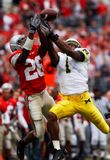
You wouldn't know that opponents had enjoyed any amount of success against Ohio State's secondary based on the Big Ten awards, as three-quarters of the Buckeyes' defensive backfield made first-team all-conference. The Buckeyes will challenge ND's tall, physical receivers with larger corners,
Ashton Youboty (6'1", 188) and
Tyler Everett (5'11", 196). Youboty is the more accomplished of the two, and Quinn will probably pay close attention to where he'll be lined up throughout the game. The safeties are perhaps even better, with resident intimidator
Nate Salley terrorizing receivers trespassing in the middle of the field from the free safety spot, while junior
Donte Whitner mans the strong safety post. If Bobby Carpenter is unable to play or limited in some respect, it's likely that the Buckeyes will often shift to a modified nickel set, with promising junior
Brandon Mitchell, a big-hitting safety with linebacker size (6'3", 205) supplanting him. Interestingly, in spite of the talent and reputation of the defensive backfield, the Buckeye secondary accounted for only five interceptions as a group during the regular season.
 Special Teams.
Most outsiders expected Ohio State to suffer dearly in 2005 after losing Lou Groza winner and second-round NFL pick, kicker Mike Nugent. However,
Josh Huston had backed up Nugent for the balance of his career and made the most of the opportunity to step out from his predecessor's shadow this season, connecting on 20 of 24 field goal attempts and all but one of his 41 extra points. Huston wields a strong leg capable of kicking field goals from 50 yards without difficulty, and he isn't likely to give the Irish much of a chance to do damage returning kickoffs.
Ted Ginn returns both kicks and punts for the Buckeyes, though he's been much more successful doing the former this year, ranking third nationally in averaging 29.6 yards per return. However, Ginn's aforementioned fumbling problems cannot be ignored, as he dropped the ball twice on returns in Ohio State's most recent win over Michigan. Given that he's also returned six punts or kicks for touchdowns in less than two years playing at the college level, Ginn makes for the ultimate risk/reward proposition on special teams.
It's difficult to find an appropriate antecedent for Notre Dame among Ohio State's opponents this year. The two teams who beat the Buckeyes this season did so behind A) great defense and B) quarterbacks who neutralized OSU's defense with their ability to sustain drives with their legs. The Irish enter the game presenting a completely new repertoire of talents and tendencies, and it's one that Ohio State isn't altogether familiar with in their experiences this season.
The best comparison is probably Michigan State, a team with a strong, accurate quarterback and a dynamic, pass-first offensive attack. In that game, the Spartans more than held their own during the first half and appeared to be in line for a big road win. However, a huge Michigan State
special-teams blunder just before halftime resulted in a ten-point swing (and sparked a memorable John L. Smith halftime meltdown). The Spartans' mistake shifted the momentum for both teams in the second half, and sent their fortunes over the remainder of the season spiraling in opposite directions.
Keys to the game:1. Winning the special teams battle. As illustrated just above, special teams are going to be critical. Charlie Weis made improvement in this area one of his priorities when he took the job, and though the Irish have had their share of shining moments here during the season, the performance in general has tapered off over the past month. The team needs to focus on containing the Buckeyes' dangerous return men, something that their snuffing of Reggie Bush on punts back in October proves that they are capable of accomplishing. The kicking game nearly cost the Irish a victory in the regular season finale at Stanford, and they can obviously use the December downtime to get D.J. Fitzpatrick healthy and this particular package sorted out. In a game between well-matched teams, the "lost yardage" that Weis has mentioned in the special teams area becomes that much more valuable.
2. Limiting Antonio Pittman. Although not the focal point of the offense, negating Antonio Pittman would have a significant impact on the outcome of this game. Pittman's hardly the cover boy of this Buckeye team, but he's the underlying heartbeat that keeps the offense's blood pumping. Quarterback Troy Smith is averaging just 20 passing attempts per game and has thrown more than 26 passes only once all season. Taking away the clock-grinding runs that Pittman provides would push the Buckeyes out of their comfort zone and likely give an Irish defense that's more opportunistic than stifling that many more chances to make a big, game-defining play.
3. Giving Brady Quinn time and space to do his thing. On the other side of the ball, ND must give Quinn adequate protection to throw the ball. While it is likely that Weis will come up with a few wrinkles that will allow his team moderate yardage on the ground, Notre Dame is going to have to throw the ball effectively first in order to crack Ohio State's defense. It's imperative that Quinn is able to set his feet on most throws and doesn't spend half of the afternoon on his back. To that end, part of that responsibility will be shouldered by the quarterback himself in recognizing at the line of scrimmage when and from where extra pressure will come and taking advantage by exploiting the resulting hole(s) in the defense. With one of the more intelligent quarterbacks in the game as directed by Weis matching wits with a swarming defense led by a very sharp Buckeye staff, this should be a fascinating chess match to observe for the duration of the contest.
In my estimation, there isn't a team in the nation Notre Dame could have been paired with (outside those competing in the Rose Bowl) who would offer them more of a challenge and a tougher measuring stick than Ohio State. By winning the Fiesta Bowl, the Irish can stake a claim to being the best team in the country not playing in Pasadena and bolster their prospects as a primary championship contender for 2006.
Irish detractors have saturated the airwaves, the print media and the internet the past several weeks, clamoring about "undeserved" BCS bids and bowls who pick teams for all the wrong reasons. Throughout, Notre Dame's coaches and players have mostly stayed mum on the issue, exuding quiet confidence and giving the impression of knowing something that the enraged masses do not. The team's best performances this season have generally come when the least was expected of them, and I believe that this underdog status will play in their favor against an Ohio State team celebrated as one of the hottest teams in the country.

My experience with OSU fans regarding Notre Dame's chances since the official announcement of the Fiesta matchup ranges widely from casually dismissive to respectfully uneasy and all points in between. A vast majority acknowledge the quality job Weis has done at ND this year, though many believe that Ohio State is just playing too damned well and has too many weapons to be vanquished. Given Tressel's recent record in bowl games --
four three consecutive wins, including both previous trips to Tempe -- their confidence is justified.
The hype surrounding two traditional powers colliding in a bowl for the very first time is already at a fever pitch. In the end, I expect another one for the ages, likely decided by a touchdown or less.


 But, the team did it, they drove the field, they got the ball in the endzone, thus sealing the win and wrapping up a bid to the BCS. Afterwards, everybody, Domer and Cardinal alike, was invited down onto the field to haul off a piece of turf, which was really akin to tearing down the stadium itself, since the whole structure was nothing more than sets of

