Tuesday, November 22, 2005

Would You Like to Play a Game? | by Jay

(First things first: Pick Six is updated from the latest BCS standings.)

Remember in the movie WarGames when Joshua started running through all the different variants of Global Thermonuclear War? That's what the BCS landscape looks like right now: a million different options, and many of them disastrous.

Believe it or not, there are eighteen different teams that still have a shot at a BCS bowl, and sixteen different games between now and December 3rd that still have some bearing on the BCS outlook.

How many possible outcomes are we talking about? I broke out my old Finite Math 101 textbook and started doing some permutations and combinations, but it quickly got to be too much. Instead of working out all the possibilities, we simply tried to lay out each team's fortunes as best we could. Click here for the master matrix.

Take a gander. Comments and clarifications are most welcome.

Sure shots. Penn State and Southern Cal are already in. Yep, Southern Cal would win the Pac 10 -- even with a loss to the Bruins, according to the arcane Pac 10 bowl selection criteria. If UCLA beats Southern Cal, there will be a three-way tie for the Pac 10 among the Trojans, UCLA, and Oregon. UCLA would be the first team eliminated from the tiebreaker, due to a loss to Arizona (whom USC and Oregon both beat). USC would then trump Oregon with a head-to-head win, and win the Pac 10.

The Longest Shot. Did you know Iowa State still had a shot at the BCS? Neither did we, until we started looking at all the possibilities. The Cyclones can win the Big XII with a little help, and a whole lot of luck. They've got one regular game against Kansas which they must win. Couple that with a Colorado loss against Nebraska, and they'll win the Big 12 north and go to the conference championship game. Then all they have to do is beat Texas.

Keeping in mind this year's BCS bowl priority system, let's do a little forecasting.

Probable scenario. This is how we (and most of the rest of the hoi polloi, including Pat Forde) think it'll probably play out:

Most Likely:
Rose
- USC vs Texas
Fiesta - ND vs Ohio State
Orange - Penn State vs Virginia Tech
Sugar - LSU vs West Virginia
The drama here is who will get the second at-large invitation after Notre Dame, with Ohio State and Oregon being the two most touted contenders. Oregon, by the way, is going full-throttle on the PR campaign to sway Fiesta Bowl officials that they should be the second at-large pick.

Possible scenario. What if Texas were to lose a game, either to A&M or Colorado? (Don't scoff -- when's the last time Mack Brown went undefeated?) Penn State might move up to #2 and go to the Rose to play USC, with either Texas or Colorado playing in Tempe. Orange would then get the first at-large pick, and you might have something like this:
if Texas loses:
Rose
- USC vs Penn State
Orange - Virginia Tech vs Notre Dame
Fiesta - Texas (or Colorado) vs Oregon
Sugar - LSU vs West Virginia
Possible, but ridiculous scenario. Yeah, it could happen -- a slew of terrible teams still have designs on the BCS. Here's what it would look like.

Texas drops both game; Iowa State sneaks in. Florida State drops its game to Florida but still wins the ACC. Georgia loses to Georgia Tech, but wins the SEC. Pittsburgh backs into the Big East. Notre Dame loses to Stanford. The BCS doomsday scenario might look like this.
all Hell breaks loose:
Rose
- Penn State vs USC
Orange - #24 Florida State (8-4) vs Ohio State
Fiesta - unranked Iowa State (9-3) vs Oregon
Sugar - unranked Pittsburgh (6-5) vs #15 Georgia (9-3)
The only option...is not to play.

The Quotable Charlie Weis | by Pat

From today's presser, another entry for the "Best Of" Charlie press conference quotes.

Now, let's talk about their defensive line. There's one guy who I like. I don't know him, but this guy (Chris) Horn, No. 95, I like him because he lists his favorite place that he's been on vacation as the Jersey Shore. I'm going to have to look him up because he's already on my good side. He actually splits time with (Gustav) Rydstedt, who's actually a kid from Sweden, so it's an interesting combination, a guy who loves the Jersey Shore and a guy from Sweden.

Schedule's out | by Jay

'06 and '07 are now set in stone.

2006
Sept. 2 at Georgia Tech
Sept. 9 Penn State
Sept. 16 Michigan
Sept. 23 at Michigan State
Sept. 30 Purdue
Oct. 7 Stanford
Oct. 21 UCLA
Oct. 28 at Navy *
Nov. 4 North Carolina
Nov. 11 at Air Force
Nov. 18 Army
Nov. 25 at USC
* in Baltimore
2007
Sept. 1 Georgia Tech
Sept. 8 at Penn State
Sept. 15 at Michigan
Sept. 22 Michigan State
Sept. 29 at Purdue
Oct. 6 at UCLA
Oct. 13 Boston College
Oct. 20 USC
Nov. 3 Navy
Nov. 10 Air Force
Nov. 17 Duke
Nov. 24 at Stanford

Notes:

• Army, which we heard rumblings about being the 12th game, is now official for the '06 season.

• Bye weeks: before UCLA in '06, before Navy (and just after USC) in '07.

• The beginning to '07 is fairly rough: eight straight games against decent competition without a breather, culminating with Southern Cal.

• "at UCLA" in '07 has the potential to be one of the better road trips in recent memory.

• How strong are these schedules? Tough to say, and too early to tell. '06 is a real cipher: the resurgent Penn State, UCLA, and Georgia Tech squads give the appearance of strength, but we saw what happened to our schedule this year, the most "brutal schedule in college football". Preseason AP had Southern Cal #1, Tennessee #3, Michigan #4, Purdue #15, and Pitt #23, with Notre Dame nowhere to be seen. Two of those teams have survived the top 25, one just barely.

• That said, I like our chances in '06. With almost every important cog returning for another year, things look good for a National Championship run. (2007, on the other hand, could be a little bit of a rebuilding year once Brady, et. al., graduate.)

If we win the NC in '06, remember, you heard it here first.

Monday, November 21, 2005

Odds & Sods, Screwdriver Edition | by Mike

Sundry thoughts about Syracuse...

Race for the prize. Darius Walker rushed for 123 yards and 1 touchdown on 26 carries. This gave Walker his sixth 100-yard game of the season and brought him within 80 yards of a 1,000-yard season. Most importantly, Walker's 37-yard run in the first quarter gave him the Irish's longest run of the season. Prior to the Syracuse game, this honor belonged to backup quarterback David Wolke, who had a 22-yard scamper in the fourth quarter of the Pittsburgh game. Thus Irish fans have been spared an offseason of message board whining about how our running back couldn't put up a longer run than the backup quarterback. Given how little there is to be unhappy about under Weis, you know the Master Shakes among the Notre Dame fanbase would have latched on to this one.

Wave of mutilation. Linebackers Brandon Hoyte and Corey Mays crashed through the Syracuse offensive line all day. Mays finished with 10 tackles, 3.5 of which were for a loss. Brandon Hoyte contributed 5 tackles, 2.5 of which were for a loss. Part of the reason the two were in the Syracuse backfield for most of the game was defensive coordinator Rick Minter's willingness to bring pressure and utilize the delayed blitz. Nonetheless, it was great to see the two seniors who formed the heart of Notre Dame's defense put up these numbers in their final game in Notre Dame stadium.

Marquee moon-ey. Charlie Weis declared that Marty Mooney's 16-yard strike to fellow senior walk-on Michael O'Hara was his "favorite play of the game." However, O'Hara is probably only Mooney's second favorite receiver. As happy as Weis was with the play, it's telling that Mooney was only given the opportunity to pass when the down, distance and game situation called for it. When the play was called, Notre Dame was in third-and-long and needed a first down in order to run out the clock. Given what we've seen from Charlie, I think this is the only situation in which he would have allowed Mooney to throw. Although Wolke and Mooney have combined to finish out all but three games this year, they have only been allowed to throw a combined four passes. Charlie's not one for needlessly throwing on a defeated opponent.

999 problems. As of the close of the Syracuse game, Biletnikoff finalist Jeff Samardzija has 999 receiving yards on the year. With just one more yard, he will become Notre Dame's first 1,000-yard receiver in thirty-five years. Maurice Stovall is not far behind with 887 yards, and Anthony Fasano has 545 yards. In twelve games last year, only Rhema McKnight (610) and Matt Shelton (515) had more than 400 yards receiving.

Let's get known. All 34 seniors saw playing time against Syracuse. Throughout the week, Weis reiterated that the theme for the Syracuse game was sending the seniors out the right way, and that is exactly what Notre Dame did. While Syracuse ultimately scored a touchdown when Weis emptied the bench on Syracuse's final drive, the Orange offense had their hands full against Notre Dame's senior walk-ons and reserves. Syracuse needed fourteen plays and two fourth-down conversions for their first-string to score against this group. While I would have loved to have seen the defense hold Syracuse on one of the fourth downs and keep the Orange out of the endzone, these players - many seeing their first game action - gave another team's frontline players all they could handle.

This protector. Just as he did against Michigan and Purdue, Ambrose Wooden once again used his blazing speed to make a game-saving tackle. In the first quarter, Wooden caught Syracuse running back Damien Rhodes from behind, putting an end to Rhodes's 51-yard run at the 14 yard line. The Syracuse offense then proceeded to sputter and was forced to settle for a field goal. This refusal to give up on plays explains why Notre Dame stands 37th in scoring defense despite the yardage the defense has given up this year. This play also provided a stark contrast to the 2003 Syracuse game, where the team gave up long before Brady Quinn took a knee on the final play. Both games illustrated Weis's truism that "the attitude of the head coach will be permeated through the players."

This and that | by Pat

Eric Hansen of the South Bend Tribune has a nice round-up article on the past weekend talking about BCS implications, Brady Quinn staying for his senior year, recruiting, and Weis' chances at being named National Coach of the Year. Check it out.


For those watching the game on NBC, you may have missed that Weis had the seniors take a lap around the stadium after the game before they walked off the field for the final time. Here is video from irisheyes.com of the moments on the field following the end of the game. You don't quite get to see the victory lap, but it's a unique perspective that not many get to see.


Continuing with the more aggressive PR stance they have taken this year, Notre Dame has set up a few pages on the und.com site to promote and highlight the various Fighting Irish players up for post season awards.

Now, I'm not a big fan of the heisman websites and cheesy promotional tie-ins you hear about every year, but I like the fact the school is at least recognizing that players like Quinn are in the race for some pretty prestigious awards.

Here is a link for the rundown of the major award candidates. Besides Quinn, Fasano, Stovall, Samardzija, Hoyte, and Zbikowski are all featured. Quinn also gets his own web page, complete with video highlights and links to various media articles. Enjoy.

Saturday, November 19, 2005

Friday, November 18, 2005

61* | by Jay

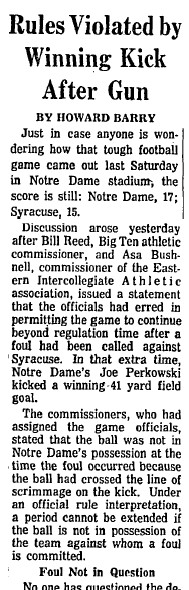
Roger Maris's record wasn't the only asterisked event in the fall of 1961. Today's the anniversary of another controversial outcome: Notre Dame's victory over 10th-ranked Syracuse on a "do-over" field goal with no time remaining.

Seventeen seconds were on the clock when the Irish hauled down Syracuse back, and eventual Heisman Trophy winner, Ernie Davis just short of a first down on their own 30, and the ball turned over on downs. Seventy yards from the end zone, the Irish were trailing 14-15, and had just seventeen seconds to get into field goal range.

Frank Budka, ND's sophomore quarterback, scrambled out of the pocket on first down, making it to midfield, but eating up nine precious seconds. Eight seconds left. Budka then hit George Sefcik who stepped out of bounds at the Syracuse 39. The clock showed three seconds remaining.

Placekicker Joe Perkowski lined up for the 55-yard try. The snap came back, and Sefcik, the holder, grabbed the ball, but was hit by the onrushing Syracuse end Walter Sweeney as Perkowski kicked. The ball came to rest far to the right, in the field of play. Apparently the game was over.

But then a flag fluttered onto the field -- the head linesman had called a foul on Sweeney, roughing the holder. They marked the ball 15 yards closer, and Pekowski got another chance, this time booting it through the uprights.

Thousands of students rushed the field, mobbing the Irish players and attempting to bring down the goalposts. The Irish had won, 17-15.

The next day, the commissioners of the Big 10 and the Eastern Intercollegiate Athletic Association (Syracuse's conference) issued a statement that the officials had erred in permitting the game to continue beyond regulation after the foul (the Big 10 and the EIAA had supplied the officials for the game.) They contended that the ball was not in Notre Dame's possession at the time the foul occurred, because the ball had crossed the line of scrimmage on the kick. Under an official rule interpretation, a period cannot be extended if the ball is not in the possession of the team against whom a foul is committed, and since ND had given up possession on the kick, there could be no extension of time for a second kick. That was their contention, anyway.

This kicked off a war of press releases. Father Joyce, then Executive VP at Notre Dame, issued the Irish response almost immediately.

"We are quite surprised at the developments following our last-minute victory over Syracuse. We felt and will still feel that the officials made the proper decision on the field. The infraction occurred before the clock ran out and before the ball was dead. Therefore, it seems mandatory that a penalty be invoked. It is strange that the officials now feel otherwise.

At any rate, the interpretation given to the basic NCAA football rules as it applied to the point in question seems to us to be both ambiguous and illogical."
Lew Andreas, the athletic director at Syracuse, then said this in a terse, two-sentence statement:
"It is certain that, except for the misinterpretation of the rule, the game would have ended with Syracuse ahead 15 to 14. The rule in question is explicit."
The interpretation apparently took no notice of a rule pointed out by Notre Dame which said that in the case of the field goal try, possession remains with the kicking team if a roughing penalty is accepted. Joyce was flabbergasted.
"The lack of logic in their ruling is overwhelming. The game didn't end the second the ball left the kicker's toe. The only way a penalty means anything in this case is another play."
But Father Hesbrugh, in a television interview, hinted at a possible forfeit.
"Obviously it is a question of interpretation of the rule. Everybody knows Notre Dame doesn't want to win a game if it really didn't. If the rules committee determines that we didn't, we'll act accordingly."
Both schools asked for a ruling from the NCAA. A couple of days later, the chairman of the NCAA rules committee, Gen. Bob Neyland of Tennessee, issued a one-man decision that the field goal was illegal, and the win, therefore, tainted. However, instead of rolling over, as Hesburgh hinted ND would, Joyce fired back again, sending a letter to the NCAA and asking for a judgment by the full NCAA committee. At ND's athletic banquet in early December, Joyce explained the stance they were taking. The Chicago Tribune covered the story:
The Rev. Edmund P. Joyce, Notre Dame's executive vice president and chairman of the faculty board in control of athletics, said tonight that the university had stood firm against the obvious gesture of giving away the disputed Syracuse football game because an important principle was at stake.

Expressing his reluctance to draw out a matter which had been decided by the players and the officials on the field, he said that he was discussing it only because he felt that the group before him expected and was entitled to a statement...

He said that it is up to the NCAA rules committee to clarify the rule so that never again will any school be put in the embarrassing position of Notre Dame.

"We were the team which was fouled, yet it was made to appear that we were attempting to squeak through to a questionable victory in one of the most exciting finishes ever," Father Joyce said.
Finally, a month later, the NCAA reviewed the rule again and issued an amendment. Under the amended rule, Notre Dame, as it did on the disputed play, would get an extra play under the same circumstances. Notre Dame and the officials on the field that day were proven correct. Today the amendment takes the form of the rule that a game may not end on a defensive penalty.

Thankfully, Father Joyce hung tough in the face of controversy, and in the end, the game went into the books as a clean, pristine Irish win.

Senior Salute | by Pat

As you know, tomorrow's game against Syracuse is the final home game of the season and as such, the final time for the 5th year and senior class to run through the tunnel and out onto the field. Und.com put up a really nice photo gallery of all of the senior players, from starters to walk-ons, and I highly recommend you take the time to check out all 34 guys who gave so much to Notre Dame.

Action Jackson | by Pat

The dominos continue to fall. Yesterday, Florida prep wide receiver Richard Jackson announced at a press conference live on ESPN that he will attend the University of Notre Dame. Jackson was the second recruit to pick the Irish on Thursday following Chris Stewart's announcement earlier in the day, and became the 22nd known verbal to the Irish so far this year.

Jackson plays in the "big school" division in Florida and in 2004 was named 1st Team All-Central Florida, 1st Team All-Area, 1st Team All-District, and 2nd Team All-State. The 1st Team All-State wide receiver was Fred Rouse, who was the top-ranked receiver in the nation last year, so I think we can forgive Jackson for only getting 2nd Team as a junior. He was also named honorable mention All-State in basketball. The teams that were chasing Jackson include Miami and Georgia Tech, as well as Tennessee, Pittsburgh, Louisville, NC State, and South Carolina.

Jackson is the type of recruit that Notre Dame has had trouble getting in the past: he's a skill position player from Florida with offers from local schools like Miami, he grew up a Miami fan, and he wants to make a college decision primarily based on football. So it's no wonder Jackson likes what he's seen so far this season with Notre Dame's offense.

"There is a lot of tradition and a lot of history on the Notre Dame campus, and for someone like me who likes history, that was impressive," Jackson said. "The way Notre Dame has opened up its offense this year with [quarterback] Brady Quinn setting all kinds of passing records is great.

"Coach Weis has proved himself in the NFL and with what he has done at Notre Dame this year."
Still, it wasn't easy to get Jackson out of Florida. Visiting for the USC game, Jackson saw the campus at its best, and Weis really made an impression back during his recruiting trips earlier in the year.
"In all my 35 years of coaching, Coach Weis is the only head football coach who has been to one of my practices," East Ridge coach Bud O'Hara said. "That tells me he is really sincere about Richard and he is going to take care of him."
For those budding recruitniks out there, here is a free 5+ minute highlight video of Jackson; feel free to channel your inner Tom Lemming. (I understand the QB throwing the ball to Jackson in the video has the surname 'Batman'.)

Anyway, digging through some old articles...here's a report on Jackson written back in March.
Tremendous size, hard to keep on the line of scrimmage. Has a way of adjusting for the ball in the middle of a pass pattern. Has deceptive speed that is hard to judge unless you see it at ground level or play against him.

Watching film on Jackson can be misleading. He does things out of the view of the lens that you can only pick up by being there and watching. He is a "can't miss" prospect who seems to rise above all levels of competition.
Despite the state honors and an impressive scholarship offer list, recruiting reviews of Jackson are a bit varied. Rivals lists him as a 4-star WR and the 13th-best WR in the country, while Scout has him pegged as a 3-star guy, ranked 47th out of all receivers. Meanwhile, the Orlando Sentinel lists Jackson as the #5 recruit in all of Florida. This just goes to show that you shouldn't put too much faith into star rankings and such. We like to mention them for posterity, but such a wide range of opinion only goes to show that after perhaps the top 5 or 10 kids in the nation, the rest really are impossible to rank side by side.


With the recent flurry of commits, let's break down the recruiting numbers for the rest of the class. A couple of fast facts:

• Schools are only allowed to sign 25 recruits in February.

• Jackson is commit #22 for Notre Dame.

• However, Aldridge and Stewart are enrolling early, and will be counted against last year's class. (George West has also been rumored as an early admit, but for now, let's work with what we know for sure.)

• That brings the recruiting class to 20, with 5 slots open on board the Charlie Express (destination: Glory).

• So far, the haul looks like this:

QB
2
Frazer, Jones
DE 2
Ryan, Wade
RB
3
Aldridge, Prince, Schmidt
LB
1
Richardson
WR
4
Gallup, Jackson, Parris, West
CB
2
McNeil, Walls
TE
1
Mullen
S
3
Brown, Gaines, Gordon
OL
3
Olsen, Stewart, Webb
K
1
Burkhardt

• Looking at the balance of the class thus far, I'm guessing ND would probably would like to sign a few more offensive and defensive lineman and maybe another linebacker. As luck would have it, those are just the type of position players left on the board that are still considering the Irish.

We'll leave more of the specifics of who is leaning towards Notre Dame and who is a pipedream to the recruiting sites, but the names that keep popping up for those final few seats include TE Konrad Reuland, OL Matt Carufel, LB/DT Micah Johnson, OL Sam Young, OL Daniel Wenger, DL/OL Butch Lewis, DT Gerald McCoy, LB Toryan Smith, LB Anthony Lewis, WR Terrance Austin, OL Lou Eliades, and DT Jason Kates. The good news is all of those players are being heavily recruited by nearly everyone, which is a testament to their abilities. The bad news is that ND only will have room for 5 (or 6) of them.

Weis commented in a recent press conference that he plans on having recruiting nearly wrapped during the first few weeks of December and then start to really focus on junior recruiting. That means we should see the rest of the dominos fall pretty soon.

Yeah, there's a game tomorrow | by Jay

Where have you gone, Don McPherson? An orangey nation turns its lonely eyes to you.

Six questions for Saturday.

1. Who are we playing? Syracuse, a pretty good hoops school.

2. What happened last time we played these guys? I can't remember...it's a little fuzzy.

3. Who's the new coach over there? Greg Robinson, former defensive coordinator at Texas and a longtime veteran of the NFL. Some say he's been dealt a lousy hand at Syracuse. Possibly. But I have to question his coaching acumen when he says stuff like this:

"[Brady Quinn] was in a good system of offense for the last two years. Tyrone's a good quarterback coach...I don't think that this is just something that happened overnight. This was a great player coming out of high school. I just think that he's grown more and more comfortable. The things that Charlie does aren't that much different from the things that Tyrone was doing, in some ways."
I'll give him a pass; maybe he isn't following Irish football as obsessively as the rest of us.

4. Any history between Charlie and this guy? You bet. Charlie's got a 3-1 lifetime record against Robinson in the pros, when Robinson was the defensive coordinator for the Broncos & Chiefs.
  • 2002: W, Patriots 41, Chiefs 38
  • 2000: W, Patriots 30, Broncos 24
  • 1999: W, Jets 21, Broncos 13
  • 1998: L, Broncos 23, Jets 10 (AFC Championship game)
5. Who's good among the Orangemen? Running back Damien Rhodes isn't too shabby. That's about it.

6. Who's gonna win? More than any other game this year, this one's in the bag. Put it this way: the only team Syracuse has beaten is 1-9 Buffalo. Even Pittsburgh killed them, 34-17.

If you need reassurance, Bill's got the breakdown.

If you need even more reassurance, the AP already has the game recap up.

Thursday, November 17, 2005

Everything's bigger in Texas | by Pat


A third offensive lineman for the recruiting class of 2006 hopped on board when Klein High school standout Chris Stewart (#79 above, center) announced his plans to attend the University of Notre Dame.
"Overall I thought that in bigger picture, life in general without football being considered, Notre Dame was a better choice for me. Not only will I get guidance from one of the best offensive line coaches (John Latina) in the game, and one best head coaches. I get a chance to go in early. Notre Dame has the academics, the school prestige, I just feel in love with the school just being up there. I hadn’t ever been to the school and I fell in love with the entire campus."
We'll get to the "go in early" part in a bit. For now, let's focus on one of the biggest recruits to commit to Notre Dame in recent memory. Checking in at an unofficial 6'5" 360 lbs, Stewart has all the markings of a future road grader at offensive guard. With a reported bench press around 400lbs, he was selected as a 1st Team All-State player in his class group, which in Texas is quite an accomplishment. Recruiting ranking wise, he was tagged as a 4-star OL by both rivals.com and scout.com and his offer sheet reflects the high opinion (offers from Ole Miss, Tennessee, LSU, Texas A&M, Arkansas, Texas, Texas Tech, and Nebraska among many others). Imagine the lucky running back that gets to run behind him for the next four years...with Asaph Schwapp as the lead blocker.

Stewart's announcement came during a press conference where he also accepted an invitation to participate in the US Army All-American Bowl. That makes him the 7th ND recruit to be invited to play in the January game, joining James Aldridge, Darrin Walls, Raeshon McNeil, Demetrius Jones, Bartley Webb, and Zach Frazer. Other Army Bowl invitees still considering the Irish include Konrad Reuland, Sam Young, Dan Wenger, Gerald McCoy, Matt Carufel, Terrance Austin, and Micah Johnson.

More than just football, it was the combination of everything at ND that lead to Stewart choice to pick the Irish.
"Primarily one of the things I was looking at was the school itself," Stewart said. "I wanted to go to a school with great academics and great football tradition. Also, I wanted to go somewhere that had good coaches and could be a father figure for the players, and I wanted to be a part of something special rather than just a football team."
Backing up the "great academics" claim, Stewart is an accomplished student who has already earned 21 college credits through advanced work with his high school and the local area community college. The kicker is that Notre Dame didn't accept all the credits - only 5 of the 21 - so in committing to ND he is losing credit for taking some of the accelerated classes.


But here's the interesting thing: Chris Stewart will be enrolling a semester early at Notre Dame, joining incoming running back recruit James Aldridge as the first football players to enroll in the spring since Ara was the head coach. George West is rumored to also be considering early enrollment.

A recent South Bend Tribune article confirmed Aldridge's plans to head up to South Bend in a couple of months. Assistant provost and director of admissions Dan Saracino talked about the new policy.
"It's never been set in stone, and it's never really been questioned for a number of years why we haven't done it,"

"We're looking at it on an individual case-by-case basis. And we're surely open to other students. We're not just doing this for football. I guess we looked at this as an opportunity to look at the whole issue of not admitting students in January.

"Is this going to be a plan to open it up in a big way? Not at all. We are definitely open to admitting individual students with good reason in January, but we do not expect it to be more than a few. And by that, I definitely mean a few."
Aldridge heard the good news from Coach Weis this past Tuesday.
"It’s cool,” he said. “It’s groundbreaking. I’m pretty honored."
The effect that early enrollment has on the current recruiting class is that it will create more room for the current year's recruiting class. When a player enrolls early, the school is given the option to add them to the current (2006) recruiting class or the previous one (2005). The NCAA dictates a maximum of 25 players can come in on one class so with 15 recruits total in the 2005 class, there is more than enough room to add Stewart and Aldridge to last year's crop. That means that while Stewart is the 21st known verbal commit to the Irish (out of 25 possible), both he and Aldridge do not "count" against the 25 limit. Therefore, Notre Dame in effect still has room for 6 more recruits to hop on board.

The benefit to the player when enrolling early is that they are allowed to participate in winter workouts (Chris Stewart, meet Ruben Mendoza) and go through spring practice with the rest of the team, all while starting the college academic life without the added time constraints of in-season football. Eligibility-wise, the early enrollment has no effect as they still receive a full four seasons of playing time, complete with the option for a 5th year should they not play one year. Usually though, a player brought in early is one that not only appears ready to handle college life from an academic and maturity standpoint, but also appears ready to make an early contribution to the football program. Both Stewart and Aldridge certainly sound like they in that position.

It seems that Stewart will be using the extra time to help get himself into position to accomplish his main goal, which is to continue Notre Dame's winning tradition.
"With us being the first recruiting class for coach Weis, hopefully we can do what USC is doing now and get some championships. I think the unifying thing is that we know we’re coming in to work. We’re coming in to get something done. You have guys that are immortalized at Notre Dame from 1988 and 1966, you say to yourself ‘why not me?’ Let’s bring America’s team back to greatness.

20 and counting | by Pat

Notre Dame's recruiting efforts yielded another verbal committment when linebacker Morrice Richardson told the coaches he was coming to Notre Dame while on his official visit during the Navy game weekend. As he told Scott Kennedy of scout.com, it was "just the best place for me." In doing so, Richardson has become the 20th known verbal commit to the Irish.

Along with promising a national championship before he leaves, Richardson had high praise for the current Irish squad.

"It's a special team," he said of Notre Dame. "That's a special team right there."
Richardson plays defensive end for his Westlake team in Georgia but at 6'2" 228lbs was recruited at linebacker by nearly every school that offered him a scholarship. And there were plenty of schools that were after Richardson. He had offers from finalist Georgia Tech, Florida, Virginia Tech, Ohio State, LSU, Auburn, Alabama, Nebraska, and Oklahoma among others.

It seems that Richardson has always been around good football players. His high school has the most active NFL players out of any high school in the country and Richardson is cousins with Georgia Tech's star WR Calvin Johnson and everybody's favorite former Hurricane Michael Irvin.

As the recruiting class of 2006 fills up (with more good news potentially on the way today), I find it hard to believe that anyone will be able to top Richardson when it comes to this comment about Notre Dame.
"They have churches up there like Georgia has Waffle Houses."

Wednesday, November 16, 2005

Touchdown Jesus | by Jay

While we're on a book review kick, we thought we'd take a look at Touchdown Jesus, Scott Eden's (ND '97) new book about faith and fandom at Notre Dame.

For Eden, what started out as an exploration of the convergence of religion and football under the Dome slowly became something different, as the events of the 2004 season and Tyrone Willingham's ouster unfolded. A tableau of vivid character portraits, Touchdown Jesus also works as a chronicle of Willingham's last season, as seen through the eyes of Notre Dame's most fervent fans.

Recently we sat down for a few beers with the author to talk about his new book.

The Blue-Gray Sky: How did you get the idea for the book?

Scott Eden: Originally it was going to be a small article, drawn from wandering around the parking lots during tailgating. It was kind of a silly idea about the combination of the sacred and the profane on a Notre Dame gameday, about how people go to the Grotto, and then go to the tailgates, which can sometimes be fairly raucous. I wanted to explore that sacred-profane move, and I eventually published the article in this obscure literary magazine. It was called “Parking Lot Religion.”

Then a friend of mine who was a grad student at ND went on to become a publisher at Paulist Press. He suggested that I expand the article into a longer piece, but still short, 150 pages max, about how religion and football fandom intermingle at ND, how people treat ND as a pilgrimage site, both religiously and secularly. But do it over the course of an entire season, and really explore why people are fans, their passion, what draws them to ND.

So, of course, it was the ’04 season, the third of Willingham’s tenure, and the other thing that’s happening is this undercurrent of dissatisfaction over the last ten years, this percolating discontent, so I wound up exploring that, too.

I set off on the research pretty early last year, back in the summer of ’04. One of the first things I looked at that summer was something called the Notre Dame Football Fantasy Camp. I figured that would be a good way to get a look at some truly diehard fans; only the most diehard would be spending three thousand dollars on something like that, so I hung around the camp for three days. Ironically, it ended up not making the book, which is a shame, because there was a lot of good material there.

Then I wanted to find an ensemble cast of fans, from alumni, to subway alumni, trying to get at all the different angles. These would be my characters through the season.

That’s one of the greatest things about the book. You found some great fans – subway alums, the seminarians – all these representatives from all kinds of different demographics who follow ND.

And there’s plenty of people I missed, too.

How did you find all these different people? Just via friends and connections, through the ND message boards…?

Well, just a for instance, the Hallahan group that tailgates at the Neighborhood of Hope…I actually went to the Blue and Gold game in the spring of ’04, and that’s where I met Hallahan. There was this hive of activity, and of course they were having a good time.

And you just walk up, and say, Hi, I’m writing a book…

Sure, and they were immediately interested. And Tracy was there with his friends, and they’ve got the leprechaun tattoos, and his son was there…in the book, I describe him. He’s this big, burly red-headed Irish kid with a leprechaun tattoo and a gothic “Fighting” on one forearm and “Irish” on the other. So of course that interested me immediately.

Other people came up by word of mouth. Eddie Gadawski, the tavern owner in Niagara Falls, well, a friend of mine is from there, too, and he put me on to Eddie. Eddie, turns out, is fairly famous. He’s known in California and other places around the country, and he's known by this core group of people that come to every game, and their headquarters is the bar in the Morris Inn, Leahy's. That’s also how I found out about Sharon Loftus, the woman who moved from California to South Bend… So you kind of move from one person to the next. A lot of it was by word of mouth.

And for every one of these stories, there’s hundreds…

Yeah, you could just keep going.

Have you talked to any of those people after the book came out? What’s the reaction?

Very positive. Of course, Hallahan, being a very sentimental guy – and maybe he doesn’t want me to say this – but he was crying when I first presented him with a copy, and then later, after he read his chapter, he told me how much he loved it. Eddie Colton, the cop, loved it too.

So on one hand, you’ve got this great book about tailgating and all the colorful personalities that surround it, and it struck me that you could do that kind of book almost any football season – they’re great stories, and they’re timeless. On the other hand, since you were writing it last year, you got to see everything through the lens of the Willingham brouhaha. And the events last season really permeate all the character profiles, and as a topic of conversation, it just keeps coming up again and again.

And that stuff wouldn’t have been as important if the season hadn't ended like it had. It wasn’t that significant a piece of the book's original scope. It wasn't my original intent to get into all the palace politics. Let’s say Willingham hadn’t been fired—it would have been a different book. From beginning to end, the structure would have been different. The “Call for Change” letter wouldn’t have been up front, for instance. But everything got shifted because of what happened with Ty.

Was it difficult to blend everything together?

Yeah. Obviously, the book follows the chronology of the season, but in figuring out the book's structure, you also have to hang off of that chronology all these different topics you want to hit, and, in addition, you’ve got to tell the story of the firing. Then you’ve got to find places within that larger structure for all the topics that don’t have anything to do, directly, with that central, season-long narrative arch: the tailgaters and the history of subway alumni and so forth. Topics that could stand alone and be written about in any season. If the book had been written almost any other year, chronology wouldn’t have been important at all.

Whom did you interview from the University for the book?

Well, some I can say, some I can’t. Obviously, I talked to Monk, and I also sat down with Father Hesburgh. I never did talk to Kevin White. Some important people were kept off-limits, like John Affleck-Graves and Father Jenkins. Believe me, I tried. Couldn’t talk to Willingham, either. But there are a lot of people within Notre Dame that I talked to that were off-the-record conversations.

Was there any official reaction from the University towards the book?

Not the University, but you know, the bookstore will not promote it. Evidently, they’re carrying it now, but originally they said they wouldn’t even sell it. So as of right now they’re selling it, but I won’t be in the lobby signing books anytime soon. Basically, they considered it an “unfriendly portrait.” Of what, I don’t know. To me, it’s not unfriendly at all. It's just the opposite.

There’s a quote in the book from Jim O’Connor, the manager of the bookstore, where he sweeps his hand across the atrium and says, “The experience begins here. Nowhere else in college football, or in collegiate merchandising, will you have such a dramatic entrance.” I must admit I chuckled at that description, because if anybody has a criticism with the ostentatious merchandising of Notre Dame, that’s where it starts.

And that’s fine, that’s Jim’s job. But, as you say, I also make note of other opinions that exist out there. As any alumni or student or faculty member will tell you, some people are critical of the new bookstore. It’s just another interesting aspect of Notre Dame football, which is that it’s this amazing commercial endeavor.

It’s a fine line to walk. You want to exploit the brand, but at the same time you don’t want to dilute it.

And it is a brand. It’s very possible, of course, that the bookstore people are a little irate about that particular chapter.

You explored a lot of history in the book, and obviously there are some exhaustive histories of Notre Dame out there. But for your book, you were able to go back and get select passages and quotes from, for example, John Cardinal O’Hara, directly relating to football and fandom at Notre Dame.

A lot of those details I discovered by reading Murray Sperber's excellent history of Notre Dame football—Shake Down the Thunder. For me, the most surprising thing to discover during the research was the O’Hara stuff, and when he was the Prefect of Religion at ND especially. His views on the role that football plays at the University are fascinating—he felt that the religious and spiritual lives of Notre Dame students had an almost one-to-one relationship with how the football team performed. He even worked out this elaborate calculus of daily communion and how it would empower the team—that it was a communal kind of effort on Saturdays.

It reminds me of the current “Candle” ad that ND features right now as the halftime advertisement for the University. Here’s a girl with a prayer to get into Notre Dame, and her prayers are answered because she apparently prays hard enough. And that message is being conveyed via the medium of a football game.

Right. And what’s the difference between that, and praying for the team to win a game? It goes right back to O’Hara. The Grotto, for instance, does too. The O’Hara days are when the Grotto really became a pre-game “place”. His Religious Bulletin [a campus circular of the day] did a lot for how we conceive of Notre Dame football today. “Notre Dame football is a spiritual service” and stuff like that. All these rituals developed, I think, directly out of his ideas.

And you go through the history, down the line to Hesburgh…

Well, one of Hesburgh’s goals, and this goes beyond football, was to get away from a certain brand of piety at ND and in Catholic America at the time—as he calls it, a “results-oriented piety”, which in his eyes was kind of superficial. Faith for Hesburgh was more than just praying and going through the motions. And it wasn't just him, either. There’s the old English professor Frank O’Malley, who had Hesburgh-esque ideas in that way. O'Malley was also after a more intellectually rigorous spirituality.

You quote one of Hesburgh’s critical remarks, about not “prizing piety over competence”, which seems to be what Hesburgh was all about. And it’s what he did with the football team, too, in a sense. He was accused of “de-emphasizing” football, but he explained it as being “over-emphasized” to the exclusion of other things at Notre Dame.

Right. And the question is: What’s de-emphasis? What’s over-emphasis? What do those terms mean? Again, it’s this fine line—a line that shifts. To this day there’s a tension about the football team, and about the role of religion as it connects with sport at Notre Dame. At the end of the one chapter, there’s the story about the priest who goes out on the field after a game and spreads the ashes of George Gipp onto the field. Within Notre Dame and within the CSC there are people uncomfortable with that kind of ritual.

And someone told that priest he wouldn’t be allowed on the field anymore because he wasn’t insured. So, it’s interesting that everything that Monk went through the wringer on with regards to football really is just a reliving of things that go on again and again in ND’s history, especially during Hesburgh’s time.

That was one of the points of retelling all that stuff, to show that what happened to Monk had happened to Hesburgh too. Hesburgh, who is now deified, who has become an icon of sorts himself, went through similar stuff when dealing with the football program.

You relied on the internet a lot for this book, for research and contacts and so forth. You also relied on it for showing the reaction of the anonymous common fan, the “man in the street”, especially during the time of the Willingham firing. Is there any danger to using anonymous quotes to characterize the feeling of the times?

Sure. Only a small percentage of the Notre Dame fan base actually posts on message boards, but because it’s a highly public forum, it seems like it’s a lot larger, and more representative of the status quo about how fans think, than it really might be. But I will say this: a lot of the fans that I talked to and profiled, like Hallahan and Gadawski, they weren’t frequenting the message boards at all, and yet their feelings pretty much mirrored what was going on on the boards.

The danger is – and I’m not sure I succeeded – is to not rely on opinions on a message board as the “majority” opinion of ND fans. Especially since there are different degrees of fans, from people who casually root for a team, to those who are posting on message boards a dozen times a day.

There are a lot of extreme viewpoints posted on a message board, so it was funny to read about posts being “printed out” and laid on the desks of officials at the University.

A place like NDNation changes things a bit, because while its chief posters might represent a fraction of all Notre Dame fans—the diehards, the ones that watch every single game or break down game tape or go to many games in a year—nevertheless, because it’s a public place, those message-board posters end up shaping opinion as well as reflecting it. Even if certain themes get put out there by the small fraction of fans who actually post on a message board, it’s still shaping opinion. So many more people read it, and even for those who read only once a week or so, or hear about it from someone else, the ideas get disseminated.

Do you think the NDNation “Call for Change” letter had a role in the firing of Willingham?

I have no idea how big, but, like the message boards themselves, I think the letter absolutely had a role in shaping general opinion about the direction of the team under Willingham. The letter voiced an opinion that was passed along not just on NDNation, but by word of mouth, or in articles that covered it in the Chicago Tribune and other papers, and it eventually formed the basis for the letter-writing campaign that occurred at the end of the season. And I have to think that people at ND must have acknowledged that there did exist a disgruntled percentage of alums and fans—however large or small—and I believe it had to have at least played a part in the ultimate decision to fire. It only makes sense, given the outcome. But there’s no way to gauge that, without sitting down with the decision makers and having them hash it all out. Or giving them some kind of truth serum.

And remember that many of the same reasons that were given by the letter were the same reasons that Father Jenkins has cited since then. So even if the Call for Change letter wasn't the prime motivator, the feelings about the situation were a shared thing; a lot of people were feeling the same way - not all of them, as we know - from grassroots subway alum all the way up to Notre Dame trustees. I think that much is obvious.

You talk about the media reaction to the Willingham firing a lot, and it’s all so recent. The book is very timely in that we just went through all this stuff, and a lot of the media reaction you can still look up online. And you pegged the two main themes that came out of all that; number one, that Notre Dame football is “dead”, and that Notre Dame is “selling its soul” to become a football factory. You point out that almost every article had one or sometimes both of those themes as its basis.

Yep, there’s an obvious cycle of ND media coverage that takes place, and now it’s turning again. Now it’s the “Return…” angle, which we’ve also seen again and again, even during Ty's first year. And as ND has success in the future, at some point it’ll be the football factory “selling-your-soul” angle again. I should say that this cycle observation isn't my own—others have pointed it out as well, and I'm not ashamed to say that I stole it. Good poets borrow, great ones steal, as someone once said.

Was there anything that didn’t make it into the book?

Oh, my gosh, lots. The ushers—the stadium ushers, I’m disappointed I couldn’t find a way to fit them in. Interesting people – diehards. And how it’s all run is very interesting, how they’ve made an effort to put a happy face on game day, “Welcome to Notre Dame stadium,” and all the ushers are graded on that. They have these meetings that are almost militaristic before the games, they get in their platoons, and there’s an interesting hierarchical organization with colonels and captains and lieutenants. They have uniform checks, and they get demerits when things aren’t right. And what’s more fascinating than that are the ushers themselves, and what lengths they will go to be ushers. There are guys who fly in from California for every game to be a part of it. And very few of them are alumni.

As an alum and a fan of Notre Dame football yourself, were you conscious of any pitfalls of perspective or subjectivity you had to avoid in writing this book?

Well, I tried not to make it too first-person-y. For one thing, I didn’t want it to be “the normal guy in the group of crazies," and let’s all chuckle at these nutball fanatics. Because I’m one of them.

I don't know if I succeeded, but I felt it would be just enough that at certain key moments I would reveal my own status as an ND fan. One of those moments is when I talk about the Boston College game in 1993, when I disclose that I was a freshman at this point, and here was me being a fan at that game. Mostly I wanted to be way in the background, and I preferred a third-person account. The “I” narrator wouldn’t have worked for all the ground I had to cover anyway, so I didn’t want it to be a travelogue account. I wanted the freedom to jump between different characters and different places in the country, or move into a digression on the history of subway alum, for instance, and if it's a first-person travelogue, you'd have less leeway to do that sort of thing. It would have taken up too many pages to explain why you were all of a sudden in Niagara Falls, New York.

Plus, I’m a boring guy. If I had an “I” narrator, then I'd have to explain myself. I'd be forced to go into my own autobiographical background, and who would want to read about that?

Thanks to Scott Eden for sharing his thoughts on his new book. Be sure to check out Touchdown Jesus: Faith and Fandom at Notre Dame.

Statistically speaking | by Pat

As usual, let's talk offense. The Notre Dame offense has improved its offensive output by 131.9 yards. That is the best improvement from the previous year in the nation. Interestingly, USC is 2nd in the nation in offense improvement at +128.5 yards while Penn State rounds out the top 3 at +126.7 yards. Consult the und.com game notes for the Top 10.

Continuing with a theme, the Irish have scored 348 points so far this season. The school single-season record is 426, set in 1991 over the course of 12 regular season games. It will take an average of 39 points over the final two games to break the record in only 11 regular season games. As it stands to reason then, the 2005 squad is currently on pace to break the school record for scoring average with a 38.67 points. The current record was set by the 1968 team that averaged 37.68 points.

No player has come on stronger lately than Maurice Stovall. After only notching 1 touchdown in the first six games of the season, Stovall has caught 8 TD passes in the last three. Interestingly, there hasn't been much middle ground for Stovall in terms of receiving yards per game. For five of the nine games he has 41 or fewer receiving yards while in the other four games he has 130 yards or more.

His recent quantum leap in production has also moved him considerably up the rankings in the ND record books. He is now 7th all time in career receptions and only 9 catches away from 6th place Tony Hunter (and only 8 catches ahead of inactive Rhema McKnight). In career receiving yards, Stovall is currently 6th all time at 1842 yards, 55 yards away from 5th place Tony Hunter. He is also tied for 3rd for career touchdown receptions with Jim Seymour. Both have 16 touchdowns, meaning Stovall equaled his previous career output in the last three games.

Another offensive player who has quietly been having an excellent year is Darius Walker. Overshadowed by the aerial attack and perhaps suffering a bit from a leg injury, Walker is still holding on to 3rd place for career average rushing yards per game. Over Walker's career, he is averaging 79.2 yards a game, which is behind Autry Denson (89.9) and Allen Pinkett (89.8) but ahead of Vagas Ferguson (73.9) and George Gipp (73.1). For the 2005 season, Walker is averaging 88.6 rushing yards/game.

And adding to his rushing contributions has been his work as a receiver. His 28 receptions not only are more than Fasano, Stovall, and Shelton had last year, but rank him 4th all-time for single season receptions by a running back. His 245 receiving yards combine with his 797 rushing yards to give him over 1000 all-purpose yards with two games remaining.

One thing about Zbikowski's recent scoring outburst that has largely gone unmentioned, at least on BGS. With his two touchdown game against Tennessee, Zbikowski stands with 5 career returns for a TD (1 fumble, 2 INTs, 2 punts). As the game notes highlight, that puts him up with some of the most famous big play players in ND history. Zibby's 5 returns place him equal with Vontez Duff (5 returns - 3 kickoffs, 1 punt, 1 INT) and just behind Tim Brown (6 returns - 3 punt, 3 kickoff), Rocket Ismail (6 returns - 1 punt, 5 kickoff), and Allen Rossum (NCAA record 9 returns - 3 punts, 3 kickoffs, 3 interceptions). With two years of eligibility left, it's highly possible that Zbikowski could move even higher on this list.

Let's switch over to defense now. A little over a month ago I took a look at when the Irish are letting teams score their points. Here's the table again, updated with current numbers. ND is still allowing the most number of points when the Irish are up by 28 or more points. And the fact that ND has allowed 41 points to be scored while the game was tied but only 14 points while the Irish trail shows that ND has done a phenomenal job so far this season responding to opponent scores with scores of their own.

Point Differential Points Allowed
28+ (+) 43
21-27 (+) 21
14-20 (+) 27
7-13 (+) 41
1-6 (+) 32
TIED
41
1-6 (-) 0
7-13 (-) 7
14-20 (-) 7
21+ (-) 0
TOTAL
219


Season Long Running Averages

Per game breakdowns of the first six games here.

Category BYU UT
Navy
1st Six
2005
2004
Yards per rush
1.9
1.4
5.7
3.6
3.5
3.32
Avg yards per PA
11.4 8.9
9.2
8.4 8.9 7.2
Avg yards per PC
14.6 14.8
12.9
13.3 13.6 13.4
Pass completion %
78%
61%
71%
63%
65%
54%
3rd downs conv.
6/11 (55%)
7/16 (44%)
8/12 (75%)
46/96 (48%)
67/135 (50%)
68/183 (37%)
Rushing yd avg 44.0
48.0
221.0
170.8
148.67 (58th)
127.4 (85th)
Passing yd avg 467.0
295.0
284.0
318.8
328.78 (5th)
218.1 (54th)
Passing Eff. (Quinn)
222.0
164.46
184.05
150.9
164.3 (5th)
125.87 (55th)
Total offense yd avg
511.0
343.0
505.0
489.7
477.44 (10th)
345.5 (81st)
Scoring Offense
49.0
41.0
42.0
36.0
38.67 (7th)
24.1 (72nd)
Time of Possession
26:21 32:12
28:25
35:12 33:08 30:50
Red Zone TDs 3/4 (75%)
1/3 (33%)
5/5 (100%)
21/27 (81%)
30/ 39 (77%)
25 / 36 (69%)

Defense

Category BYU
UT
Navy
1st Six
2005
2004
Yards per rush given up
2.2
2.8
4.1
4.4
3.9
2.7
Avg yards per PA
7.0 5.8
7.5
7.7
7.4 7.9
Avg yards per PC
12.2 14.4
18.8
14.8
14.4 13.6
Pass completion percentage
58%
41%
40%
52%
52%
58%
Quarterback sacks
4
3
0
13
20
30
Rushing yd avg. against 75.0
109.0
239.0
126.3
131.22 (40th)
88.2 (4th)
Passing yd avg. against 317.0
187.0
75.0
304.8
267.56 (100th)
281.2 (116th)
Passing Eff. def. avg.
122.73
90.39
116.00
122.24
118.74 (46th)
138.34 (98th)
Total yd offense avg. against 392.0
296.0
314.0
431.2
398.78 (77th)
369.4 (54th)
Scoring Defense
23.0
21.0
21.0
25.67
24.33 (47th)
24.08 (46th)
Red Zone Defense
3/4 (75%)
4/4 (100%)
3/3 (100%)
16/23 (70%)
26/34 (76.5%)
33/38 (87%)
Red Zone TD Def.
3/4 (75%)
2/4 (50%)
3/3 (100%)
13/23 (57%)
21/34 (62%)
19/38 (50%)

Turnovers

Category BYU
UT
Navy
1st Six
2005
2004
Interceptions by ND
2
2
1
7
12
9
Fumbles Forced / Recovered
0/0
2/1
2/1
12/7
16/ 9
27 / 12
Turnovers gained
2 3
2
14
21 21
Had Intercepted 0
0
1
5
6
10
Fumbles / Lost 3/2
2/1
0/0
9/3
14/ 6
15 / 6
Turnovers lost
2
1
1
8
12
16
Turnover Margin +0
+2
+1
+6
+9
+5

Special Teams

Category BYU
UT
Navy
1st Six
2005
2004
Kickoff return average
17.2
23.3
13.5
19.8
18.7
18.7
Kickoff return average allowed
21.7 21.4
26.5
19.1
20.7 19.9
Punt return average
7.5 39.3
12.5
16.5
18.9 10.8
Punt return average allowed
11.8
4.7
-
5.2
6.3
8.2